Agent Skills: The Complete 2026 Guide to AI Agent Superpowers (260+ Skills Explained)
If you use Gemini CLI, Claude Code, Cursor, or GitHub Copilot to write code — you are likely leaving 80% of their capability unused.
That untapped capability has a name: Agent Skills.
In this guide, I’ll explain exactly what agent skills are, how they work under the hood, how to install and manage them, and walk you through all 260+ skills organized by category — so you can build faster, smarter, and with less friction starting today.
What You’ll Learn
In this article, you’ll discover:
- What agent skills are and why they matter
- The 6-step lifecycle of an agent skill
- How to set up and manage your skill library
- A complete reference of 260+ skills across 12+ domains
- How to create your first custom skill
- Strategies for token optimization
What Are Agent Skills? (The Honest Definition)
Agent skills are modular, self-contained directories that give AI coding agents on-demand specialized expertise.
Each skill is a folder containing a SKILL.md file — a structured instruction document with a name, description, and detailed procedural guidance. When you start an agent session, only the skill’s name and one-line description are loaded into the context window. The full instructions only load when the agent detects you need that skill and you approve the activation.
This design principle — called progressive disclosure — is the key innovation. Compare how skills stack up against the alternatives:
| Method | Always in context? | Portable? | Reusable? | Token cost |
|---|---|---|---|---|
| System Prompt | ✅ Yes (always) | ❌ No | ❌ No | High (every turn) |
| MCP Tool | Only when called | ✅ Yes | ✅ Yes | Medium |
| Agent Skill | ❌ No (on-demand) | ✅ Yes | ✅ Yes | Low (load once) |
| Subagent | Only when spawned | Partial | ✅ Yes | Varies |
Agent skills were introduced as an open standard by Anthropic, later adopted natively by Google’s Gemini CLI, and are now compatible with most major AI coding environments. The canonical registry lives at skills.sh.
How Agent Skills Work: The 6-Step Lifecycle
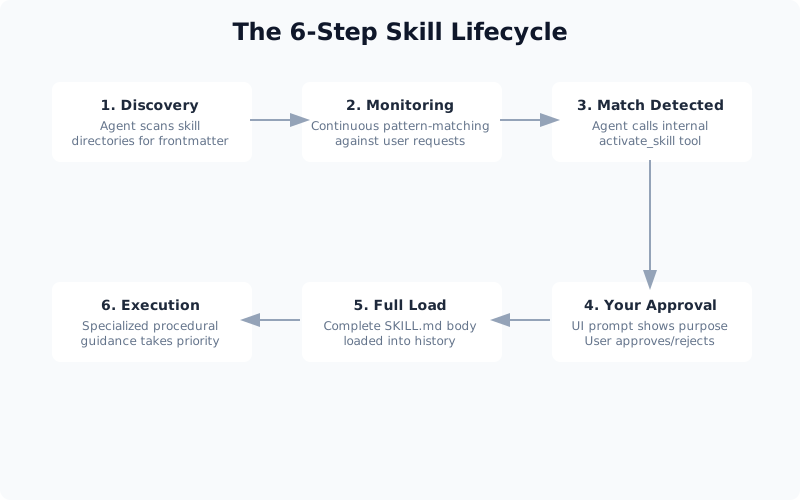
Understanding the lifecycle helps you use skills strategically rather than blindly:
Step 1 — Discovery
When you start a Gemini CLI (or Claude Code) session, the agent scans configured skill directories. It finds every SKILL.md and extracts only the name and description frontmatter. These two fields are injected into the system prompt. Nothing else.
Step 2 — Monitoring
As you work, the agent continuously pattern-matches your requests against all loaded skill descriptions.
Step 3 — Match Detected
When your request matches a skill’s description (e.g., you ask “review this code for security issues” and security-review skill is present), the agent calls an internal activate_skill tool.
Step 4 — Your Approval
A UI prompt appears showing: skill name, its stated purpose, and the directory path. You approve or reject.
Step 5 — Full Load
Upon approval, the complete SKILL.md body, all bundled scripts, references, and asset files are loaded into conversation history. The skill directory is added to the agent’s allowed file paths.
Step 6 — Execution
The agent proceeds with the skill’s specialized procedural guidance prioritized for the rest of the session. It behaves like a domain expert just joined your session.
The Agent Skills Open Standard
Agent skills are not proprietary to any single company. They follow an open standard — meaning a skill you write once works across:
- Google Gemini CLI (native first-class support)
- Anthropic Claude Code (native support)
- GitHub Copilot (via extensions)
- Cursor (via
.cursorrulesintegration) - Any agent that reads from
~/.agents/skills/(the universal path)
The community registry at skills.sh hosts thousands of published skills you can install with a single command. As of 2026, this is the fastest-growing open ecosystem in AI developer tooling.
Where Skills Live: Discovery Tiers
Skills are loaded from three tiers, in priority order:
1. Workspace Skills (Project-Specific)
Path: .gemini/skills/ or .agents/skills/ inside your project root
- Committed to version control
- Shared with your entire team
- Override user-level skills of the same name
- Best for: project-specific conventions, tech stack rules
2. User Skills (Your Global Library)
Path: ~/.gemini/skills/ or ~/.agents/skills/
- Available in every project on your machine
- Personal skills that follow you everywhere
- Best for: your coding standards, preferred stacks, personal workflows
3. Extension Skills
Path: ~/.gemini/extensions/<extension-name>/skills/
- Bundled by installed CLI extensions
- Auto-managed, no manual setup
- Best for: official skills from Google, Anthropic, Vercel, Firebase, etc.
Pro tip: Use
~/.agents/skills/as your canonical master store and symlink from agent-specific paths. This future-proofs your setup as new agents adopt the standard.
Complete Setup Guide: New Project Checklist
One-Time Global Setup (Do Once)
If you installed skills via rulesync (as many developers do), sync them to your agent:
# Windows PowerShell — sync rulesync → Gemini CLI
Get-ChildItem ~/.rulesync/skills/ -Directory | ForEach-Object {
    $dst = "~/.gemini/skills/$($_.Name)"
    if (-not (Test-Path $dst)) {
        Copy-Item -Recurse -Force $_.FullName $dst
        Write-Host "✅ $($_.Name)"
    }
}
# macOS/Linux equivalent
for skill in ~/.rulesync/skills/*/; do
  name=$(basename "$skill")
  dst="$HOME/.gemini/skills/$name"
  if [ ! -d "$dst" ]; then
    cp -r "$skill" "$dst"
    echo "✅ $name"
  fi
done
Per-Project Setup
# Create workspace skills folder
mkdir -p .gemini/skills

# Copy a user skill into your project
cp -r ~/.gemini/skills/nextjs-developer .gemini/skills/

# Or symlink it (saves disk space, auto-updates)
ln -s ~/.gemini/skills/react-expert .gemini/skills/react-expert

# Install from skills.sh registry
npx skills install vercel-labs/nextjs-developer
npx skills install anthropics/prompt-engineer

# Install to user directory (available globally)
npx skills install --user react-expert
Managing Skills in a Session
# List all discovered skills
/skills list

# Disable a skill temporarily (remove from context)
/skills disable game-developer

# Re-enable it
/skills enable game-developer

# Reload after adding new skills to disk
/skills reload

# Link an external skill via symlink
/skills link /path/to/my-custom-skill

# From terminal (outside a session)
gemini skills list
gemini skills install <skill-name>
The Complete 260+ Agent Skills Reference
Below is every skill organized by domain. Use Ctrl+F to find what you need.
🤖 AI & Agent Engineering (32 Skills)
For developers building autonomous agents, multi-agent systems, and AI pipelines:
| Skill | Purpose |
|---|---|
agentic-engineering | Build autonomous multi-step agent systems end-to-end |
agent-eval | Evaluate agent output quality and correctness |
agent-harness-construction | Wrap agents in automated test harnesses |
agent-introspection-debugging | Debug an agent’s internal reasoning loop |
agent-payment-x402 | Implement x402 HTTP payment protocol for agent-to-agent transactions |
agent-sort | Prioritize and sort agent task queues |
autonomous-agent-harness | Full harness for autonomous agents with guardrails |
autonomous-loops | Build persistent, continuous execution loops |
continuous-agent-loop | Keep an agent running with state across sessions |
council | Multi-agent deliberation: multiple agents vote on a decision |
create-agent-skills | How to create new agent skills from scratch |
create-subagents | Spawn and coordinate parallel sub-agents |
enterprise-agent-ops | Deploy, monitor, and govern agents at scale |
eval-harness | Build eval pipelines measuring agent performance |
fine-tuning-expert | Fine-tune foundation models on custom datasets |
foundation-models-on-device | Run models locally without cloud dependencies |
gan-style-harness | GAN-based style transfer inside an agent harness |
nanoclaw-repl | Interactive agent execution REPL |
openclaw-persona-forge | Create and manage distinct agent personas |
token-budget-advisor | Monitor and optimize token usage per session |
context-budget | Manage context window budgets for long sessions |
cost-aware-llm-pipeline | Optimize cost across LLM API calls |
create-meta-prompts | Generate prompts that generate prompts |
prompt-engineer | Expert prompt engineering frameworks (CoT, few-shot, etc.) |
prompt-optimizer | Improve prompt quality and reduce tokens |
safety-guard | Add content filtering and safety rails to agents |
rag-architect | Design and build RAG systems |
iterative-retrieval | Multi-hop retrieval: search until answer is complete |
dmux-workflows | Multiplexed parallel agent workflow routing |
social-graph-ranker | Rank content using social graph signals |
the-fool | Creative chaos agent for divergent thinking |
council | Multi-agent council decision pattern |
🧑💻 Code Quality & Standards (22 Skills)
| Skill | Purpose |
|---|---|
code-reviewer | Structured code review with actionable, prioritized feedback |
code-documenter | Auto-generate JSDoc, docstrings, inline comments |
coding-standards | Enforce team coding style and conventions |
debug-like-expert | Systematic debugging: hypothesize → test → eliminate |
debugging-wizard | Tackle hard-to-reproduce and intermittent bugs |
bug-fix | Root cause analysis + minimal correct fix |
plankton-code-quality | Micro-level checks: naming, complexity, duplication |
pre-commit | Pre-commit validation: lint, format, tests |
pre-deploy | Pre-deployment checklist enforcement |
release-prep | Changelogs, tags, release artifacts |
secure-code-guardian | Detect and fix security vulnerabilities in code |
tdd-workflow | Red → green → refactor TDD cycle |
test-master | Full test strategy: unit, integration, E2E |
verification-loop | Loop until output is verifiably correct |
full-audit | Comprehensive codebase audit: security, perf, quality |
repo-scan | Scan for vulnerabilities, outdated deps, issues |
legacy-modernizer | Migrate legacy code to modern patterns |
codebase-onboarding | Generate onboarding docs for new developers |
code-tour | Guided interactive walkthrough of a codebase |
spec-miner | Extract implicit specifications from existing code |
rules-distill | Distill project-specific rules from code patterns |
skill-comply | Ensure code complies with active skill standards |
🌐 Frontend (20 Skills)
| Skill | Purpose |
|---|---|
react-expert | React: hooks, patterns, performance, concurrent features |
react-native-expert | React Native mobile development best practices |
nextjs-developer | Next.js App Router, SSR, ISR, server components, API routes |
nextjs-turbopack | Next.js optimized with Turbopack bundler |
vue-expert | Vue 3 Composition API, Pinia, routing |
vue-expert-js | Vue with plain JavaScript (no TypeScript) |
nuxt4-patterns | Nuxt 4 architecture and migration patterns |
angular-architect | Angular signals, standalone components, architecture |
frontend-design | Translate design mockups into clean, accessible code |
frontend-patterns | Reusable frontend architecture patterns |
design-system | Build, maintain, and document design systems |
liquid-glass-design | Apple-style glassmorphism UI effects |
ui-demo | Interactive prototype and demo creation |
web-asset-generator | Generate favicons, OG images, icons, web assets |
accessibility | WCAG compliance, ARIA implementation, a11y testing |
browser-qa | Browser-based QA and visual regression testing |
click-path-audit | Audit UX flows and user click paths |
e2e-testing | E2E testing with Playwright and Cypress |
playwright-expert | Advanced Playwright patterns and configurations |
frontend-slides | Build presentation slides with web technologies |
⚙️ Backend (30 Skills)
| Skill | Purpose |
|---|---|
backend-patterns | REST patterns, middleware, auth, error handling |
fastapi-expert | FastAPI async APIs, Pydantic models, dependency injection |
django-expert | Django models, views, ORM, admin interface |
django-patterns | Advanced Django architecture |
django-security | Django security hardening checklist |
django-tdd | TDD workflow for Django applications |
nestjs-expert | NestJS modules, guards, pipes, interceptors |
nestjs-patterns | NestJS advanced architecture patterns |
rails-expert | Ruby on Rails: ActiveRecord, Action Mailer, conventions |
laravel-specialist | Laravel full-stack PHP framework |
laravel-patterns | Laravel architecture and design patterns |
laravel-security | Laravel security hardening |
laravel-tdd | Test-driven development in Laravel |
spring-boot-engineer | Spring Boot microservices, JPA, REST |
springboot-patterns | Spring Boot architecture patterns |
springboot-security | Spring Security configuration patterns |
graphql-architect | GraphQL schema design, resolvers, federation |
api-design | RESTful API design principles and conventions |
api-designer | API specification and tooling (OpenAPI, Swagger) |
api-connector-builder | Build connectors to external third-party APIs |
websocket-engineer | Real-time WebSocket communication patterns |
bun-runtime | Bun JavaScript runtime development patterns |
nodejs-keccak256 | keccak256 hashing in Node.js (blockchain) |
microservices-architect | Microservices design, service mesh, event-driven |
hexagonal-architecture | Ports and adapters architecture pattern |
🗄️ Databases (7 Skills)
| Skill | Purpose |
|---|---|
postgres-pro | Advanced PostgreSQL: indexes, EXPLAIN, partitioning |
postgres-patterns | PostgreSQL architecture patterns |
database-optimizer | Query optimization and performance tuning |
database-migrations | Safe, reversible schema migrations |
sql-pro | Advanced SQL across multiple dialects |
clickhouse-io | ClickHouse OLAP analytics patterns |
jpa-patterns | Java Persistence API with Hibernate |
☁️ Infrastructure & DevOps (14 Skills)
| Skill | Purpose |
|---|---|
devops-engineer | CI/CD pipelines, automation, deployment workflows |
cloud-architect | Multi-cloud architecture on AWS, GCP, Azure |
kubernetes-specialist | K8s: pods, services, ingress, RBAC, HPA |
terraform-engineer | Infrastructure as Code with Terraform |
docker-patterns | Dockerfile optimization, Compose, multi-stage builds |
deployment-patterns | Blue/green, canary, rolling deployment strategies |
monitoring-expert | Metrics, logging, distributed tracing, alerting |
sre-engineer | SLOs, error budgets, post-mortems, reliability |
canary-watch | Monitor canary releases for regressions |
chaos-engineer | Chaos testing: inject failures to validate resilience |
architecture-designer | System design, diagramming, architectural decisions |
architecture-decision-records | Write and maintain ADRs |
🔐 Security (12 Skills)
| Skill | Purpose |
|---|---|
security-review | Security code review checklist |
security-reviewer | Automated code security review agent |
security-scan | Static analysis for known vulnerability patterns |
security-bounty-hunter | Bug bounty hunting methodology and checklists |
hipaa-compliance | HIPAA compliance checks for healthcare applications |
defi-amm-security | DeFi AMM smart contract security audit patterns |
llm-trading-agent-security | Security hardening for AI trading agents |
gateguard | Input validation, request gating, injection prevention |
django-security | Django-specific security hardening |
laravel-security | Laravel-specific security patterns |
springboot-security | Spring Security implementation patterns |
perl-security | Perl security best practices |
🔤 Languages (35 Skills)
| Skill | Purpose |
|---|---|
python-pro | Advanced Python: async/await, decorators, dataclasses, typing |
python-patterns | Python architecture and design patterns |
python-testing | pytest, mocking, fixtures, coverage |
typescript-pro | Advanced TypeScript: generics, utility types, type inference |
javascript-pro | Modern JS: ESM, async iterators, WeakRef, patterns |
golang-pro | Go: goroutines, channels, interfaces, stdlib |
golang-patterns | Go architecture and design patterns |
golang-testing | Go testing: table tests, mocks, benchmarks |
rust-engineer | Rust: ownership, lifetimes, async, error handling |
rust-patterns | Rust architecture patterns |
rust-testing | Rust testing with cargo test and mocking |
kotlin-specialist | Kotlin: coroutines, sealed classes, data classes, DSLs |
kotlin-patterns | Kotlin architecture and design patterns |
kotlin-testing | Kotlin testing with JUnit5 and MockK |
kotlin-coroutines-flows | Kotlin Flows and structured concurrency |
kotlin-exposed-patterns | Kotlin Exposed ORM patterns |
kotlin-ktor-patterns | Ktor server framework patterns |
java-architect | Java enterprise architecture |
java-coding-standards | Java coding standards and style enforcement |
csharp-developer | C# .NET development patterns |
csharp-testing | C# testing with xUnit and Moq |
dotnet-core-expert | .NET Core: dependency injection, middleware, EF Core |
dotnet-patterns | .NET architecture and design patterns |
cpp-pro | C++20/23: concepts, modules, ranges, coroutines |
cpp-coding-standards | C++ coding standards enforcement |
cpp-testing | C++ testing with GoogleTest and Catch2 |
swift-expert | Swift: protocols, generics, actors, property wrappers |
swift-concurrency-6-2 | Swift 6.2 strict concurrency model |
swift-actor-persistence | Swift actor model with persistence layer |
swift-protocol-di-testing | Protocol-based DI and testability in Swift |
perl-patterns | Perl idioms, CPAN patterns |
perl-testing | Perl testing with Test::More and Test2 |
php-pro | PHP 8+ fibers, named arguments, enums |
pandas-pro | pandas: DataFrames, groupby, performance, vectorization |
📱 Mobile (7 Skills)
| Skill | Purpose |
|---|---|
flutter-expert | Flutter widgets, state management, platform channels |
flutter-dart-code-review | Code review for Flutter/Dart applications |
dart-flutter-patterns | Dart + Flutter architecture (Riverpod, Clean Architecture) |
compose-multiplatform-patterns | Kotlin Compose Multiplatform for Android/iOS/Desktop |
android-clean-architecture | Android MVVM, Repository, UseCase patterns |
swiftui-patterns | SwiftUI: state, navigation, animations, previews |
react-native-expert | React Native: Bridge, New Architecture, Expo |
🤖 ML & Data (10 Skills)
| Skill | Purpose |
|---|---|
ml-pipeline | End-to-end ML: ingest → train → evaluate → serve |
pytorch-patterns | PyTorch: training loops, datasets, transforms, ONNX |
spark-engineer | Apache Spark for large-scale data processing |
benchmark | Benchmarking methodology for code, models, systems |
ai-regression-testing | Regression testing specifically for AI/ML models |
ai-first-engineering | Systems where AI is the primary business logic layer |
exa-search | Integrate Exa neural search API into agents |
data-scraper-agent | Build intelligent web scraping agents |
regex-vs-llm-structured-text | Decision guide: regex vs. LLM for text parsing |
pandas-pro | Data analysis and transformation with pandas |
🎨 Content & Media (12 Skills)
| Skill | Purpose |
|---|---|
article-writing | Structured, SEO-aware article and blog writing |
brand-voice | Establish and maintain consistent brand voice across output |
content-engine | Build automated content production pipelines |
seo | On-page SEO: meta tags, headings, structured data |
crosspost | Distribute content across platforms automatically |
manim-video | Create math/code animation videos with Manim |
remotion-video-creation | Programmatic video creation with Remotion |
video-editing | Video editing automation and batch workflows |
videodb | AI video search and retrieval with VideoDB |
fal-ai-media | AI image/video generation via fal.ai API |
investor-materials | Pitch decks, one-pagers, investor presentations |
investor-outreach | Investor outreach templates and sequencing |
🛠️ Dev Tooling & Workflows (25+ Skills)
| Skill | Purpose |
|---|---|
git-workflow | Branching strategies, commit messages, rebase vs merge |
github-ops | GitHub Actions, PR automation, issue triage |
mcp-developer | Build Model Context Protocol servers |
mcp-server-patterns | MCP server architecture and testing patterns |
create-mcp-servers | Step-by-step guide for building MCP servers |
create-hooks | Build React hooks and lifecycle hooks |
create-plans | Structured execution plans before building |
create-slash-commands | Custom slash commands for AI agent sessions |
cli-developer | Build production CLI tools with Node, Python, or Go |
terminal-ops | Terminal productivity, scripting, automation |
documentation-lookup | Look up official docs and integrate inline |
handoff | Generate handoff docs between agents or team members |
blueprint | Architectural blueprints and system design documents |
brainstorm | Structured ideation: diverge → converge → prioritize |
deep-research | Multi-source, cross-referenced deep research |
research-ops | Systematic information gathering operations |
search-first | ”Does it exist?” check before building anything |
continuous-learning | Systems that improve from interaction history |
knowledge-ops | Build and query team knowledge bases |
dashboard-builder | Real-time data dashboards |
feature-forge | Feature pipeline: spec → build → test → ship |
new-feature | Standard new feature development workflow |
product-capability | Map and expand product capabilities |
product-lens | Analyze through user, market, and business lenses |
🏥 Healthcare (4 Skills)
| Skill | Purpose |
|---|---|
healthcare-cdss-patterns | Clinical Decision Support System patterns |
healthcare-emr-patterns | Electronic Medical Record system integration |
healthcare-phi-compliance | PHI (Protected Health Information) data handling |
hipaa-compliance | HIPAA compliance validation and enforcement |
📦 Operations & Business (24 Skills)
| Skill | Purpose |
|---|---|
automation-audit-ops | Audit and optimize automation workflows |
customer-billing-ops | Subscription billing, refunds, proration logic |
email-ops | Email automation, deliverability, template management |
finance-billing-ops | Finance-side billing, reconciliation, reporting |
google-workspace-ops | Automate Gmail, Sheets, Drive, Calendar |
inventory-demand-planning | Inventory forecasting and demand planning |
jira-integration | Jira API integration and project management |
atlassian-mcp | Atlassian MCP server patterns |
lead-intelligence | Lead scoring, enrichment, and routing |
logistics-exception-management | Handle logistics exceptions and escalations |
messages-ops | Multi-channel messaging (SMS, push, in-app) |
production-scheduling | Job queue and production scheduling |
project-flow-ops | Project bottleneck detection and flow optimization |
returns-reverse-logistics | Returns management automation |
team-builder | Build teams, define roles, responsibilities |
unified-notifications-ops | Multi-channel notification system |
market-research | Market research methodology and synthesis |
x-api | X (Twitter) API integration |
strategic-compact | Strategic mission/vision/OKR documents |
Quick-Start Skill Stacks by Project Type
Don’t activate all 260 skills — pick the right pack for your current project:
🚀 Full-Stack Web App (Next.js + Postgres)
nextjs-developerreact-experttypescript-propostgres-probackend-patternsapi-designtdd-workflowgit-workflowdeployment-patterns
🛒 SaaS Product with Payments
nextjs-developercustomer-billing-opsfinance-billing-opsemail-opsseomonitoring-expertdeployment-patternssecurity-review
🤖 AI Agent / Automation Tool
agentic-engineeringautonomous-loopscreate-subagentsrag-architectprompt-engineermcp-developercost-aware-llm-pipelinesafety-guard
How to Create Your Own Agent Skill
Creating a skill is one of the highest-leverage things you can do as a developer. Your custom skill encodes your team’s specific conventions, preferred libraries, and coding standards — making every AI session start with expert context about your project.
Step 1: Create the Skill Directory
# For global user skill
mkdir -p ~/.gemini/skills/my-custom-skill

# For project-specific skill
mkdir -p .gemini/skills/my-custom-skill
Step 2: Write the SKILL.md
This is the only required file. The description field is critical — it determines when the skill auto-activates:
---
name: my-custom-skill
description: >-
  Use this skill when the user wants to build, review, or debug anything
  related to [your tech stack]. Activates when working on [specific triggers
  like: \"React components\", \"database queries\", \"authentication flows\"].
---

# My Custom Skill

## When to Use This Skill
- Building [X] component or feature
- Reviewing [Y] type of code
- Debugging [Z] category of issues

## Standards & Conventions
1. Always use [your convention]
2. Prefer [library A] over [library B] because [reason]
3. Error handling pattern: [your pattern]

## Step-by-Step Workflow
1. [First step]
2. [Second step]
3. [Verification step]

## Common Pitfalls to Avoid
- Never [anti-pattern 1]
- Don't [anti-pattern 2] unless [condition]
TL;DR
- Agent Skills are modular, on-demand expertise for AI coding agents.
- Progressive Disclosure keeps context windows lean and tokens cheap.
- Open Standard means skills are portable across Gemini CLI, Claude Code, and more.
- Custom Skills allow teams to encode their own engineering standards into AI context.
If you found this useful, subscribe to my newsletter below for more AI research, coding tutorials, and no-BS tech insights.
Have a skill recommendation or spotted an error? Reach out on LinkedIn or email me at business@hassanali.site.
Last updated: April 29, 2026