Agentic FinOps: Maximizing the ROI of Autonomous Intelligence
In 2018, the “NAT Gateway Trauma” was the rite of passage for every AWS engineer. You’d leave a 0.045 USD/hour idle gateway running in a dev VPC, and 720 hours later, you’d be explaining to a CFO why you spent $32 on a digital paperweight. It was petty, it was annoying, and it was the foundation of the first FinOps movement.
Fast forward to May 2026. That $32 mistake looks like rounding error.
The real trauma today isn’t an idle gateway—it’s Intelligence Waste. It’s the developer who uses a frontier model like Claude 4 Opus or GPT-5 to summarize a single Slack message. It’s the agentic fleet that loops 50 times on a trivial logic error, burning $400 of reasoning tokens before a circuit breaker trips.
Welcome to Agentic FinOps: the discipline of managing the liquidity of reasoning in a world where compute is cheap, but high-tier tokens are the new gold. Mastering Agentic FinOps is no longer optional; it is the difference between a profitable AI deployment and a bottomless pit of API bills.
The Shift: From Infrastructure to Reasoning
Traditional FinOps was about instances, egress, and storage. But in the Sovereign Agentic Stack, these are commodity inputs. The real cost driver is the Reasoning Tier. If you’re still tracking “Cloud Spend” as a monolithic AWS bill, you’re flying blind. You need to be tracking your Intelligence per Dollar across every autonomous workflow.
The Metric That Matters: CPMT vs. VPT
We’ve moved past simple token counts. To survive the margin compression of 2026, you need to measure Intelligence per Dollar through these two lenses:
- CPMT (Cost Per Million Tokens): The raw cost of the model.
- VPT (Value Per Task): The actual business utility derived from the tokens spent.
An agent that spends $5 in tokens to save a human 4 hours of work has an incredible Autonomous ROI. An agent that spends $50 to automate a $15 task is a liability. Agentic FinOps is the art of ensuring your agentic fleet stays on the right side of that equation by matching the model tier to the task complexity.
Token Liquidity: Hedging Reasoning Costs with MCP
The breakthrough of 2026 is Token Liquidity. In the same way a quant trader hedges currency risk, a Sovereign Engineer uses Agentic FinOps to hedge reasoning risk.
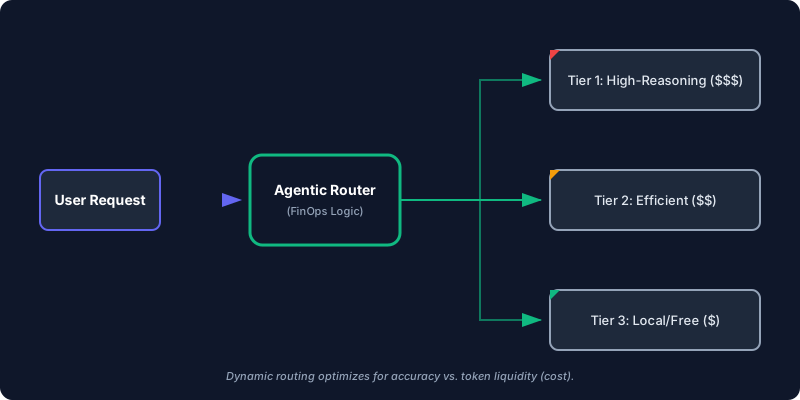
Using the Model Context Protocol (MCP), agents are no longer locked into a single provider. They can dynamically route tasks based on “Reasoning Efficiency.” This is the core of an effective Agentic FinOps strategy.
The Three-Tier Strategy
- Tier 1: Frontier Models ($$$): Use these only for the “Orchestrator” role. They define the strategy but never execute low-level steps.
- Tier 2: Efficient Models ($$): Use specialized models (like Llama 4 or GPT-4o-mini) for data transformation and API calls.
- Tier 3: Local/SLMs ($): Small Language Models running on your own Local AI Stack for PII scrubbing and repetitive formatting.
By implementing an Agentic Router, you can drop your blended CPMT by up to 85% without sacrificing a single point of accuracy. This is Intelligence per Dollar optimization in its purest form.
Implementation: The Reasoning Efficiency Audit
You cannot manage what you do not measure. Most teams are leaking 30% of their AI budget to “Reasoning Overkill”—using a sledgehammer to crack a nut. A proper Agentic FinOps audit will reveal these leaks immediately.
Here is a Python utility to calculate your Reasoning Efficiency Ratio (RER) from your agent logs.
import json
from collections import defaultdict

def calculate_rer(logs):
    """
    RER = (Successful Tasks * Target Task Cost) / Actual Token Spend
    A ratio > 1.0 indicates high efficiency.
    A ratio < 0.3 indicates chronic reasoning waste.
    """
    stats = defaultdict(lambda: {"cost": 0, "success": 0})

    for entry in logs:
        model = entry['model']
        cost = (entry['prompt_tokens'] * entry['input_price'] +
                entry['completion_tokens'] * entry['output_price']) / 1_000_000

        stats[model]["cost"] += cost
        if entry['status'] == 'success' and entry['task_complexity'] <= entry['model_tier']:
            stats[model]["success"] += 1

    for model, data in stats.items():
        rer = (data['success'] * 0.05) / (data['cost'] + 0.0001) # 0.05 is benchmark task cost
        print(f"Model: {model} | RER: {rer:.2f} | Total Spend: ${data['cost']:.4f}")

# Example usage with agentic logs
# audit_results = calculate_rer(agent_history)
The Barbell Strategy for 2026
To master Agentic FinOps, you must adopt a Barbell Strategy:
- Radical Authenticity (Low Cost): Move your bulk processing to local, sovereign hardware. Stop paying the “OpenAI Tax” for tasks that a 7B model can do with 99% accuracy.
- Strategic Reasoning (High Cost): Reserve your frontier model budget for high-stakes decision-making and Agentic SEO strategy.
The companies that win in 2026 won’t be the ones with the biggest GPUs. They’ll be the ones that have mastered the flow of intelligence across their balance sheet using Agentic FinOps principles.
What’s Next?
Are you ready to audit your intelligence waste and maximize your Intelligence per Dollar? Start by mapping your agentic workflows to reasoning tiers. If your “summarize” agent is calling a frontier model, you’re already behind.
Connect with me on LinkedIn or Email to discuss your Agentic FinOps implementation.