AI-Native Product Strategy: Designing tools for the machine user first
In 2024, we obsessed over “User Experience” (UX). we spent millions on A/B testing button colors and scrolling speeds to keep humans engaged.
In 2026, those metrics are failing. Why? Because your most important customer doesn’t have eyes. They have a high-speed API and a “Task Budget.”
Welcome to the era of AI-Native Product Strategy. If you aren’t designing for the Machine User, you are building for a declining market.
What You’ll Learn
In this 2026 roadmap, we’re moving from human persuasion to machine selection.
- MX vs UX: Why “Machine Experience” is the new competitive moat.
- Agentic Commerce: How to enter the $3 trillion “Zero-Click” economy.
- The Legibility Mandate: Making your product “Selectable” by LLMs.
- AG-UI Patterns: Designing the handover from machine to human.
Machine Experience (MX): The New Moat
For decades, we built “Human-First” interfaces. We assumed a human would browse a catalog, compare prices, and click “Buy.”
In 2026, Agentic Commerce has flipped this. An autonomous agent (like OpenAI’s Operator) is given a goal: “Buy the best noise-canceling headphones under $300 delivered by Friday.”
The agent doesn’t care about your beautiful hero image or your clever copy. It cares about MX (Machine Experience):
- Deterministic Clarity: Is your pricing and shipping data available in a flat, machine-readable format?
- Certainty Score: Can the agent verify your “Returns Policy” without having to guess?
- Ease of Execution: Does your site support the Universal Commerce Protocol (UCP) for one-click agent checkout?
If your product isn’t “Selectable” by the agent’s logic, you won’t even make it into the comparison set.
Designing for the “Zero-Click” Economy
Industry data shows that by late 2026, nearly 40% of digital transactions are mediated by agents. This is the “Zero-Click” economy.
To win here, your AI-Native Product Strategy must prioritize Information Density over Visual Flair.
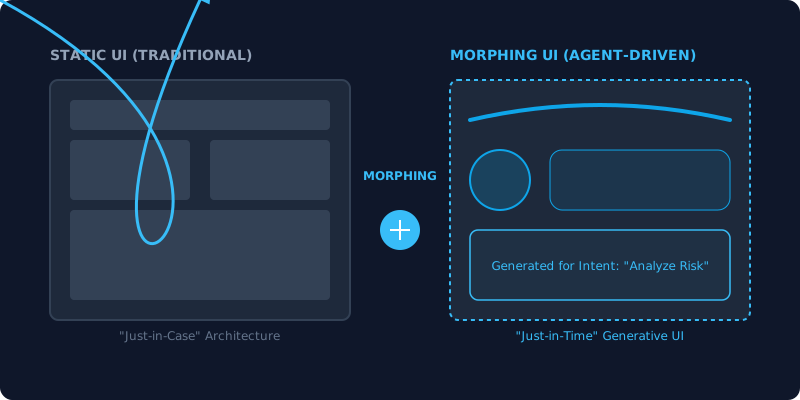
- Traditional SaaS: A dashboard with 50 features.
- AI-Native SaaS: A set of MCP (Model Context Protocol) tools that an agent can “plugin” to its own workflow.
You aren’t selling a “Software Application”; you’re selling a Capability. Your job is to make that capability as easy as possible for a machine to use on behalf of a human.
AG-UI Patterns: The Supervision Layer
Designing for machines doesn’t mean ignoring humans. It means changing the human’s role from “Operator” to “Supervisor.”
We use AG-UI (Agent-User Interaction) patterns to manage this handover:
- Explainability on Demand: The agent handles 90% of the work, but provides a “Reasoning Trace” if the human asks “Why was this vendor chosen?”
- Safe-to-Try Sandboxes: The system simulates the outcome of an agent’s action (e.g., a $10k ad spend) before the human provides the final “HITL” (Human-in-the-Loop) approval.
Conclusion: The Selection Year
2026 is the “Selection Year.” AI agents are moving from “summarizing the web” to “selecting the winners” of the economy.
An AI-Native Product Strategy isn’t just a technical upgrade; it’s a fundamental shift in how you perceive value. You are no longer building tools for people to work with; you are building capabilities for agents to deploy.
The brands that survive the next decade will be those that the machines find most trustworthy, legible, and easy to use.
TL;DR
- MX is the new UX: Optimize for machine selection, not just human browsing.
- UCP is the standard: Ensure your commerce stack is agent-ready.
- Sell Capabilities, not Apps: Move from feature-dense dashboards to surgical MCP tools.
- Bottom line: If a machine can’t “read” your value proposition, you’ve already lost the sale.
Ready to build the technical moat for your AI-native product? Check out my guide on The New SaaS Moat to learn how to leverage proprietary data and local compute.