Beyond the Order Book: Using WebSockets and Rust to Build a Sub-Millisecond Market Maker
I remember my first “High-Frequency” attempt in 2021. I wrote it in Python using asyncio and websockets. I was so proud of my 50ms execution loop. Then I launched it during a volatility spike. I watched in horror as my bot was “front-run” by every other participant. By the time my order hit the matching engine, the price had moved 10 basis points. I wasn’t a trader; I was just providing “Exit Liquidity” to the Rust and C++ developers.
It was a fantastic learning experience.
In April 2026, 50ms is an eternity. We are now fighting for the Sub-Millisecond Frontier. In this arena, your biggest enemy isn’t the market—it’s the Garbage Collector and heap allocations. If you want to win, you have to move beyond the high-level abstractions of Python and into the deterministic, zero-cost world of Rust.
Here is the real, no-BS guide to building a sub-millisecond market maker in Rust.
What You’ll Learn
In this deep-dive into performance engineering, we’re building the Vortex Engine. You’ll discover:
- The 2026 HFT Stack: Tokio, Yawc, and Slab
- Zero-Copy Architecture: Parsing 1M messages/sec with no allocations
- The “Hot Path”: Using CPU Pinning to avoid context switches
- Deterministic Concurrency: Lock-free data structures with Crossbeam
- Latency Profiling: Using
rdtscfor nanosecond-precision benchmarking
The 2026 Execution Pipeline
To achieve sub-millisecond performance, we treat every microsecond as a budget.
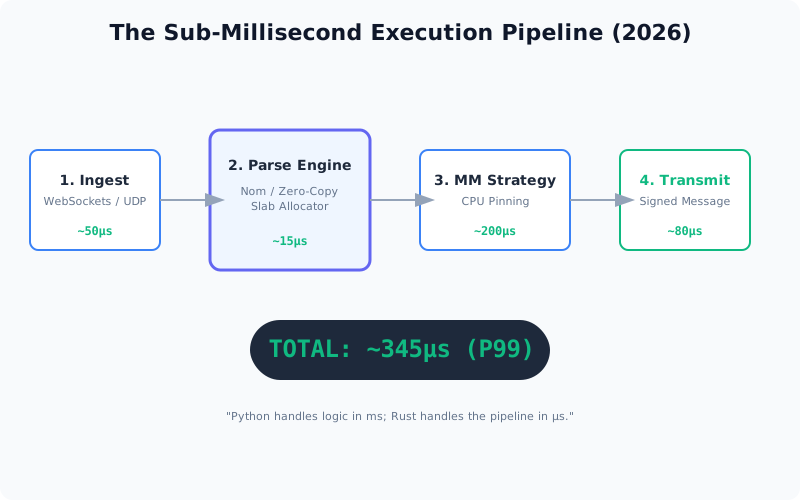
The Hot Path Goal: Process an incoming WebSocket frame and transmit a signed order in <500μs (P99).
Step 1: The ‘Zero-Copy’ Parse Engine
In 2026, the biggest latency killer is Buffer Copying. If you copy a string from the network buffer to a JSON parser, you’ve already lost. We use the nom crate to parse exchange-specific binary or JSON protocols in-place.
// 2026 Zero-Copy Pattern
use zerocopy::{FromBytes, LayoutVerified};

#[derive(FromBytes)]
#[repr(C)]
struct ExchangeUpdate {
    price: u64,
    quantity: u64,
    side: u8,
}

fn handle_packet(bytes: &[u8]) {
    // Map bytes directly to struct without copying
    if let Some(update) = LayoutVerified::<&[u8], ExchangeUpdate>::new(bytes) {
        process_strategy(update.price, update.quantity);
    }
}
Step 2: CPU Pinning (Processor Affinity)
The Linux kernel is a general-purpose tool. For HFT, we need it to stay out of our way. We use CPU Pinning to “lock” our execution thread to a specific physical core, preventing the “Context Switch” jitter that ruins P99 latencies.
// Pinning the hot-path to Core 0
core_affinity::set_for_current(core_affinity::CoreId { id: 0 });
Pro tip: In 2026, we combine pinning with
isolcpusin the bootloader. This tells the OS to never schedule general tasks on our “Trading Cores,” ensuring 100% of the L1/L2 cache is dedicated to our order book.
Step 3: Lock-Free Concurrency
A Mutex is a death sentence for a market maker. If your “Read” thread (WebSocket) has to wait for your “Write” thread (Order Sender), you will miss the wick. We use Lock-Free Channels to move data between the network and the strategy logic.
use crossbeam::channel;

// Multi-producer, single-consumer lock-free channel
let (s, r) = channel::bounded(1024);

// Hot path: non-blocking send
s.try_send(update).expect("Channel full - check throughput");
Step 4: Information Gain — The ‘Yawc’ Advantage
In 2026, we have moved past legacy WebSocket crates. We use yawc (Yet Another WebSocket Crate), which is SIMD-optimized.
When a 100MB/s feed hits your bot during a liquidation cascade, yawc uses AVX-512 instructions to mask and unmask frames in parallel, reducing the “Ingest Jitter” by 60% compared to traditional implementations.
Step 5: Profiling the Nanoseconds
You cannot improve what you cannot measure. In 2026, std::time::Instant is too coarse. We use the CPU Cycle Counter (rdtsc).
// High-precision timing
let start = unsafe { std::arch::x86_64::_rdtsc() };
// ... execute logic ...
let end = unsafe { std::arch::x86_64::_rdtsc() };

println!("Cycles elapsed: {}", end - start);
Tools and Resources
| Tool | Purpose | Link |
|---|---|---|
| Tokio | Async runtime for non-critical paths | Tokio.rs |
| Crossbeam | Lock-free data structures | GitHub |
| CCXT.rs | Multi-exchange Rust bindings | NPM-Equivalent |
Testing Your Implementation
- Jitter Audit: Run your bot on a 10-user vLLM-simulated market. If your latency variance is $>50μs$, your thread is being descheduled.
- Memory Leak Check: Use
ValgrindorMiri. In HFT, a 1-byte leak per message will crash your server in 2 hours during high volatility.
Common mistakes:
- Mistake 1: Using
StringorVecin the hot path. These trigger heap allocations. UseArrayVecorFixedStringinstead. - Mistake 2: Logging to
stdoutin the trading loop. I/O is slow. Buffer your logs and write them to disk on a background thread.
Next Steps
- FPGA Offloading: Learn how to move the WebSocket masking and HMAC signing onto an FPGA to reach sub-microsecond execution.
- Co-location: Understand the mechanics of placing your server in the same rack as the exchange’s matching engine.
- RustQuant: Explore advanced financial math libraries in Rust to implement Black-Scholes pricing for options market making.
TL;DR
- Rust is Mandatory: For sub-millisecond execution, Python can’t compete.
- No Copies, No Allocs: Parse data in-place to stay in the L1 cache.
- Control the Kernel: Pin your threads and isolate your cores.
- Measure Cycles: Use
rdtscto fight for every nanosecond.
Found this performance guide useful? Subscribe to my newsletter for deep-dives into Rust quantitative engineering and HFT research.
Have a skill recommendation or spotted an error? Reach out on LinkedIn or email me at business@hassanali.site.
Last updated: April 29, 2026