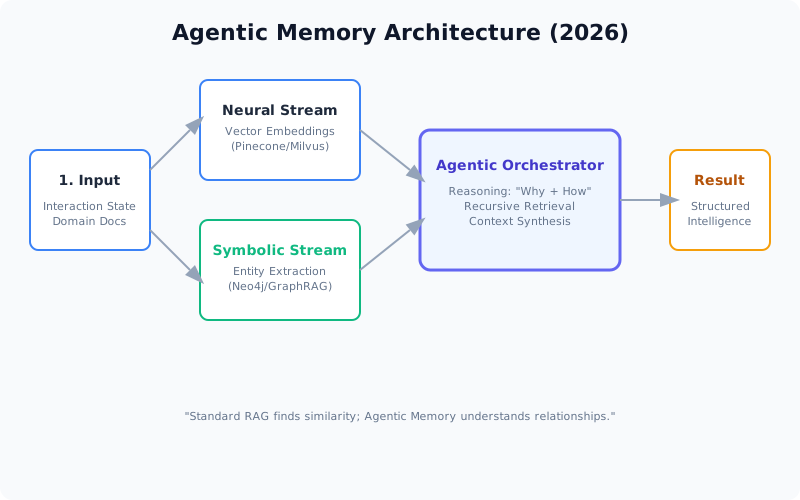
Beyond Vector DBs: Engineering Agentic Long-Term Memory (LTM) with Knowledge Graphs
The biggest weakness of the 2024 AI wave was “amnesia.” You could chat with a model, but the moment you closed the window, the context was gone. In 2026, we’ve solved this with agentic long-term memory (LTM).

But here is the hard truth: Vector RAG is not enough. If you want your local agents to actually “understand” your business, your codebases, or your trading strategies, you need to move beyond simple similarity search and into Knowledge Graphs.
What You’ll Learn
In this technical guide, we’re building the “Local Brain” for your sovereign stack.
- The Memory Maturity Curve: Moving from raw logs to permanent facts.
- GraphRAG vs. Vector RAG: Why relationships matter more than keywords.
- Skeleton-Based Construction: A 2026 hack for high-efficiency graph building.
- The Multi-Hop Loop: How agents navigate your knowledge map.
The Problem with Vector “Amnesia”
Vector databases are great for “finding things that look like X.” But they fail at “finding the person who approved the budget for project Y three months ago.”
Why? Because semantic similarity doesn’t understand relationships. It only understands proximity. In a sovereign agentic stack, your agents need to know how entities are connected. They need to know that User A belongs to Team B, which owns Repo C, which has a dependency on Package D.
The 2026 Memory Stack: Graph + Vector
The most powerful LTM architectures in 2026 are Hybrid.
- The Vector Layer (Semantic): Handles the “vibe check.” It finds relevant chunks of text based on meaning.
- The Graph Layer (Structural): Handles the “fact check.” It maps the hard links between people, projects, and decisions.
By combining these using a tool like SurrealDB or FalkorDB, your agent can perform Multi-Hop Reasoning—traversing five or six relationships to find the exact answer to a complex query.
The Memory Maturity Curve: From Episodic to Semantic
Your agent’s memory should follow a biological-inspired lifecycle:
- Stage 1: Episodic Memory (The “Short-Term”): Raw session logs and tool outputs. This is high-volume and messy.
- Stage 2: Consolidation (The “Sleep Cycle”): Every 24 hours, a background agent summarizes these logs. It identifies new facts and discards the fluff.
- Stage 3: Semantic Memory (The “Long-Term”): Verified facts are injected into your local Knowledge Graph.
This process ensures that your agentic engineering environment actually gets smarter the more you use it.
Tutorial: Implementing Skeleton-Based Graph Construction
Building a massive Knowledge Graph is slow and expensive. In 2026, we use the Skeleton-Based approach to keep costs low and performance high:
1. Identify the Skeleton
Don’t extract entities from every document. Use a simple centrality algorithm to find the most “important” files (the ones that are linked to the most).
2. Targeted Extraction
Use a high-reasoning model (like DeepSeek-R1) to extract entities and triplets only from the skeleton files.
// Example Cypher query for a Sovereign Stack
CREATE (p:Project {name: "Apex Terminal"})
CREATE (u:User {name: "Hassan Ali"})
CREATE (u)-[:BUILT]->(p)
3. Fleshing Out the Graph
Link the rest of your files to this skeleton via semantic similarity. This gives you 90% of the reasoning power at 10% of the indexing cost.
Connecting via MCP (Model Context Protocol)
To make this memory truly sovereign, you should expose your Knowledge Graph via an MCP server. This allows any local agent (from Claude Code to OpenClaw) to surgically query your “brain” without you having to write custom integrations for every new tool.
Conclusion
If your sovereign stack is just an LLM and a PDF folder, you don’t have an agent—you have a fast librarian. To build a true partner, you must engineer agentic long-term memory.
TL;DR
- Relationships > Proximity: Use graphs to map connections that vectors miss.
- Consolidate daily: Move information from episodic logs to semantic facts.
- Use MCP: Standardize how your agents access their memory.
Ready to build the orchestration layer for your memory? Check out my guide on Building Custom MCP Servers to get started.