
Regulatory Disclaimer: The content published in this trading journal is strictly for educational, analytical, and self-archiving purposes. The author is an independent technical analyst and quantitative researcher, not a licensed financial advisor. Foreign exchange (Forex) and derivative trading carry significant risk. None of the commentary, charts, or trade parameters outlined below constitute financial or investment advice.
Market Context & Session Bias
Financial markets represent a complex, non-linear data environment. Building a sustainable edge in intraday Forex trading requires systematic documentation, disciplined risk management, and rigorous trade journaling.
My analytical focus centers on major currency pairs like EUR/USD and GBP/USD. Major pairs offer over $7 trillion in daily volume, providing clean institutional order flow and low susceptibility to single-entity manipulation.
       ┌────────────────────────────────────────────────────────┐
       │             24-Hour Session Liquidity Cycle            │
       └───────────────────────────┬────────────────────────────┘
                                   │
      ┌────────────────────────────┼────────────────────────────┐
      ▼                            ▼                            ▼
[ Asian Session ]          [ London Open ]               [ New York Open ]
Accumulation Phase         Liquidity Sweep / Expansion   Continuation or Reversal
(Range Bound)              (Judas Swing)                 (Macro Drivers)
Higher Timeframe (HTF) Context
Daily (D1) & 4-Hour (H4) Mapping: Used to evaluate overall trend, premium/discount pricing, and overall market direction.
- Buy-side Liquidity (BSL): Target previous day highs, equal highs, and unmitigated supply zones.
- Sell-side Liquidity (SSL): Target previous day lows, trendline liquidity, and unmitigated demand zones.
Technical & Order Flow Breakdown
My trading framework captures the primary intraday expansion move (the daily candle body) rather than scalping lower-timeframe noise or holding multi-week positions.
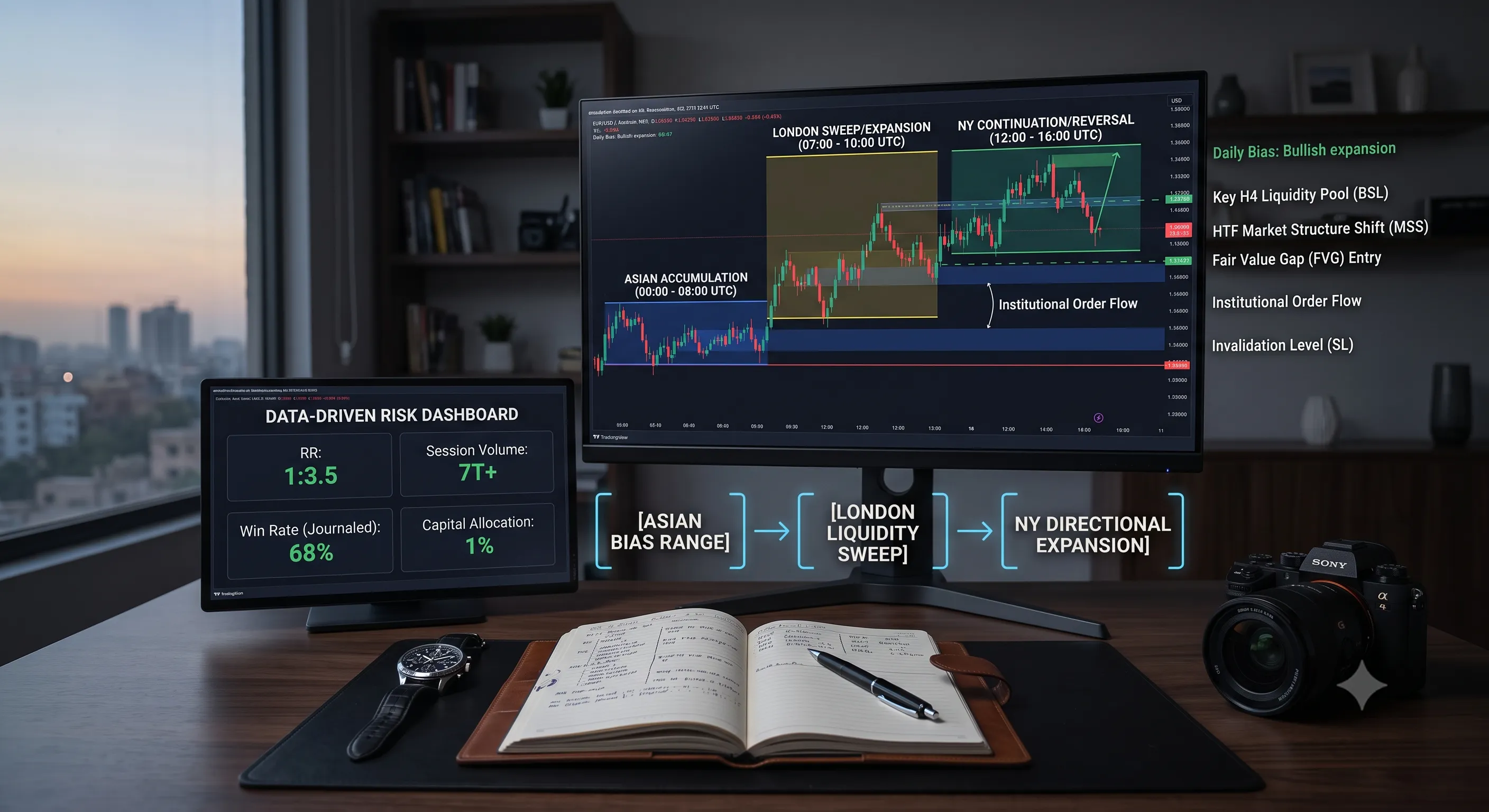
Price expansion moves align strictly with regional financial center opens. Trading from Karachi, Pakistan (PKT / UTC+5) requires systematic execution across key global time zones.
| Market Session | Time (UTC) | Institutional Role & Order Flow Characteristics |
|---|---|---|
| Asian Session | 00:00 - 08:00 | Accumulation Phase: Establishes the initial high and low boundaries of the day. |
| London Open | 07:00 - 10:00 | Manipulation Phase: Sweeps session liquidity (Judas Swing) before expanding toward HTF targets. |
| New York Open | 12:00 - 16:00 | Continuation / Reversal Phase: Driven by economic data releases and institutional order injection. |
Core Institutional Concepts
- Liquidity Sweeps: Identifying stop runs above or below key session levels prior to directional expansion.
- Fair Value Gaps (FVG): Locating lower-timeframe dynamic imbalance zones for precision entry triggers.
- Market Structure Shift (MSS): Confirming order flow shifts on lower timeframes (M5 / M1) following a liquidity sweep.
Execution & Risk Management Parameters
Disciplined capital preservation drives trading longevity. Entries are governed by strict structural rules rather than emotional discretion.
- Entry Model: Limit order triggers placed at unmitigated Order Blocks (OB) or Fair Value Gaps (FVG) following an intraday Market Structure Shift (MSS).
- Invalidation Point: Stop Losses (SL) sit strictly beyond swing highs or lows. Fixed point counts are never used.
- Breakeven (BE) Adjustment: When price reaches 50% expansion toward the target, the SL moves to Breakeven plus spread fees (BE+).
- Profit Targets (TP): Aligned directly with opposing HTF liquidity pools to achieve asymmetrical Risk-to-Reward (RR).
Key Lessons & Trade Journaling Notes
Continuous improvement requires iterative feedback loops. Current journal analysis highlights two core variables for refinement:
- Spread Expansion Management: Fine-tuning lower-timeframe (M5/M1) entries during session opens to prevent premature stop-outs caused by broker spread expansion.
- Profit Retention Strategy: Optimizing partial profit-taking rules at key intermediate liquidity points while letting core position size run to terminal HTF targets.
Connect & Collaborate
Constructive discussion accelerates analytical growth. Whether you trade Smart Money Concepts (SMC), Inner Circle Trader (ICT) concepts, or general quantitative market structure, feedback is always welcome.
Connect and collaborate on daily chart breakdowns and market setups via X / Twitter Profile, LinkedIn Profile, or TradingView Profile.