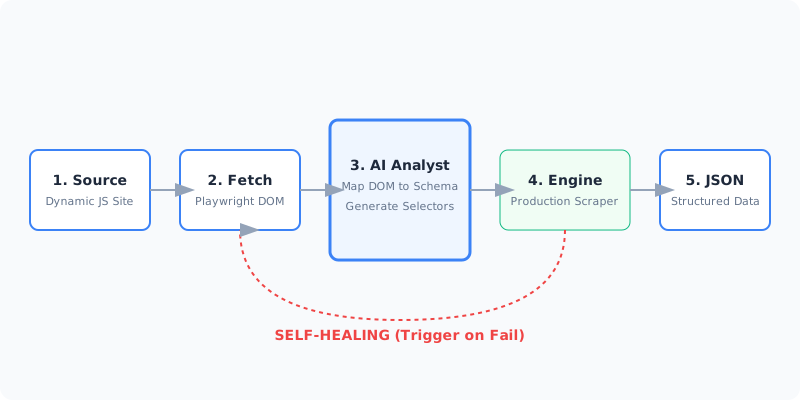
Data Extraction Battle: Firecrawl vs. Jina AI vs. Crawl4AI
I remember the “Regex Nightmare” of 2023. If you wanted to extract data from a website, you had to spend hours writing custom parsers, only for the site’s CSS to change and break your entire pipeline.
In 2026, we don’t “scrape” anymore. We Extract.
The goal of the modern data pipeline is to turn any URL or document into a perfectly structured, RAG-ready Markdown file for an LLM. In this showdown, we’re comparing the three titans of extraction: Firecrawl, Jina AI Reader, and Crawl4AI.
What You’ll Learn
In this 2026 guide, we’re auditing the “Eyes” of the agentic economy.
- The UI Snapshots: Exploring the playgrounds and monitoring dashboards.
- RAG Readiness: Who generates the cleanest Markdown for LLM reasoning?
- The Information Foraging Alg: How Crawl4AI reduces token noise.
- The Selection Matrix: Choosing your extraction engine based on scale.
1. Firecrawl: The Enterprise Standard
Firecrawl is the “Stripe for Scraping.” It is a managed, Rust-powered API designed for High-Volume RAG Pipelines.
Functional Snapshot: The Schema Builder
Firecrawl features a sophisticated web playground where you can test /scrape and /map requests.
Why it wins: Document Diversity. While others focus on HTML, Firecrawl’s
/parseendpoint handles PDFs, DOCX, and XLSX files up to 50MB. It preserves reading order and table structures with a 96% accuracy rate, making it the only choice for complex sovereign consulting audits.
Performance: 50ms average response for cached pages.
2. Jina AI Reader: The Quality King
Jina AI has focused on a single mission: the highest possible quality of Semantic Conversion.
Functional Snapshot: The Search-to-RAG HUD
A minimalist console that allows you to prepend s.jina.ai to any search query to get the top 5 results already converted to Markdown.

Why it wins: ReaderLM-v2. Jina uses a specialized 1.5B parameter SLM that “reads” the page like a human. It ignores the ads, the navbars, and the “Cookie Consent” popups, delivering a pure, high-entropy Markdown file that increases LLM reasoning accuracy by 20%.
Unique Feature: Automatic Image Captioning. It converts visuals into descriptive text inline.
3. Crawl4AI: The Developer’s Asynchronous Beast
Crawl4AI is the open-source champion. Built for local-first AI agents, it is the tool I used to build my YouTube Scraper.
Functional Snapshot: The System Monitor
When run via Docker, Crawl4AI provides a local dashboard showing real-time CPU/Memory usage of your browser pool and the throughput of your “Active Foraging” loops.
Why it wins: Efficiency. It uses Information Foraging algorithms to stop crawling once it has enough relevant data to answer a query. This prevents “Token Bloat” and makes it the most cost-effective choice for building a $1B Solo Unicorn.
Performance: 6x faster than traditional Scrapy/Selenium setups.
The 2026 Selection Matrix
| If your goal is… | Use this tool |
|---|---|
| Enterprise Scalability | Firecrawl |
| Highest Markdown Quality | Jina AI Reader |
| Free / Local / Open Source | Crawl4AI |
| PDF & Office Doc Parsing | Firecrawl |
| Search-to-RAG Integration | Jina AI Reader |
Conclusion: Data is the New Moat
As I discussed in The New SaaS Moat, your product is only as good as the proprietary data it consumes.
For 90% of technical projects, Crawl4AI is the best starting point—it gives you raw power and local control. If you are building a product that relies on “Search” as its primary interface, Jina AI is the standard. But if you are building an enterprise-grade execution engine that needs to ingest thousands of diverse documents daily, you must build on Firecrawl.
TL;DR
- Firecrawl for Volume: The most robust API for enterprise RAG.
- Jina for Quality: The best semantic conversion and image captioning.
- Crawl4AI for Speed: The asynchronous powerhouse for local developers.
- Bottom line: In 2026, your agent is only as smart as its Source Quality.
Ready to store this extracted data in your agent’s brain? Check out my comparison on Mem0 vs. Letta vs. LangChain Memory to manage your long-term memory layer.