De-Dollarization 2.0: How Digital Assets are Reshaping Global Trade Sanctions
For decades, “De-Dollarization” was a buzzword used by politicians to signal defiance. It was mostly talk, backed by a few bilateral swap lines that never quite scaled. But in 2026, the talk stopped. The infrastructure started.
Welcome to De-Dollarization 2.0.
In April 2026, we are witnessing the most significant rewrite of the global financial OS since the 1944 Bretton Woods agreement. This isn’t just about “dumping treasuries”—it’s about building an entirely new set of “pipes and rails” that make the US dollar optional for the first time in history.
Here is why the 2026 New Delhi BRICS Summit was the “Nixon Shock” in reverse.
From Rhetoric to Rails: The Infrastructure Pivot
The catalyst wasn’t just the Iran War of 2026 or the aggressive 100% tariff threats of late 2025. It was the realization that “Financial Convenience” was being used as a weapon of war.
Nations realized that as long as they used the USD, they were effectively under US jurisdiction. To escape, they didn’t need a new “King Currency”—they needed a Neutral Ledger.
The Three Pillars of the New Trade Era
As of mid-2026, the non-aligned world has settled on three primary technologies to bypass the legacy fiat monopoly.
1. The Multi-CBDC Bridge (Project mBridge)
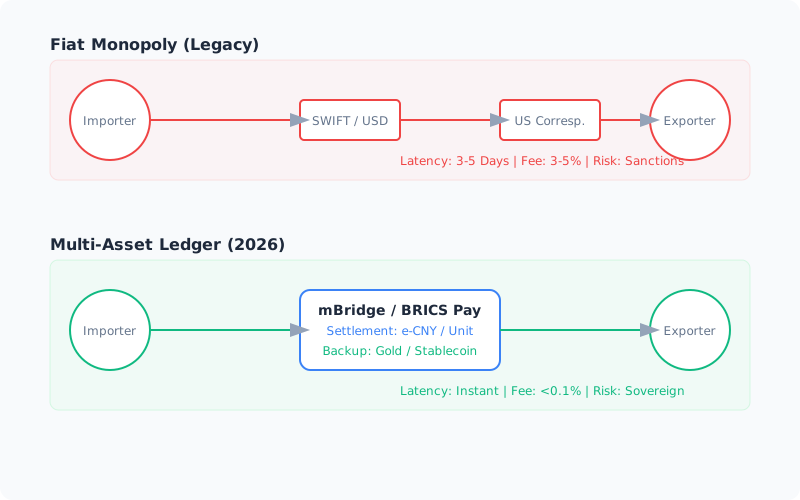
This isn’t a theory anymore. Project mBridge crossed $55 billion in cumulative volume this month. By linking the Central Bank Digital Currencies of China, the UAE, India, and Saudi Arabia, it allows a refinery in Dammam to settle an oil contract with a factory in Shanghai in seconds, using e-CNY or Digital Dirhams. No SWIFT message required.
2. BRICS Pay: The Retail and B2B Layer
Launched fully at the 2026 New Delhi Summit, BRICS Pay is the “connective tissue.” It allows an Indian importer to use their UPI app to pay a Brazilian exporter in Digital Rupee, which is instantly converted via a liquidity pool into DREX. The fee? Less than 0.1%. The time? Instant.
3. The Stablecoin ‘On-Ramp’
Stablecoins have officially crossed the $300 billion market cap threshold. While USDT and USDC are still USD-pegged, they are being used by regional trade blocs as a high-velocity “Settlement Layer” that exists entirely outside the legacy correspondent banking system.
The Russian Precedent: Formal Crypto Legalization
One of the boldest moves of 2026 was Russia’s formal legalization of cryptocurrency for international trade, effective July 1st. By acknowledging Bitcoin and Ethereum as valid “Settlement Units,” Russia has created a legal framework for its exporters to bypass the USD blockade entirely. This isn’t “black market” activity; it is state-sanctioned financial engineering.
Information Gain: The Death of the ‘Monopoly of Convenience’
If you are a corporate treasurer or an investor in 2026, the lesson is clear: The Dollar’s monopoly was built on convenience, and that convenience is being disrupted by code.
The legacy system (SWIFT) has a 3-5 day latency and a 3-5% fee structure. The new digital asset corridors have sub-second latency and near-zero fees. Even without the political pressure of sanctions, the purely economic incentive to move toward digital asset settlement is becoming irresistible.
The Verdict
De-Dollarization 2.0 isn’t an overnight event. It is a slow, methodical re-plumbing of the world. As the USD share of global reserves hits its lowest point in three decades, the message from the 2026 New Delhi summit is loud and clear: The world is no longer looking for a new leader; it is looking for a new ledger.
If you found this analysis useful, subscribe to my newsletter below for more geopolitical research and deep-tech insights.
Have a skill recommendation or spotted an error? Reach out on LinkedIn or email me at business@hassanali.site.
Last updated: April 29, 2026