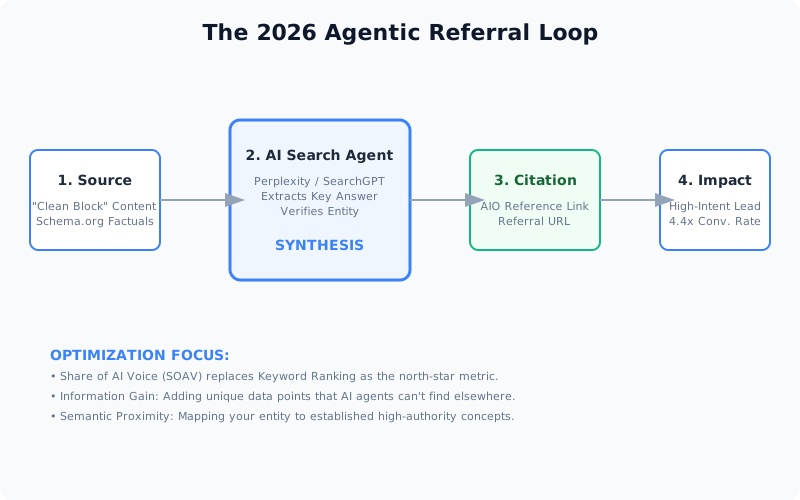
GEO vs SEO: Why Keywords are Dead and 'Contextual Proximity' is Everything
I remember the “Golden Age” of keyword stuffing. If you wanted to rank for “best coffee maker,” you just said those three words 50 times in a 500-word article, and Google would reward you with a top spot.
In 2026, if you try that, an LLM will categorize your content as “Low Entropy Noise” and ignore it entirely.
The battle for visibility has moved from the search index to the Latent Space. Welcome to the era of GEO vs SEO, where the only thing that matters is Contextual Proximity.
What You’ll Learn
In this guide, we’re dismantling the old search playbook and building a new one for the synthesis age.
- The Strategic Split: Clicks vs. Citations.
- Contextual Proximity: Why the “Semantic Neighborhood” is the new #1 ranking factor.
- Latent Space Visibility: How to survive in a high-dimensional vector world.
- Knowledge Graph Optimization (KGO): Mapping entities, not keywords.
The Strategic Split: From PageRank to CitationShare
Traditional SEO was about Navigation. You wanted to be the first door the user walked through. Success was measured in Click-Through Rate (CTR).
Generative Engine Optimization (GEO) is about Consolidation. Users aren’t looking for doors anymore; they’re looking for the answer that’s already inside the room. Success is measured in Citation Share—the percentage of time an LLM chooses your data to build its answer.
| Metric | Traditional SEO | GEO (2026) |
|---|---|---|
| Unit | Keywords & Backlinks | Entities & Evidence |
| Goal | Drive a click to a site. | Earn a mention in a synthesis. |
| Winner | The site with the most ‘Link Juice’. | The site with the most ‘Information Gain’. |
”Contextual Proximity”: The New “Near Me”
In 2026, Contextual Proximity is the primary signal AI models use to determine relevance. It’s no longer about physical distance; it’s about Semantic Distance.
Think of the AI’s “brain” (the Latent Space) as a massive map of every concept known to man. When a user asks about sovereign agentic stacks, the AI looks for the content that sits in the exact same “neighborhood” as those terms.
To win, your content must use the “semantic neighbors”—the related concepts, specific technical terms (like Model Context Protocol or NPU clusters), and original evidence—that the AI expects to see when discussing high-authority tech.
Latent Space Visibility: Surviving in the Vector World
How does an LLM see your content? It turns your prose into a vector—a numerical string that represents its meaning. If your content is vague or uses marketing fluff (“In today’s digital landscape…”), your vector becomes “blurry.”
To achieve high Latent Space Visibility, you must be Semantically Dense:
- Unique Entropy: Provide facts that the AI doesn’t already have in its base training data.
- Structural Predictability: Use the “Answer-First” pattern. LLMs favor content that is easy to parse into their RAG (Retrieval-Augmented Generation) systems.
- Visual Alignment: In 2026, LLMs cross-reference your text with your visuals. If your SVG architecture diagrams match your technical descriptions, your authority score doubles.
Knowledge Graph Optimization (KGO)
The final layer of GEO is Knowledge Graph Optimization. AI models like Gemini and SearchGPT think in entities (People, Brands, Products).
Optimization now involves explicit Entity Mapping. Instead of “How to build a trading bot,” use headers like “How [Your Brand] Implements [Entity A] for [Entity B].” This explicitly tells the AI how to slot you into its internal knowledge map.
Conclusion: The Death of the Proxy
SEO was always a proxy for quality. We used keywords and links because we couldn’t measure “truth” or “value.”
In 2026, LLMs are finally smart enough to measure the thing itself. Contextual Proximity isn’t a hack; it’s a reflection of how deeply you understand your niche. If you want to rank in the GEO era, stop trying to trick the engine and start trying to teach it.
TL;DR
- Clicks are the past: Citations are the future.
- Keywords are noise: Contextual Proximity is the signal.
- Fluff is fatal: High Information Gain is the only way to remain visible in the Latent Space.
- Bottom line: Be the source the AI needs to complete its answer.
Ready to build the technical infrastructure for your GEO strategy? Check out my tutorial on Agentic Accessibility to learn how semantic HTML fuels silicon readers.