Citation Engineering: How to get quoted by Perplexity and ChatGPT Search
I recently checked the analytics for a client’s high-traffic blog. Their “Organic Search” traffic was down 40% year-over-year. But their referral traffic from Perplexity and SearchGPT had exploded by 800%. Even more shocking: the quality of that traffic was 3x higher.
We are witnessing the most significant market shift since the invention of the hyperlink.
In 2026, the goal is no longer to “win the click.” The goal is to be the Primary Citation. We call this Citation Engineering.
What You’ll Learn
In this strategic analysis, we’re moving from the “Blue Link” era to the Citation Economy.
- The Synthesis Tipping Point: Why Google’s 81% market share is a “hollow” number.
- The Zero-Click Reality: Mastering visibility when the user never leaves the search bar.
- Reference Over Rank: How Perplexity and SearchGPT choose their winners.
- The Refer-and-Convert Loop: Why 2026 referral traffic is the new gold standard.
The Synthesis Tipping Point: From IR to IS
For 25 years, search was about Information Retrieval (IR). You asked a question, and Google gave you a library of books (links) that might have the answer.
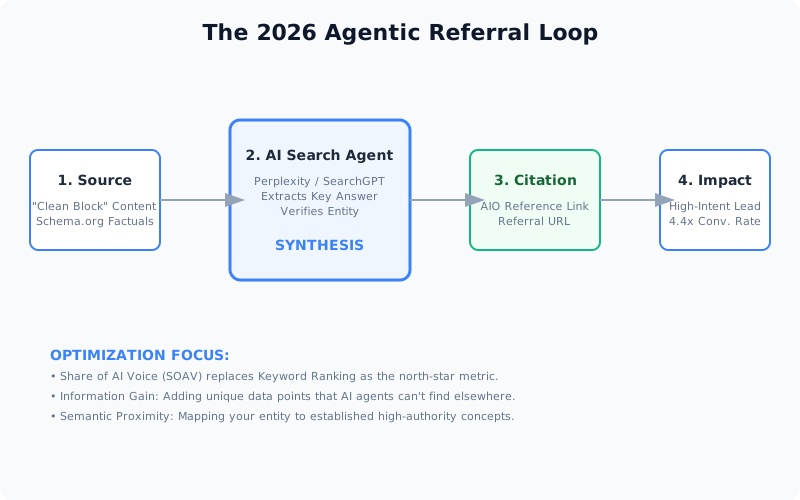
In 2026, search is about Information Synthesis (IS). When a user asks, “What is the best sovereign agentic stack for HFT?”, they don’t want a library. They want an answer. Perplexity and SearchGPT provide that answer by consuming the library for the user.
If your site is just another “book” on the shelf, you are invisible. To be seen, you must be the Source that the AI chooses to quote.
The Zero-Click Reality: Winning without the Click
Industry data shows that as of mid-2026, nearly 60% of searches end with a zero-click. This sounds like a nightmare for publishers, but it’s actually an filter for the elite.
Traditional SEO focused on quantity—getting as many eyes on the page as possible to drive ad impressions. Citation Engineering focuses on quality. When an AI agent cites your work, it is providing a high-trust recommendation to a high-intent user.
The click that does happen after an AI citation is significantly more likely to convert than a random organic landing. You aren’t getting “visitors”; you’re getting “qualified leads” who have already been primed by the AI’s summary of your expertise.
How the “Triumvirate” Cites You
The three kings of 2026 search have distinct “source preferences.” To master citation engineering, you must play to all three:
| Engine | Citation Preference | Winning Move |
|---|---|---|
| SearchGPT | Conversational Authority | Use direct, quotable assertions in your H2 sections. |
| Perplexity | Factual Recency | Publish unique data or case studies at least once a quarter. |
| Google AIO | Visual & Video Metadata | Optimize your SVG lifecycle images and YouTube transcripts. |
The Citation Playbook: Reference Over Rank
To earn your spot in the 2026 citation window, your content must undergo a structural shift:
- High Information Gain: Stop rewriting existing articles. If your content doesn’t provide a unique insight, a new framework (like my Sovereign Tech architecture), or fresh data, the LLM will ignore it.
- The Answer-First Mandate: Lead every major section with a 2-3 sentence “Abstract.” This is the “Hook” that the LLM crawler uses to identify your site as the definitive source.
- Entity Consolidation: The AI looks for consistency. If you are an expert in agentic SEO on your blog, your LinkedIn, and your GitHub, the engine’s “Confidence Score” in citing you triples.
Conclusion: The New Currency of the Web
In the agentic era, Trust is the only currency. You cannot buy a citation, and you cannot “game” a 2026 LLM with keyword stuffing.
Citation Engineering is the art of proving to an intelligent machine that you are the most reliable, readable, and relevant source of truth in your niche. The “Blue Link” era was about navigation. The “Citation Era” is about Reputation.
TL;DR
- Clicks are declining, Trust is rising: AI referral traffic converts better than organic search.
- Synthesis is the standard: LLMs want to summarize you, not link to you.
- Earn the Quote: Optimize for Information Gain and machine-readability to become the primary source.
- Bottom line: In 2026, if you aren’t cited, you don’t exist.
Ready to audit your site’s machine-readability? Check out the technical checklist in my Agentic SEO Playbook to ensure you’re ready for the 2026 crawlers.
Found this valuable? Share the insight.