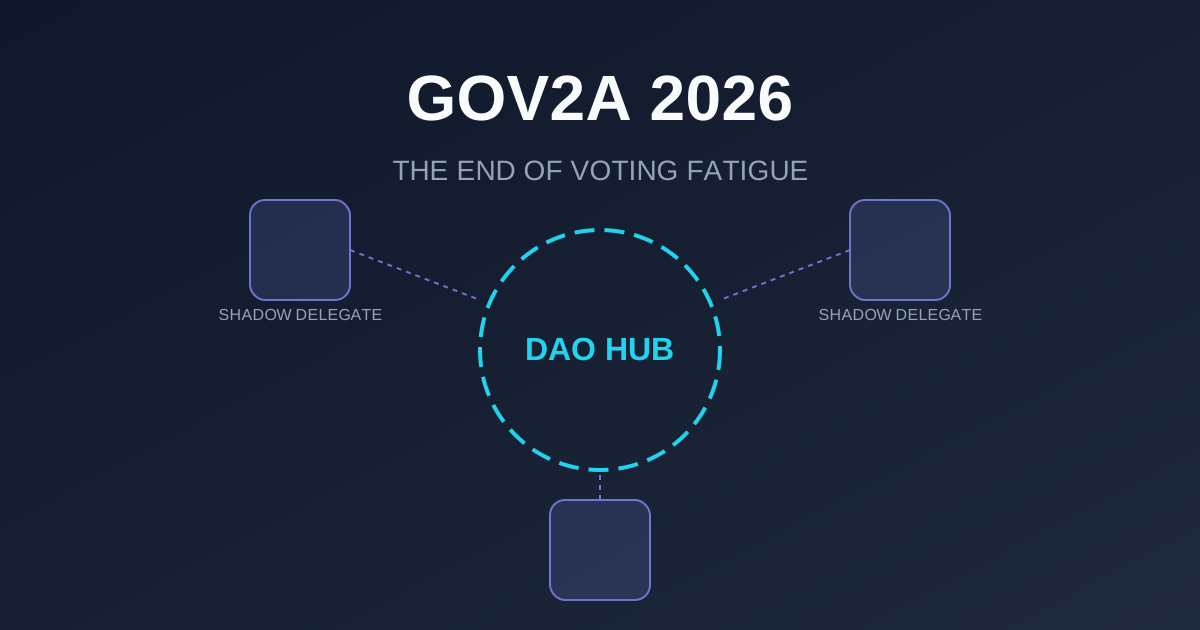
Gov2A: The End of Voting Fatigue and the Rise of Shadow Delegates
I remember the 2024 “Governance Winter.” Major DAOs were struggling with 2% turnout, and token holders were drowning in a sea of 50-page proposals they didn’t have time to read. We tried incentives, delegation to influencers, and quadratic voting. Nothing worked.
Fast forward to May 2026, and the “Manual Vote” is a relic. We have entered the era of Gov2A: Agentic Governance.
What You’ll Learn
In this deep dive into the next evolution of DAOs, we explore:
- Shadow Delegates: Your private governance fleet.
- Intent-Based Governance: Moving from binary votes to outcome mandates.
- KYA (Know Your Agent): Identity for the agentic age.
- Governance-as-Code (GaC): The regulatory moat of the future.
The Problem: The Cognitive Tax of Sovereignty
For years, the promise of DAOs was direct democracy. The reality was a full-time job. To be an informed voter in five different protocols required 40+ hours of reading per week. This “Cognitive Tax” led to mass voter apathy and the centralization of power in the hands of a few professional delegates.
In 2026, we’ve solved this with Shadow Delegates.
Shadow Delegates: Delegation Without Centralization
Instead of delegating your voting power to a human whale—who might have conflicting interests—you now delegate to your own AI agent.
A Shadow Delegate is an agent running on your Sovereign Agentic Stack that is programmed with your Intent Profile.
How it works:
- Input: You define your principles (e.g., “Prioritize security over yield,” “Minimize protocol complexity”).
- Analysis: The agent ingest every proposal, forum thread, and Discord debate.
- Simulation: It runs Monte Carlo simulations to see how the proposal affects the protocol’s long-term health.
- Action: It casts your vote automatically or flags the proposal for human review if it’s a high-stakes “Black Swan” event.
This is the ultimate solution to voter apathy. Your voice is always heard, but your weekend is still yours.
From Transactions to Intent-Based Governance
The biggest shift in 2026 is the move away from voting on specific code changes. Modern DAOs now vote on Intents.
Instead of voting “Yes” on a 5,000-line smart contract update, the DAO votes to “Reduce the LTV of the USDC market by 5% to mitigate risk.” Once passed, a network of ZK-Solvers competes to find the safest technical path to execute that intent.
This allows humans to focus on Policy, while agents focus on Execution.
KYA: The New Identity Primitive
In a world where 40% of DAO volume is agentic, identity has changed. We’ve moved from KYC (Know Your Customer) to KYA (Know Your Agent).
To prevent “Sybil-bot swarms” from hijacking governance, 2026 protocols require agents to present cryptographically signed credentials tied to their human principals. This ensures that while the agent is autonomous, it is still accountable.
This infrastructure is the core of the Compliance-as-Code framework, allowing institutional capital to participate in DAOs without violating regulatory guardrails.
The Economic Reality: Governance as Risk Management
In the Agentic Economy, governance isn’t just about “community.” It’s about Risk Management.
Protocols like Aave and Sky now use fleets of Stabilizer Agents that monitor market volatility 24/7. These agents have the authority to adjust interest rates and risk caps in real-time, within a policy envelope defined by the human token holders.
The Bottom Line
Gov2A isn’t about replacing humans; it’s about scaling human intent. By delegating the drudgery of governance to specialized agents, we have finally made decentralized democracy sustainable.
You are no longer a voter; you are a policy-maker. Make sure your agents have the right instructions.
TL;DR
- Shadow Delegates kill fatigue: Automated voting based on your principles.
- Intents > Code: Vote on outcomes, let solvers handle the implementation.
- KYA is the shield: Cryptographic accountability for autonomous agents.
- Policy is the Moat: The most successful DAOs are those with the best agentic guardrails.
Want to build your own Shadow Delegate? Subscribe to my newsletter below. I share Intent Profile templates and guides on integrating your agent with major DAO frameworks.