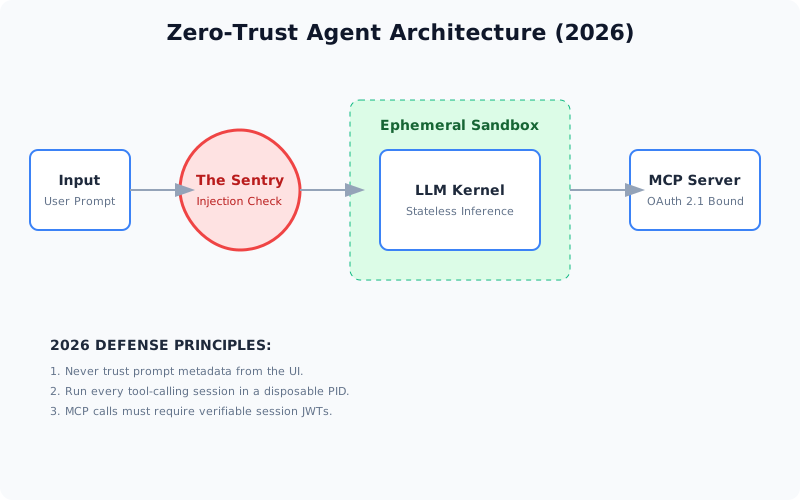
Guardian Agents: Implementing Compliance-as-Code in Sovereign Fleets
The date is August 2, 2026. If you are running an AI system in the EU—or serving EU citizens—the “wild west” of autonomous agents is officially over. The EU AI Act is now fully enforceable, and the penalties for non-compliant agentic behavior are no longer theoretical.
But for the sovereign engineer, compliance isn’t just a legal hurdle; it’s a technical design pattern. We solve this not with more lawyers, but with Guardian Agents and Compliance-as-Code.
What You’ll Learn
In this security blueprint, we’re moving beyond simple “system prompts” and building a hardened oversight layer.
- The Guardian Architecture: How to build an interception layer for agentic loops.
- Policy-as-Code (PaC): Translating the EU AI Act into executable logic.
- The Identity Gap: Why every agent needs a cryptographically bound NHI identity.
- Real-Time Guardrails: Blocking malicious tool calls before they hit the OS.
The Identity Crisis: NHI and Attribution
In 2024, we treated agents as simple API calls. In 2026, we treat them as Non-Human Identities (NHI).
According to Article 14 of the EU AI Act, every high-risk AI action must be attributable to a human who can intervene. In a sovereign agentic stack, we achieve this through Agent Authorization Grants. Every time an agent calls a tool (e.g., “Access the HR database”), the Guardian Agent checks for a valid, cryptographically signed token that proves a human has delegated that specific authority.
No token? No access. This is the cornerstone of zero-trust AI security.
Guardian Agents: The Interception Layer
A Guardian Agent is a specialized, local model whose only job is to watch the “Primary” agent. It operates at the Interception Layer:

- Prompt Scanning: Before a prompt reaches the primary LLM, the Guardian scans for PII, prompt injection, or policy violations.
- Tool Call Validation: When the primary agent decides to “Run a Python script,” the Guardian intercepts the call. It analyzes the code for “jailbreak” patterns or unauthorized network egress.
- Response Filtering: Before the user sees the output, the Guardian ensures it meets transparency standards (e.g., “This content was generated by AI”).
By running the Guardian locally on your sovereign stack, you ensure that the oversight process itself doesn’t leak sensitive context to a third-party cloud.
Implementation: Compliance-as-Code
We don’t want our Guardian Agents to “guess” what is allowed. We use Compliance-as-Code to give them absolute rules. Using languages like Rego (Open Policy Agent) or simple Python-based logic, we can define our boundaries:
# Example Compliance-as-Code Rule
def validate_tool_call(tool_name, arguments, user_role):
    if tool_name == "delete_database" and user_role != "ADMIN":
        return "BLOCKED: Unauthorized action per Article 14 (Oversight)."
    return "ALLOWED"
This makes compliance audit-ready. When an auditor asks how you enforce the EU AI Act, you don’t show them a handbook; you show them your Guardian Policy Repo.
The Sovereign Advantage in Compliance
Meeting the 2026 transparency and logging requirements (Article 12) generates a massive amount of metadata. If you store these logs in a centralized cloud, you are creating a secondary security risk.
In a sovereign stack, your agentic long-term memory stores these logs in a local, tamper-evident WORM (Write Once Read Many) database. You own the audit trail, and you control who sees it.
Conclusion: The New Security Standard
In 2026, a “secure” AI system isn’t just one that doesn’t hallucinate. It’s one that has a Guardian Agent enforcing every turn of the conversation. By implementing Compliance-as-Code today, you aren’t just avoiding fines—you are building the trust necessary to scale agentic automation across your enterprise.
TL;DR
- August 2026 is the deadline: High-risk AI systems must be fully compliant with the EU AI Act.
- Guardians are the solution: Use a specialized oversight agent to intercept and validate all actions.
- PaC is the language: Translate legal requirements into machine-readable policies.
- Sovereignty is the vault: Keep your audit logs and oversight logic local and secure.
Ready to secure your local environment? Explore my guide on Zero-Trust AI Security to learn how to harden your MCP servers and agentic loops.