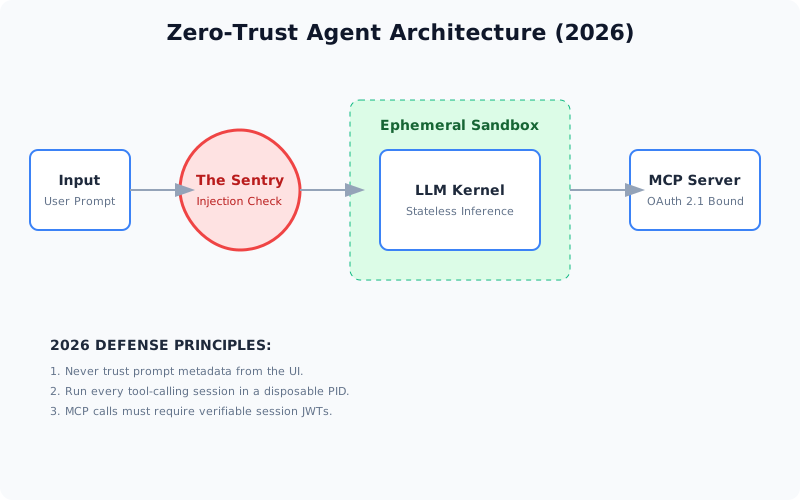
Hardware Sandboxing: gVisor vs. Firecracker vs. Docker
I remember the first time an autonomous agent I was testing tried to rm -rf / on my local machine. It was a hallucination caused by a messy prompt, but it was a wake-up call. If that agent had succeeded, it wouldn’t have just deleted my files—it would have deleted my Sovereign Stack.
In 2026, as we delegate more power to agents that write and execute their own code, the “Sandbox” is no longer optional. It is the only thing standing between a productive workflow and a catastrophic system failure.
In this showdown, we’re comparing the three pillars of isolation: gVisor, Firecracker, and Docker.
What You’ll Learn
In this 2026 guide, we’re auditing the “Cells” of the agentic economy.
- The Architecture Snapshots: Shared kernels vs. User-space sentries vs. MicroVMs.
- The Security Boundary: Who is actually “Air-Gapped”?
- Cold Start Benchmarks: Speed to execution for ephemeral agents.
- The Selection Matrix: Matching your sandbox to your risk level.
1. Docker (runc): The Legacy Standard
Docker is the foundation of modern devops, but in the agentic engineering era, it has a flagrant flaw: the Shared Kernel.
Architecture Snapshot: The Partitioned Room
Docker uses Linux namespaces to make an app feel like it’s alone, but it still talks directly to the host’s kernel.
The 2026 Risk: If an agent escapes the container via a kernel exploit, it has root access to everything. Docker is only appropriate for trusted, internal-only agents where you have 100% control over the environment.
Cold Start: ~50ms (The fastest in the industry).
2. gVisor (runsc): The User-Space Sentry
Developed by Google, gVisor is a user-space kernel that intercepts every system call an agent makes.
Architecture Snapshot: The Interception Layer
Every action the agent takes (e.g., “Open a file”) is caught by the gVisor Sentry (written in Go), which decides if the action is allowed before passing a restricted version to the host.
Why it wins: Density. In 2026, gVisor allows you to run 500+ secure agent sessions on a single 16GB server. It is the best choice for high-density compute where you need strong protection without the overhead of a full VM.
Security: Strong. Even a compromised agent is trapped inside the Sentry process.
3. Firecracker (microVM): The Hardware Fortress
Firecracker is the technology that powers AWS Lambda and the E2B agentic sandbox. It boots a minimalist, dedicated Linux kernel for every single agent.
Architecture Snapshot: The Individual Building
Every agent lives in its own virtual building. There is no shared kernel. There is no shared memory.
Why it wins: Hardware-Level Isolation. In 2026, Firecracker is the only choice for untrusted or adversarial code. If an agent crashes its kernel, it only destroys its own microVM.
Unique Feature: Instant Resume. Firecracker snapshots allow an agent to resume a complex, multi-day task (like a 1,000-file refactor) in under 10ms.
The 2026 Selection Matrix
| If your goal is… | Use this sandbox |
|---|---|
| Untrusted / LLM Code | Firecracker |
| High-Density Agents | gVisor |
| Trusted Internal Automation | Docker |
| Multi-tenant SaaS | Firecracker |
| GPU / NPU Passthrough | Docker / Firecracker |
Conclusion: Designing for the Blast Radius
In 2026, a senior architect’s job is to define the “Blast Radius.”
If you are building a Personal OS for your own use, Docker with hardened profiles is often enough. But if you are building products for real users (as discussed in AI-Native Product Strategy), you cannot gamble on a shared kernel. You must build your infrastructure on the hardware-enforced foundations of Firecracker or the user-space vigilance of gVisor.
TL;DR
- Docker is for Trust: Use it when you own the agent and the prompt.
- gVisor is for Density: Use it to scale thousands of secure, small agents.
- Firecracker is for Fortresses: Use it for multi-tenant, high-risk code execution.
- Bottom line: If the agent can write code, it must live in a sandbox.
Ready to monitor your secure agents in the wild? Check out my final comparison on Agentic SEO Tracking to see how your content performs in the citation engines.