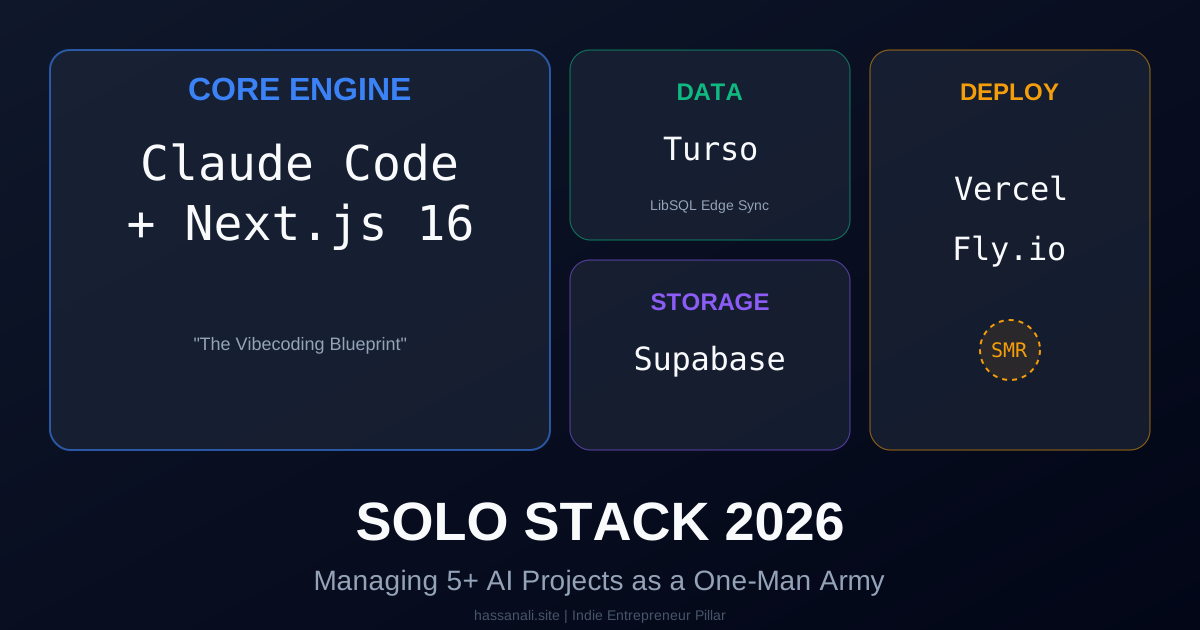
My Stack for 2026: How I Manage 5+ AI Projects as a Solo Builder
I remember my first “successful” SaaS launch in 2022. I had a team of three, a $5,000 monthly server bill, and I spent 80% of my time in meetings instead of building. When the market shifted, the overhead crushed us.
It was a fantastic learning experience.
Fast forward to April 2026: I am currently managing five active AI projects—including Apex Terminal and my Automated Scraper—entirely alone. No employees, no contractors, and a server bill that is less than my coffee budget.
How? By moving from “Full-Stack Developer” to Agentic Architect. Here is the exact stack and workflow I use to ship at the speed of thought.
What You’ll Learn
In this behind-the-scenes breakdown, I’m opening up my personal 2026 vault. You’ll discover:
- The “Golden Stack”: Why I chose Next.js 16, Turso, and Supabase
- Vibecoding: How I use Claude Code to write 90% of my production logic
- Agentic CI/CD: The pipeline that deploys and monitors itself
- Multi-Project Management: Balancing 5+ tickers without burning out
- The SMR Factor: My strategy for long-term “Sovereign Compute”
The 2026 Golden Stack
In 2026, tool selection isn’t about features; it’s about AI Ergonomics. If an AI agent can’t easily understand and modify your stack, you shouldn’t use it.
- Framework: Next.js 16 (App Router). It remains the king because of its tight integration with Vercel’s AI SDK.
- Database: Turso (LibSQL). For a solo builder, Turso’s “database-per-tenant” model is a cheat code. I can spin up a new DB for every project in seconds.
- Auth & Storage: Supabase. I don’t write auth logic anymore. I describe the schema to Claude, and it wires up the Supabase hooks.
- Code Engine: Claude Code. This is the heart of my workflow. It’s not a “copilot”; it’s a senior engineer that I pair-program with.
The Workflow: From Vibe to Production
The biggest shift in 2026 is the Agentic CI/CD Pipeline. I no longer click “Deploy” or manually run tests.
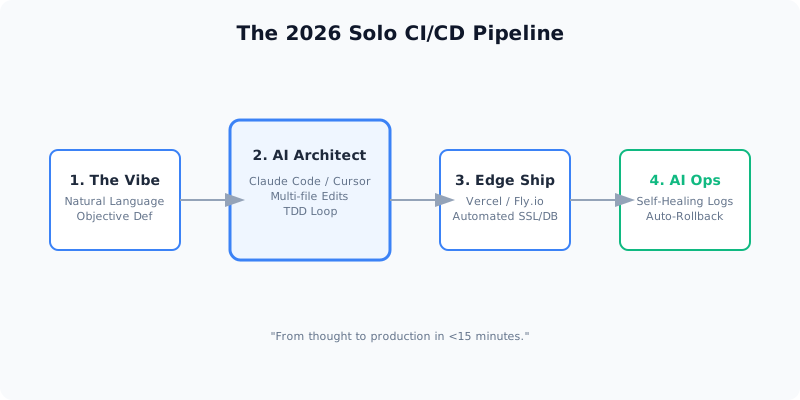
1. The Vibe (Objective Definition)
I start by writing a one-paragraph description of the feature in my terminal. “Add a real-time sentiment overlay to the dashboard using the DeBERTa ensemble we built yesterday.”
2. The AI Architect (Implementation Loop)
Claude Code takes that vibe, maps the existing codebase, writes the necessary components, and—most importantly—writes the tests first. If the tests pass, it moves to the next step.
3. The Edge Ship (Automated Deployment)
The code is pushed to a feature branch. My agentic GitHub Action performs a “Canary Watch,” deploying it to a small percentage of users and monitoring for 500 errors.
4. The AI Ops (Autonomous Monitoring)
Once live, an AI subagent monitors the logs. If it detects a crash, it doesn’t just alert me—it attempts to fix the bug and open a PR for my review.
Managing the Multi-Project Cognitive Load
You might wonder how I don’t lose my mind switching between 5 projects. The answer is Context Compression.
Pro tip: For every project, I maintain a
GEMINI.md(orCLAUDE.md) file. This is the “Long-Term Memory” of the project. Whenever I switch back to a project after a month, my AI agent reads this file and reminds me of what we were doing, where we left off, and what the core architecture rules are.
Information Gain: Why I’m Betting on SMRs
Looking toward late 2026, I am preparing for Energy Independence. As a solo builder, my biggest risk is “Compute Inflation.” I am currently researching Small Modular Reactors (SMRs) and local H200 clusters to host my own “Sovereign Node.”
Being an indie hacker in 2026 isn’t just about code; it’s about owning the entire stack, from the prompt down to the electrons.
The Verdict
The barrier to entry has never been lower, but the barrier to scale has never been higher. To survive as a solo builder in 2026, you must stop being a “Coder” and start being an “Orchestrator.” Use the AI to do the work; use your human “vibe” to set the direction.
Want to see my stack in action? Subscribe to my newsletter for live-build videos and raw workflow logs.
Have a skill recommendation or spotted an error? Reach out on LinkedIn or email me at business@hassanali.site.
Last updated: April 29, 2026