National Hardware Stacks: The Foundation of Digital Sovereignty
In May 2026, the first rack-scale sovereign compute cluster powered by Semidynamics’ RISC-V cores and SiPearl’s Rhea-2 processors went live in a secure European facility. It didn’t use NVIDIA H100s. It didn’t run on an American hyperscaler. It was the moment the National Hardware Stack moved from a policy whitepaper to a runtime reality.
For decades, we’ve treated the “cloud” as an ethereal utility. But in 2026, the realization has finally set in: the cloud is someone else’s jurisdiction. If you don’t own the silicon, you don’t own your sovereignty.
The pivot toward sovereign AI infrastructure isn’t just about supply chain resilience; it’s about architectural independence.
Beyond NVIDIA: The Pivot to Keystone Independence
The global scramble for GPUs in 2024 and 2025 exposed a fatal flaw in national AI strategies. Dependence on a single vendor (NVIDIA) and a single instruction set (x86/ARM) meant that national security was essentially a subscription service subject to California’s export controls.
We are now seeing a massive decoupling. Countries are moving “Beyond NVIDIA” to build what I call Keystone Independence.
The shift is focused on two fronts:
- RISC-V Adoption: By adopting the open RISC-V architecture, nations like the UK and Japan are ensuring that their “Keystone” instruction set can never be revoked by foreign sanctions.
- Custom AI Accelerators: Instead of general-purpose GPUs, sovereign stacks are utilizing domain-specific accelerators optimized for the Sovereign Agentic Stack and local SLMs.
The narrative that “you can’t catch up to NVIDIA” is being dismantled by the fact that for many sovereign tasks, you don’t need a general-purpose GPU—ive only need a dedicated inference engine that you own entirely.
The Sovereign Stack Pyramid
Digital sovereignty is a layered requirement. You cannot have secure intelligence if the OS is a black box, and you cannot have a secure OS if the silicon has backdoors.
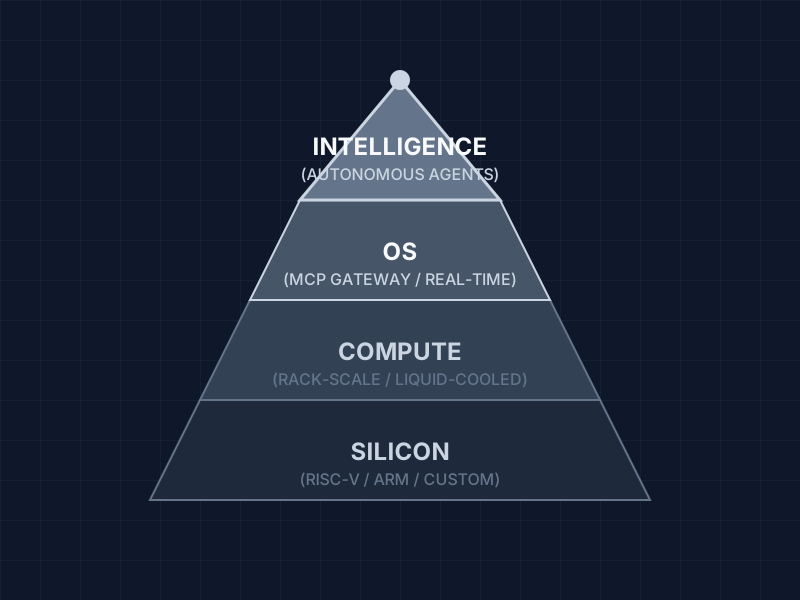
The Sovereign Stack is composed of four critical tiers:
- Silicon (The Base): Indigenous chip design using RISC-V or licensed ARM cores. This is where the Silicon Curtain is being drawn.
- Compute: The physical infrastructure—racks, cooling, and power—geopatriated within national borders to avoid “jurisdictional seepage.”
- Operating System: Hardened, open-source kernels that provide a Zero Trust AI environment.
- Intelligence: The models and agents themselves, trained on local data and running on sovereign compute.
Each layer must be verifiable. If there is a single proprietary link in the chain that answers to a foreign court, the entire stack is compromised.
Sovereignty is a Runtime Requirement
In the age of autonomous agents, sovereignty is no longer a legal status—it is a runtime requirement. When an agent makes a decision on behalf of a state or a critical industry, that execution trace must remain within the “National Hardware Stack.”
We are moving toward a world of Sovereign Clouds where compute is treated with the same territorial gravity as land and water.
The era of architectural passivity is over. Geopatriation of infrastructure is the only path forward for nations that wish to remain more than just digital vassals in the agentic age.
The Bottom Line
A National Hardware Stack isn’t a luxury; it’s an insurance policy against the weaponization of the API. The question isn’t whether building a custom stack is expensive—it’s whether your nation can afford the cost of being remotely deactivated.
TL;DR
- Thesis: True digital sovereignty requires owning the entire hardware stack, from the RISC-V instruction set to the physical compute racks.
- Key insight: The May 2026 Semidynamics/SiPearl deployment proves that high-performance sovereign compute is no longer a theoretical goal.
- Prediction: By 2027, “Hardware Decoupling” will be a standard component of all G20 national security frameworks.
- Watch: The growth of RISC-V tape-outs in Europe and Asia as a proxy for US tech decoupling.
If you’re building the infrastructure of the future, subscribe to my newsletter below for more analysis on the intersection of geopolitics, hardware, and sovereign AI.