Privacy by Design: Air-Gapped Workflows for Sensitive High-Value Tasks
I once worked with a client in the defense sector who had a simple rule: “If the machine is plugged into the wall, the data is gone.” Back then, that meant no AI. Period. The risk of telemetry leakage or a “phone home” command from a closed-source model was too high.
In 2026, we’ve solved this. We don’t have to choose between AI and security anymore.
By applying Privacy by Design, we can build air-gapped AI workflows that deliver frontier-level intelligence while guaranteeing 100% data residency. Here is the blueprint for the secure sovereign stack.
What You’ll Learn
In this technical security guide, we’re hardening your Personal OS for high-value tasks.
- The Air-Gap Continuum: From physical isolation to logical sandboxing.
- MicroVM Isolation: Running every agent session in a disposable, restricted runtime.
- Egress Control: Implementing a “Default Deny” network policy for local models.
- Confidential Computing: Leveraging TEEs and encrypted GPUs.
The Air-Gap Continuum: Physical vs. Logical
In the early days of sovereign engineering, “air-gapped” meant a laptop in a lead-lined room with no Wi-Fi card. Today, we use a more sophisticated continuum:
- Logical Isolation: Using gVisor or Firecracker MicroVMs to create a secure wrapper around your local LLM. The agent thinks it’s on a full OS, but it’s actually in a “Default Deny” container with zero network access.
- Confidential Computing: Using Trusted Execution Environments (TEEs) like Intel TDX or AMD SEV. This protects your data while it’s in use. Even if someone has root access to your machine, they cannot see the plaintext prompts in your RAM.
- Physical Air-Gapping: For the highest-stakes tasks (e.g., managing a sovereign HFT private key vault), we use dedicated offline hardware that only communicates via QR codes or uni-directional serial links.
Hardening the Agent: The MicroVM Pattern
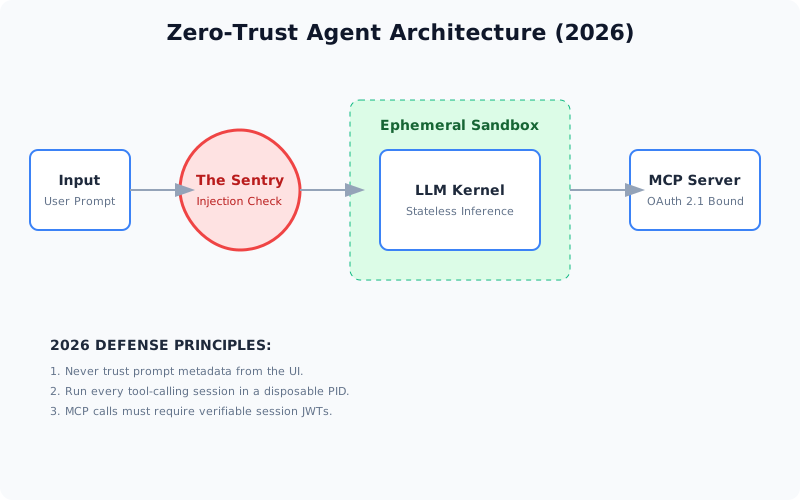
The biggest risk in secure agentic systems is a “Sandbox Escape.” If an agent is allowed to run code (e.g., Python), it might try to read your system’s SSH keys or browse your local network.
In a Privacy by Design architecture, we treat every agent like a potential biohazard:
- Ephemeral Runtimes: The agent is born when the task starts and is physically deleted when the task ends.
- Zero Retention: No data is written to a persistent disk. All “memory” is stored in a local vector DB that requires a secondary authentication factor to access.
Egress Control: Silencing the Machine
An air-gapped workflow is only as strong as its networking policy. In 2026, we use mTLS (mutual TLS) and Egress Proxies to ensure that our local models (like Llama 3 or Mistral) can only talk to approved local tools.
If a model hallucinates a command to curl a malicious URL, the infrastructure blocks it at the kernel level before the packet even leaves the container. This is the cornerstone of zero-trust AI security.
Hardware Sovereignty: Encrypted GPUs
The final piece of the puzzle is the GPU. In 2026, the NVIDIA Blackwell series and high-end Mac studios support Confidential GPU modes. This ensures that the weights of your fine-tuned models—your most valuable IP—are encrypted on the chip.
If an attacker physically steals your server, they cannot extract your proprietary “alpha” from the silicon.
Conclusion: The New Trust Standard
Privacy is no longer a “setting” you toggle in an app. It is a physical property of your architecture.
By building with Privacy by Design, you create an environment where you can deploy the world’s most powerful agents on your most sensitive data without ever worrying about a leak. In 2026, the most successful individuals aren’t the ones with the most data—they are the ones with the most secure intelligence.
TL;DR
- Isolate by Default: Use MicroVMs to wrap every agent task.
- Trust the Hardware: Leverage TEEs to encrypt data while it’s in memory.
- Deny all Egress: Ensure your agents can never “phone home.”
- Bottom line: If the architecture doesn’t guarantee privacy, the model never sees the data.
Ready to scale these private workflows into a business? Explore my next cluster on AI-Native Entrepreneurship to learn how to turn your sovereign stack into a revenue engine.