Prompt Engineering is Dead; Long Live Agentic Engineering
I remember the “Golden Age” of Prompt Engineering back in 2023. We all had our secret Notion docs full of “Act as a senior developer” spells. We thought the future was about being an “AI Whisperer”—the person who knew exactly which adjectives would unlock the model’s potential.
It was a fantastic learning experience.
Fast forward to April 2026: Prompt Engineering is effectively dead. If you are still spending your day “perfecting the prompt,” you are building on a legacy paradigm. The models are now smart enough that they don’t need your magic spells; they need your Architectural Guidance.
Welcome to the era of Agentic Engineering.
From Spells to Systems
The transition didn’t happen overnight. It was an evolution of how we interact with intelligence.
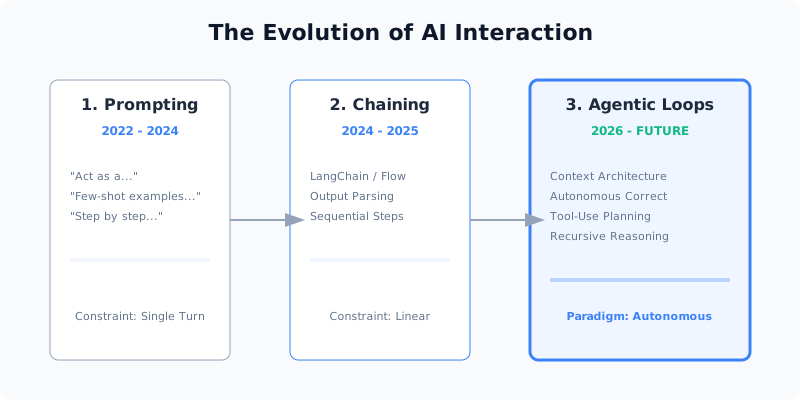
- 2022-2024 (The Prompting Era): We focused on the “Input.” If the output was bad, we blamed the prompt.
- 2024-2025 (The Chaining Era): We realized one turn wasn’t enough. We built linear chains (LangChain) to force the AI through sequential steps.
- 2026+ (The Agentic Era): We focus on the Environment. We build loops where the AI can fail, realize it failed, and fix itself without human intervention.
What is Agentic Engineering?
Agentic Engineering is the practice of designing Context, Tools, and Reasoning Loops rather than static text inputs.
In a traditional prompt-based workflow, you are the driver. In an agentic workflow, you are the Air Traffic Controller. You set the destination (The Vibe), and the Agent (Claude Code, Gemini CLI) handles the flight path, the turbulence, and the landing.
The Three Pillars of the Agentic Stack:
- Context Architecture: Instead of pasting code into a window, you provide structured project memory (
llms.txt,CLAUDE.md). This is the agent’s “Sensor Array.” - Tool-Use Planning: You don’t tell the AI how to write code; you give it access to the terminal, the filesystem, and the web.
- Recursive Reasoning: The agent doesn’t just output code; it runs the code, reads the linter errors, and iterates until the tests pass.
The Death of the ‘Magic Spell’
In 2026, the best “prompt” is often just a raw objective.
Old Way: “You are an expert React developer. Write a component that does X using Y library and ensure it is accessible…”
New Way (Agentic): “Implement the accessible search component described in @spec.md. Use the local design system. Run the accessibility audit tool after implementing.”
The agentic approach is deterministic. It doesn’t rely on the model “feeling” like an expert; it relies on the model verifying its expertise against real tools.
Information Gain: Why ‘Vibecoding’ is the Future of PRs
As an engineering lead, my role has shifted. I no longer review line-by-line syntax. I review Objective Completion.
When a “Vibecoder” on my team submits a PR in 2026, the PR description is generated by the agent, the tests are verified by the agent, and the performance benchmarks are attached by the agent. My job is to ensure the “Vibe” (the strategic intent) aligns with the product roadmap.
The Verdict
If you want to stay relevant in the 2026 AI economy, stop being a “Writer.” Start being an Engineer of Intelligence. Stop focusing on what the AI says, and start focusing on what the AI does.
The spells are gone. The systems are here.
If you found this technical thesis useful, subscribe to my newsletter below for more deep-dives into agentic architecture and the future of work.
Have a skill recommendation or spotted an error? Reach out on LinkedIn or email me at business@hassanali.site.
Last updated: April 29, 2026