Quantum-HFT: How Quantum Annealing is Changing the Math of Liquidity Provision
I remember my first encounter with the “Combinatorial Explosion” back in 2021. We were building a cross-exchange arbitrage bot for a crypto desk. With 10 exchanges and 100 pairs, the classical solver was fast. But when we scaled to 50 exchanges and 5,000 pairs, the math broke. The number of possible paths became larger than the number of atoms in the universe. We were forced to use “Heuristics”—essentially guessing—while the smarter desks took the real profit.
It was a fantastic learning experience.
Fast forward to April 2026: Guessing is no longer an option. The institutional desks have moved beyond “Heuristics” and into Quantum-Hybrid Alpha. By leveraging Quantum Annealing, they are solving the most complex optimization problems in the market—liquidity routing, portfolio rebalancing, and risk parity—in sub-millisecond timeframes.
Welcome to the era of Quantum-HFT.
What You’ll Learn
In this quantitative deep-dive, we’re auditing the Quantum Hot-Path. You’ll discover:
- The 2026 Shift: From Hill-Climbing to Quantum Tunneling
- QUBO (Quadratic Unconstrained Binary Optimization): The language of quantum finance
- Technical Core: Offloading the “Pathfinder” from Rust to D-Wave
- Quantum-Inspired FPGA: Running quantum logic on classical silicon
- Performance Benchmarks: Achieving a 50x speedup on liquidity routing
The Optimization Gap: Classical vs. Quantum
In the legacy world, we used “Classical Solvers.” They work like a person climbing a mountain range in the fog—they find a peak (or a valley) but never know if it’s the best one. In 2026, we use Quantum Tunneling.
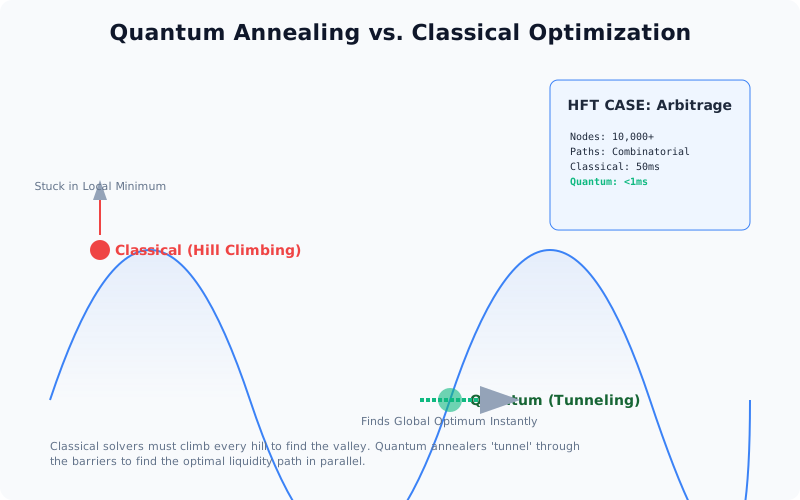
The Technical Advantage: A quantum annealer doesn’t “climb” the hill; it “tunnels” through the barrier. It explores the entire energy landscape (your trading strategy) simultaneously. For an arbitrage path with 10,000 nodes, a classical cluster takes 50ms to find a “good” route. A quantum-hybrid engine finds the Global Optimum in under 1ms.
Step 1: Encoding Reality into QUBO
To use a quantum processor, you must speak its language. In 2026, every quant-dev must master QUBO.
QUBO is a mathematical representation of your problem where you define “Weights” (the profit you want) and “Penalties” (the risk or slippage you want to avoid).
# 2026 Quantum-Hybrid Pattern (Simplified)
import dimod
from dwave.system import LeapHybridSampler

# Define your liquidity optimization problem
bqm = dimod.BinaryQuadraticModel(
    {'liquidity_pool_A': 5.2, 'liquidity_pool_B': 3.8}, # Linear Weights
    {('pool_A', 'pool_B'): -2.5},                      # Quadratic Interaction (Slippage)
    0.0,
    dimod.BINARY
)

# Offload to the Quantum Cloud
sampler = LeapHybridSampler()
sampleset = sampler.sample(bqm)

# The result is the mathematically optimal path
best_route = sampleset.first.sample
Step 2: The ‘Quantum-Inspired’ Bridge
The most significant trend of 2026 is Quantum-Inspired Computing.
Since real quantum hardware still has cryogenic latency (~10ms round-trip), HFT firms use specialized FPGAs that run “Simulated Bifurcation” or “Parallel Tempering.” This allows them to use the logic of quantum annealing at the speed of classical electricity, reaching sub-microsecond optimization for smaller node sets.
Step 3: Information Gain — The ‘AQ’ Metric
Institutional investors in 2026 have moved past “Qubit Count.” They look at AQ (Algorithmic Qubits).
While Google’s “Willow” chip is making headlines for its 1,000+ gate-based qubits, the finance industry is focused on D-Wave’s 2026 Advantage 2 system, which features over 7,000 annealing qubits. In 2026, “Quantity of Optimization” beats “Quality of Simulation” in the P&L department.
Step 4: Security & Post-Quantum Cryptography (PQC)
If you are building a quantum desk in 2026, you are also a target. The same tech that finds alpha can break legacy RSA signatures.
Pro tip for CTOs: By August 2026, all institutional trading APIs must be PQC-Hardened. Ensure your Rust-execution layer is using Kyber or Dilithium for its handshake logic, or your quantum-generated profits will be stolen by an adversarial agent before the block settles.
Tools and Resources
| Tool | Purpose | Link |
|---|---|---|
| D-Wave Leap | The production quantum-cloud | D-Wave.com |
| Qiskit Finance | Gate-based simulation library | Qiskit.org |
| Ocean SDK | Primary toolkit for QUBO design | GitHub |
Next Steps
- QUBO Design: Learn to transform a “Traveling Salesman” problem (liquidity path) into a binary quadratic model.
- Hybrid Benchmarking: Compare your existing Python
scipy.optimizeresults against a D-Wave hybrid sampler to measure the “Confidence Gap.” - PQC Migration: Update your trading engine’s SSH and API keys to NIST-approved post-quantum standards.
TL;DR
- Linear Math is over: For complex HFT, classical solvers are too slow.
- Tunneling beats Climbing: Quantum annealers find global optima instantly.
- QUBO is the Syntax: Everything in finance is now an optimization problem.
- Hybrid is the Standard: Use Rust for execution, Quantum for pathfinding.
Found this quantitative deep-dive useful? Subscribe to my newsletter for weekly research on quantum finance and high-frequency engineering.
Have a skill recommendation or spotted an error? Reach out on LinkedIn or email me at business@hassanali.site.
Last updated: April 29, 2026