Russia Is Scrambling for $16 Billion and It Tells You Everything About the War Economy
I stared at the number for a while before it sank in — 1.2 trillion rubles.
That is the hole the Russian state needs to plug right now just to make its early-2026 budget math work. Not next year. Not “over the cycle.” Now.
When a government that built its reputation on “financial fortress Russia” starts scrambling for spare change, something has already broken. This is the moment where war economics stop being theoretical and start colliding with reality.
Why the Russian Budget Is Suddenly Choking
For years, the Kremlin could hide behind buffers. High oil prices. Fat reserves. Creative accounting. That cover is gone.
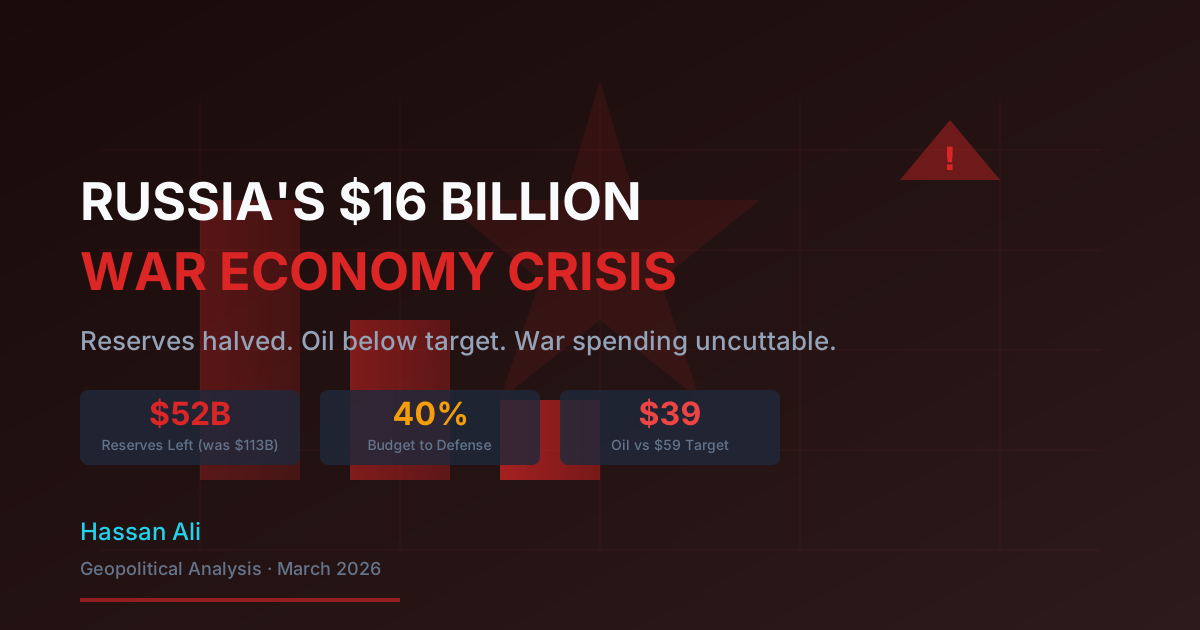
The 2026 budget assumed oil at around $59 a barrel. Russian Urals crude is trading closer to the high-30s to low-40s. Every dollar below that line punches a fresh hole in revenue.
At the same time, war spending never slowed — it accelerated:
- Defense outlays have roughly tripled since 2021
- By 2025 they were eating close to 40% of federal spending
- Tanks, shells, drones, wages, compensation payments — none of it optional, none of it productive
The result is ugly arithmetic. The 2025 deficit exploded to roughly 5.7 trillion rubles — five times the original plan. And now, to keep 2026 from spiraling immediately, officials need to find another 1.2 trillion rubles on short notice. That is not fiscal fine-tuning. That is emergency mode.
The Only Place Left to Look
Every discussion eventually circles back to one institution: the National Wealth Fund.
Before the war, its liquid portion stood near $113 billion — cash, gold, foreign currency. Real money. As of January 2026, liquid assets are closer to $52 billion. Almost half gone.
And that headline number flatters the situation. Much of the remaining fund is tied up in Chinese yuan and gold — assets that are harder to deploy quickly and more politically constrained.
To bridge current gaps, the Finance Ministry is selling foreign currency and gold almost daily. This is not saving for a rainy day. This is burning furniture to heat the house.
Analysts doing the math are blunt: keep this pace and the liquid portion of the fund runs dry in roughly 12 to 18 months. After that, choices get painful.
Who Is Managing the Damage
This scramble has faces.
- Anton Siluanov — the finance minister tasked with finding money without detonating the economy. Raise taxes too hard and growth collapses. Borrow too much and interest costs explode.
- Elvira Nabiullina — fighting inflation with interest rates near historic highs. Her tools work, but they also strangle civilian industry and make government borrowing brutally expensive.
- Vladimir Putin — whose political priority is unmistakable: the war gets funded first. Everything else adjusts.
That hierarchy explains the budget better than any spreadsheet.
How the Kremlin Is Trying to Plug the Hole
Three levers are being pulled simultaneously — all of them risky:
- Reserves — Gold and yuan from the National Wealth Fund liquidated at a pace unseen before the war. Buys time, not sustainability.
- Taxes — Higher levies on energy firms, higher VAT, higher exit taxes on foreign companies. Raises cash but suppresses consumption and shrinks the future tax base.
- Domestic borrowing — Massive issuance of government bonds at interest rates flirting with 20%. Crowds out private business and locks future budgets into heavier debt servicing.
None of these fix the underlying problem. They just delay the reckoning.
The Hidden Cost — A Hollow Economy
On paper, Russia still reports growth. Factories are busy. Wages in the defense sector are rising. But look closer at what that growth actually is:
- Shells that get fired
- Vehicles that get destroyed
- Infrastructure that never gets built
This is what economists quietly call “bad calories” — output that disappears without leaving productive assets behind. Meanwhile, civilian sectors are starving. Construction slows. Manufacturing outside defense contracts shrinks. Labor shortages worsen as young men disappear into the war.
The economy keeps moving — but it is running in place.
Why the 1.2 Trillion Rubles Matter So Much
This gap is small relative to Russia’s total budget. That is what makes it so revealing.
A state with healthy finances does not panic over $16 billion. It adjusts quietly. The fact that officials are scrambling tells you buffers are thin and flexibility is gone. Every ruble is now spoken for.
If oil prices stay below budget assumptions through early 2026, this hole widens. If reserves dip below psychological thresholds, confidence cracks. If borrowing costs rise further, debt dynamics turn hostile. At that point, the options narrow fast: print money, slash social spending, or impose tighter controls. None of those are politically painless.
What I Am Watching Next
Three signals matter more than official GDP numbers:
| Signal | Why It Matters |
|---|---|
| Urals oil vs. the $59 line | Stay below it and the deficit keeps bleeding |
| National Wealth Fund liquid assets | The real doomsday clock |
| Ruble policy | Controlled devaluation quietly taxes households while boosting export revenues |
This is not collapse. Not yet. But it is the end of the illusion that Russia can fund an open-ended war without consequence.
When a government starts scrambling for 1.2 trillion rubles, the war has already come home. And it does not leave quietly.
TL;DR
- Russia needs 1.2 trillion rubles immediately to balance early-2026 finances
- War spending and weak oil prices blew apart budget assumptions
- Liquid reserves in the National Wealth Fund are down by more than half
- Taxes and debt buy time but deepen structural damage
- The economy is growing on paper — and hollow underneath
Disagree? Have a different take? Subscribe to my newsletter and let’s argue — I respond to every email.