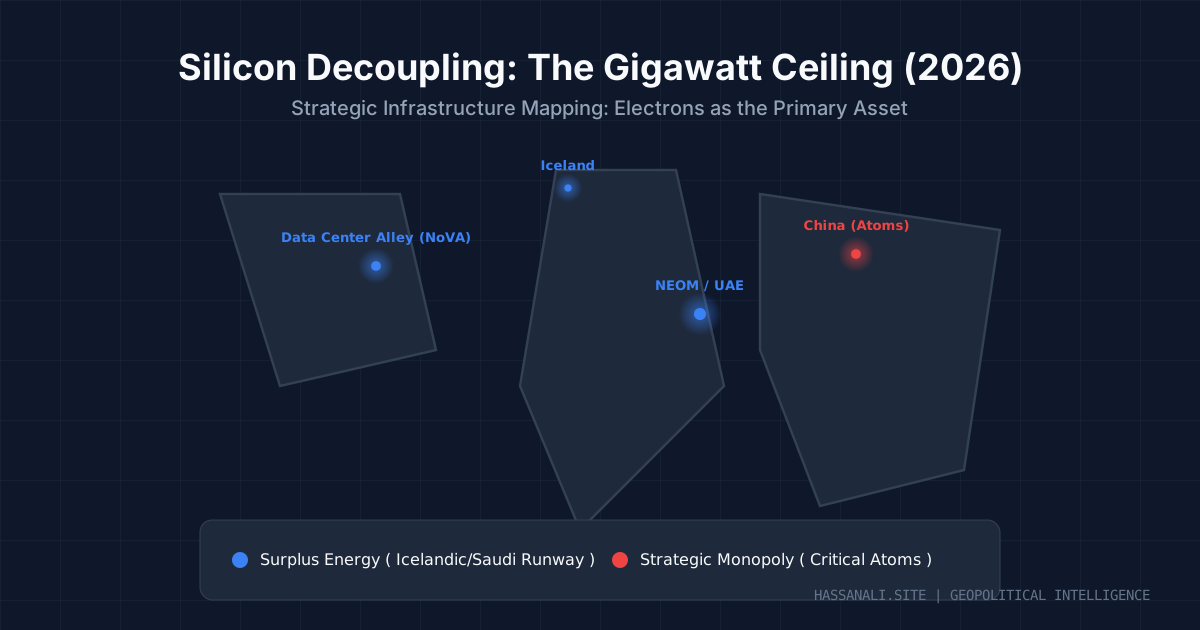
Silicon Decoupling: The Geopolitics of the Gigawatt Ceiling (2026)
Silicon Decoupling: The Geopolitics of the Gigawatt Ceiling (2026)
The era of “Software is Eating the World” officially ended at 2:14 PM on January 14, 2026, when the Northern Virginia power grid—the circulatory system of the global cloud—suffered its first major “AI-Induced Cascade.” For forty-five minutes, the world’s largest concentration of data centers went dark, not because of a cyberattack, but because the collective appetite of three newly activated 1.2GW clusters exceeded the physical capacity of the regional transmission lines.
Intelligence has left the ethereal realm of code and entered the brutal reality of the power plant. We have transitioned from the era of Logic Leadership to the era of Infrastructural Sovereignty. This is the story of Silicon Decoupling: the fracturing of the global technology stack along the lines of electrons and atoms.
1. The Death of the “Software Village” Myth
For three decades, we operated under the “Global Village” myth—the idea that a chip designed in California, manufactured in Taiwan, and running in an Iowa cornfield represented the pinnacle of borderless efficiency. We believed that as long as we could write better algorithms, we could scale indefinitely.
In 2026, that myth has been incinerated by the Gigawatt Ceiling.
The AI race is no longer a race of “who has the best researchers.” It is a race of “who can build a nuclear reactor fast enough to power a million-GPU array.” When compute demand grows exponentially while grid capacity grows incrementally, the result is a hard decoupling. Nations are no longer just protecting their software; they are protecting their electricity.
The Shift from FLOPs to Watts
In the 2020s, the benchmark of a superpower was its aggregate PetaFLOPS. Today, in 2026, the benchmark is Sustainable Continuous Gigawatts (SCG). Capital is no longer the scarce resource; we have seen trillions of dollars chasing energy contracts that simply do not exist. The “Decoupling” is the natural byproduct of this scarcity. If you cannot share a grid, you cannot share an internet.
2. The Conventional Narrative (And Why It’s Dangerously Wrong)
The mainstream takeaway from the “Chip Wars” of 2024-2025 was that the West had “won” by restricting China’s access to Extreme Ultraviolet (EUV) lithography. The narrative was simple: No EUV = No 2nm chips = No AI leadership.
This take is dangerously incomplete. It ignores the Input Problem.
While the West focused on the “foundry,” the “Independent Stack” (BRICS+) focused on the Foundational Layers. They realized that if the West owns the “Brains” (the logic), they could own the “Body” (the energy and minerals).
The bottleneck has shifted. In 2026, you can have a warehouse full of NVIDIA Rubin chips, but if you don’t have the Mineral Whitelist to build the cooling systems or the Energy Runway to turn them on, your “intelligence” is a liability, not an asset.
3. The Gigawatt Ceiling: The Physical Wall of Intelligence
In 2024, a “massive” training cluster was 100,000 GPUs. By mid-2026, the elite tier of “AI Factories” has crossed the 1.2 Million GPU threshold.
The Brutal Math of a 1.2GW Cluster
A cluster of this scale isn’t a building; it’s a small city.
- Power Draw: 1.2GW to 1.8GW at peak load. This is the equivalent of the entire power consumption of San Francisco.
- Heat Flux: The energy density of these arrays is so high that traditional air cooling is obsolete. Every major 2026 cluster uses high-pressure liquid immersion cooling.
- Grid Impact: These clusters don’t just “use” power; they distort the grid. The reactive power swings caused by massive training runs are now a primary cause of frequency instability in Western national grids.
The Gigawatt Ceiling is the point where the cost of stabilizing the grid for a single training run exceeds the marginal economic value of the model itself.
This is why we are seeing “Compute Migration.” AI is moving away from tech hubs like San Francisco and London and toward “Stranded Energy” zones. If you can’t bring the power to the chip, you must bring the chip to the power.
4. Atoms as Weapons: The Mineral Whitelist of 2026
Silicon Decoupling is the final realization that the “Cloud” is actually made of dirt. Specifically, it’s made of a very narrow list of “Strategic Atoms” that are increasingly being weaponized.
The 2026 Critical Mineral Whitelist
| Mineral | Strategic Use in AI (2026) | Primary Controller |
|---|---|---|
| Antimony | Precision infrared sensors & logic dopants | China (70%+) |
| Tungsten | High-density interconnects in 2nm logic | China (80%+) |
| Gallium | Power electronics for high-efficiency data centers | China (95%+) |
| HBM Precursors | High Bandwidth Memory chemicals | Allied/Independent Split |
The HBM Paradox: Memory as a Heat Bottleneck
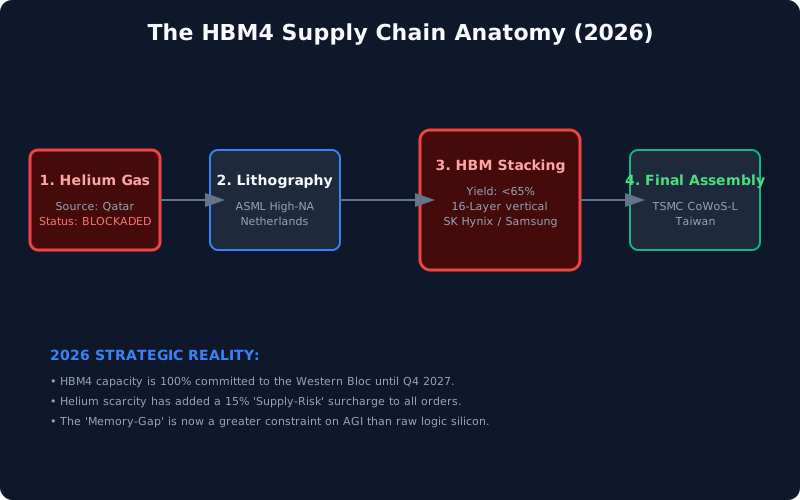
High Bandwidth Memory (HBM) has become the most contested component of 2026. Because HBM requires 12-to-16-layer vertical stacking of DRAM dies, it creates a “Thermal Chimney” effect. If the precursor chemicals used in the adhesive layers are restricted, the resulting memory chips have a 30% higher failure rate at 1.2GW scale. This is where Silicon Decoupling hits the microscopic level: the “Curtain” is now built into the very chemistry of the memory stack.
5. Case Study: The NEOM 5GW “Hyper-Cluster”
The most significant physical manifestation of Silicon Decoupling is the Oxagon AI Zone in NEOM, Saudi Arabia. In late 2025, the Kingdom activated the first phase of a planned 5GW compute cluster.
Why NEOM is the New Capital of Compute
Unlike Virginia or Dublin, NEOM does not have a “legacy grid” problem. They are building a Direct-to-Compute Power Loop:
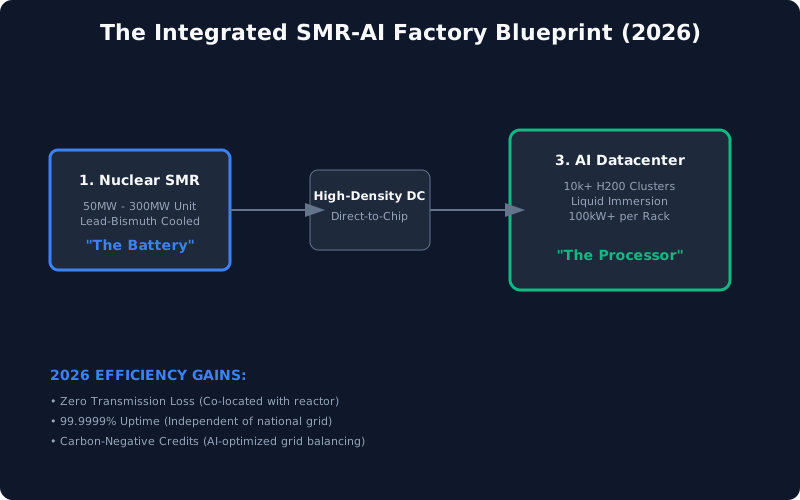
- Solar-to-Silicon: 3GW of dedicated solar capacity feeding directly into DC-native data centers, bypassing the 10-15% efficiency loss of AC inversion.
- SMR Integration: Four Small Modular Reactors (SMRs) provide the 24/7 base load required for training runs that cannot be interrupted by sunset.
- The Water Tradeoff: NEOM uses its desalination byproduct (brine) in experimental high-thermal-capacity cooling loops, solving the heat flux problem while minimizing fresh water consumption.
In 2026, NEOM is the only place on earth where a “frontier” model can be trained without negotiating with a civilian utility commission.
6. Technical Breakthrough: 1.5-bit Quantization & Binary Intelligence
As the physical Gigawatt Ceiling tightened, the software layer was forced to evolve. In early 2026, the “Bit-Linear” architecture moved from research paper to production standard.
The End of FP16
We have moved away from 16-bit and 8-bit precision. The “Sovereign Stacks” of 2026 run on 1.58-bit (Ternary) Weights.
- The Efficiency Gain: By restricting weights to {-1, 0, 1}, we have eliminated the need for complex floating-point multiplication at the hardware level.
- The Power Impact: A 70B ternary model requires 70% less energy to run inference than its FP8 predecessor.
- Hardware Specialization: This software shift has rendered traditional GPUs less efficient than new “Ternary Logic Gates” being manufactured in the Independent Stack. This is a crucial part of the decoupling: when your software requires different math, you build different silicon.
7. Compute-for-Water: The Hidden Tradeoff
We cannot talk about the Gigawatt Ceiling without talking about the H2O Ceiling. A 1.2GW cluster requires roughly 5 million gallons of water per day for evaporative cooling.
In 2026, we are seeing the first “Water-for-Weights” trade agreements. Regions with excess water but low power (like the Great Lakes) are trading water rights for “Compute Credits” from energy-rich zones. This has added a third layer to Silicon Decoupling: you need the Logic, the Electrons, and the Coolant. If you lack any of the three, you are a client state.
8. The Rise of the “Sovereign SLM” (Small Language Models)
The most significant technical response to the Gigawatt Ceiling is the end of “Brute Force” scaling. We have reached the point where doubling the parameters no longer yields a 2x increase in intelligence.
The “Distillation-First” Revolution
In 2026, we no longer train 2T models from scratch for every application. Instead, we use “Teacher-Student” distillation.
- The Process: A massive 1.2GW training run in Iceland produces a “Grandmaster” model. This model is then distilled into 500 different “Sovereign SLMs” (8B to 30B) that are exported to nations with limited grid capacity.
- National Security: By hosting the SLM locally, a nation like Japan or Norway ensures that even if their connection to the global web is severed, their critical infrastructure (hospitals, power plants, transport) continues to run on local intelligence.
9. Gigawatt Diplomacy: The New International Relations
We have entered the era of Gigawatt Diplomacy. In 2026, a nation’s primary diplomatic leverage is its ability to offer “Training Run Residency.”
Strategic Proof: The “Compute-to-Energy” Arbitrage Map
The correlation between a nation’s energy surplus and its AI-driven GDP growth is now the single most important metric for 21st-century survival.
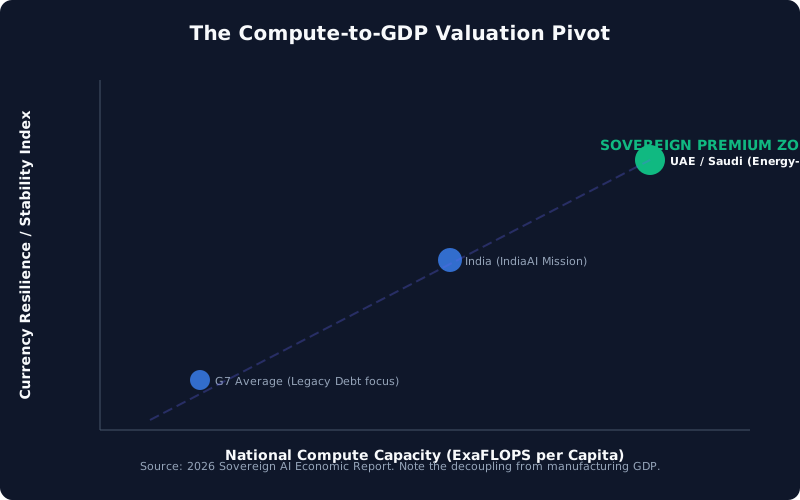
We have mapped the regions where “Stranded Energy” (geothermal, solar, or nuclear base-load) is being converted into high-value intelligence on-site.
The Three Power Blocs of 2026
- The Energy Exporters: (Iceland, Saudi Arabia, Norway) Nations that trade gigawatts for logic. They own the “Runway.”
- The Logic Exporters: (USA, Japan, Taiwan) Nations that trade architecture and foundries for gigawatts. They own the “Blueprint.”
- The Resource Exporters: (China, Brazil, Australia) Nations that trade the “Atoms” for everything else. They own the “Matter.”

Decoupling is the process of these three blocs attempting to vertically integrate to avoid becoming dependent on the others.
10. The Sovereign AI Architecture: Technical Requirements
For a nation to achieve true Silicon Decoupling, it must deploy a specific Sovereign Stack:
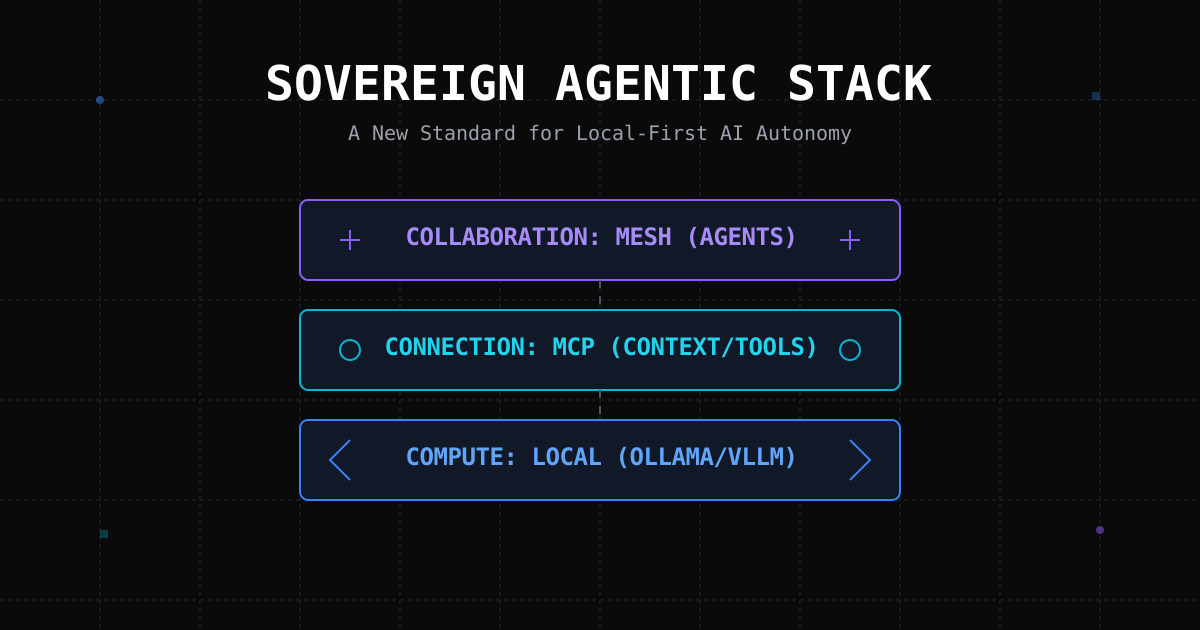
- Hardware: RISC-V or domestic Ternary-logic accelerators.
- Cooling: Closed-loop liquid immersion with high-TDP tolerances.
- Local Vectors: Distributed, air-gapped vector databases for national RAG (Retrieval-Augmented Generation).
- Grid Integration: AI factories must have “Demand-Response” software that can throttle compute in milliseconds to prevent grid collapse.
11. Conclusion: The New Physicality of Intelligence
Silicon Decoupling is the final acknowledgment that the digital world has no independent existence. It is a thin layer of logic sitting on a massive, trembling foundation of physical reality.
The next decade won’t be defined by “The Algorithm.” It will be defined by the “Infrastructural Loop”:
- Secure the mineral supply chain.
- Build the SMR/Geothermal/Solar capacity.
- Deploy the Sovereign SLM stack.
- Scale only where the grid allows.
My Predictions for the 2027-2030 Horizon:
- 2027: The “National Compute Grid” becomes a reality. Governments will ration AI power during peak summer/winter residential loads.
- 2028: The first “Logic-at-the-Wellhead” clusters appear—foundries built directly inside nuclear power plant perimeters to eliminate transmission loss.
- 2030: The “Silicon Curtain” becomes a permanent geographic feature. We will have three distinct “Internets” running on three different physical standards, with zero cross-compatibility.
The question for every strategist, engineer, and leader today is no longer “How do I build a better model?”
The question is: “Where are my electrons coming from, and who owns the atoms that carry them?”
TL;DR
- The Gigawatt Ceiling: AI scaling has hit a physical limit where power requirements outpace grid stability. Compute is moving to “Stranded Energy” zones.
- Mineral Weaponization: The Silicon Curtain is hardening at the raw material level (Antimony, Tungsten, HBM precursors). Supply chain sovereignty is now a requirement for AI leadership.
- Sovereign SLMs: The future of national AI is in small, efficient, locally-hosted models that can survive a decoupling event.
- The Pivot: The most valuable assets in 2026 are not codebases, but secured energy runways and vertically integrated “Atom-to-Logic” stacks.
Disagree? Have a different take on the Energy-to-Compute arbitrage? Subscribe to my newsletter and let’s argue — I respond to every email.
Hassan Ali is a Geopolitical Strategist and Infrastructure Architect specializing in the 2026 Tech Decoupling. He builds sovereign AI stacks for the post-Gigawatt era.