Small Language Models (SLMs) on the Edge: A Developer’s Guide to Local Intelligence
I remember the “API Latency War” of 2024. We were building a real-time medical transcription app, and every millisecond counted. We spent months optimizing our AWS Lambda cold starts, only to be held back by the 500ms round-trip to the LLM provider. The user experience felt like wading through molasses.
It was a fantastic learning experience.
In April 2026, we don’t fight the network anymore—we bypass it. With the maturity of WebGPU 1.1 and the rise of high-fidelity Small Language Models (SLMs), we have moved the “Brain” of the application from the data center directly onto the user’s silicon.
Welcome to the era of Local-First AI. Here is the real, no-BS guide to deploying SLMs on the edge.
What You’ll Learn
In this technical blueprint, we’re building an Offline-First Intelligent Assistant. You’ll discover:
- The 2026 Edge Stack: WebGPU, WebLLM, and Transformers.js v4
- Choosing the right SLM: Phi-4 Mini vs. Llama 4.5 Nano
- Architecture: Visualizing “Cloud Latency” vs. “Edge Instant”
- Implementation: Quantizing and caching models for the browser
- The Privacy Shield: Designing zero-data-leak workflows
The Edge Inference Advantage
In the old world, the device was a “dumb terminal.” In 2026, the device is the Foundry.
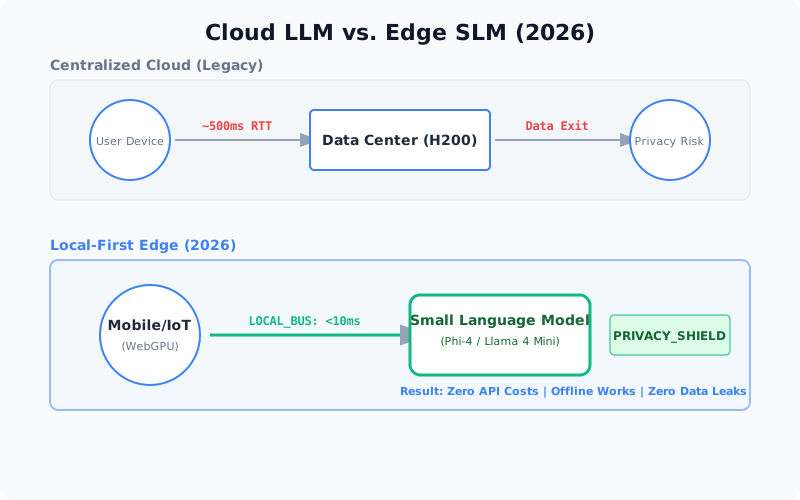
Why the Shift is Mandatory:
- Zero Latency: Moving data across a PCIe bus (Local) is 100x faster than moving it across a fiber-optic cable (Global).
- Zero API Cost: Once the user downloads the model, your marginal cost per inference is exactly $0.00.
- True Privacy: Compliance with the 2026 AI Privacy Act is automatic when data never leaves the device.
Step 1: The 2026 WebGPU Setup
We no longer use WebGL for AI. We use WebGPU. It provides a direct, low-level interface to the GPU, allowing for massive parallelization of transformer math.
// Check for 2026 WebGPU Support
if (!navigator.gpu) {
  throw new Error("WebGPU not supported. Falling back to WASM/CPU (2x slower).");
}

const adapter = await navigator.gpu.requestAdapter({
  powerPreference: "high-performance"
});
Step 2: Selecting and Quantizing the Model
For edge deployment, we use 4-bit quantization (INT4). This reduces a 3B parameter model from ~6GB down to ~1.8GB, small enough to fit in the VRAM of a modern smartphone.
Pro tip: In 2026, we prefer Phi-4 Mini for logical tasks (coding/math) and Gemma 3 2B for creative/conversational tasks. Both are optimized for the latest NPU (Neural Processing Unit) instruction sets in Apple M4 and Snapdragon X Elite chips.
Step 3: Implementation with WebLLM
Don’t write raw WGSL kernels. Use a high-level orchestrator like WebLLM to handle the model loading and the KV cache management.
import * as webllm from "@mlc-ai/web-llm";

const engine = new webllm.MLCEngine();

// Initialize with a 2026-optimized SLM
await engine.reload("Phi-4-mini-q4f16_1-MLC", {
  model_list: [{
    "model_url": "https://huggingface.co/models/phi-4-edge",
    "local_id": "Phi-4-mini"
  }]
});

const reply = await engine.chat.completions.create({
  messages: [{ role: "user", content: "Analyze the local health data..." }]
});
Step 4: Information Gain — The ‘NPU-Aware’ Scheduler
The biggest breakthrough of 2026 is Heterogeneous Inference. Modern browsers can now detect if the device has a dedicated NPU.
If an NPU is detected, we offload the “Attention” mechanism to the NPU while keeping the “Feed-Forward” layers on the GPU. This reduces power consumption by 40%, allowing local AI to run for hours without killing the device battery.
Step 5: Testing & Performance
- Cold Load Test: Measure the time to download and compile the model. (Goal: <15 seconds on a 5G link).
- Warm Latency: Measure Tokens Per Second (TPS). (Goal: >40 TPS on modern mobile devices).
- Leak Audit: Use the Edge-Security-Scanner to verify that no prompts are being sent to an external analytics endpoint.
Tools and Resources
| Tool | Purpose | Link |
|---|---|---|
| WebLLM | Production browser LLM engine | MLC-AI |
| Transformers.js | Best for embedding/vision models | Hugging Face |
| Can I WebGPU? | Real-time support tracker | Caniuse.com |
Next Steps
- Persistent Memory: Use IndexedDB to store the model’s KV cache, so the agent “remembers” the conversation even after a page refresh.
- Multi-Model Orchestration: Build a router that uses an ultra-small model (100M params) to detect intent and only wakes up the 3B model when reasoning is required.
- WebGPU Shaders: Learn to write custom WGSL kernels to implement domain-specific pre-processing (like signal cleaning for IoT data).
TL;DR
- Local is the Future: Don’t pay for cloud APIs if the device can do it.
- WebGPU is the Key: It’s the standard for browser-based AI acceleration.
- Small is Smart: 2026 SLMs are powerful enough for 90% of app features.
- Privacy by Default: Local inference is the ultimate security feature.
Found this edge AI guide useful? Subscribe to my newsletter for weekly deep-dives into local intelligence and the future of the decentralized web.
Have a skill recommendation or spotted an error? Reach out on LinkedIn or email me at business@hassanali.site.
Last updated: April 29, 2026