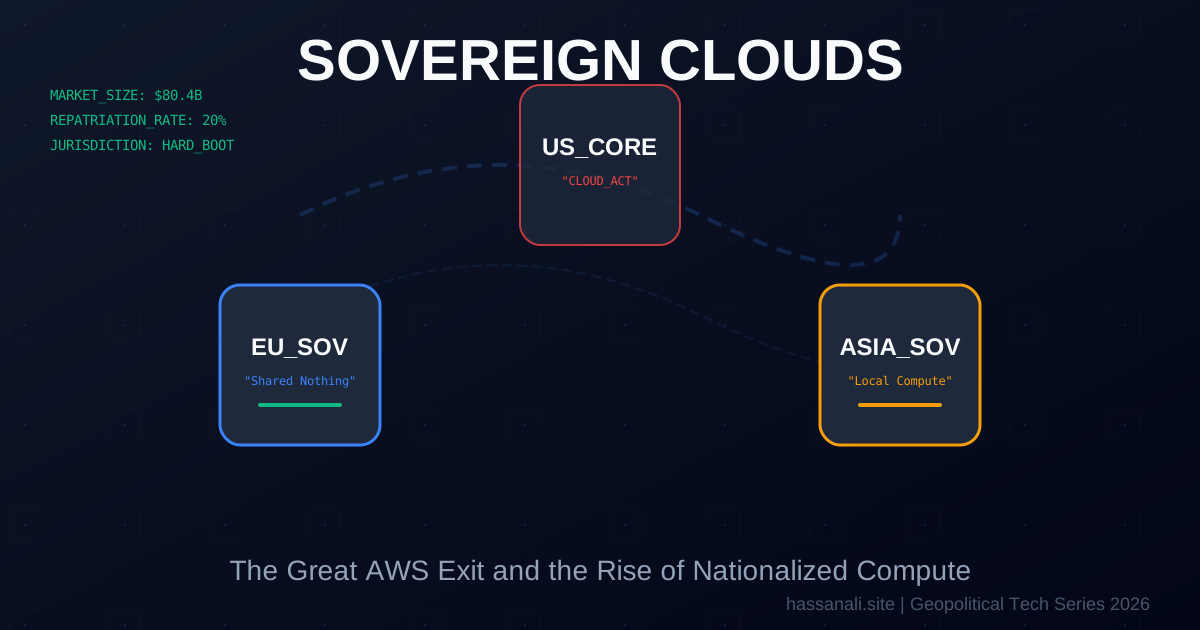
Sovereign Clouds: The Great AWS Exit and the Transition to Nationalized Compute Blocs
I remember the “Infinite Cloud” era of 2018. We believed that data was a liquid asset that could flow anywhere. We thought that as long as our data was encrypted, the physical location of the server didn’t matter. We believed that AWS, Microsoft, and Google were neutral utilities that existed above the fray of national politics.
It was a fantastic learning experience.
In April 2026, that myth has been shattered by the Sovereignty Earthquake. With the August deadline for the EU AI Act looming and the US CLOUD Act being used as an extraterritorial legal weapon, the geography of your data has become as important as its latency.
Welcome to the era of Cloud Geopatriation. The “World Computer” is fracturing into nationalized compute blocs.
The Death of ‘Data Residency’
For a decade, we talked about “Data Residency”—ensuring the .db file was on a server in Frankfurt. But in 2026, residency is considered “Sovereignty Lite.” The new standard is Jurisdictional Isolation.
Nations have realized that if your cloud’s “Control Plane”— the dashboard that turns the servers on and off—is managed from Seattle or Beijing, you don’t truly own your data. If a foreign court can subpoena your metadata or “turn off” your national AI models during a trade dispute, you are a digital colony.
The ‘Shared Nothing’ Architecture
The breakthrough of 2026 is the Shared Nothing Sovereign Node. This is the foundation of the newly launched AWS European Sovereign Cloud.
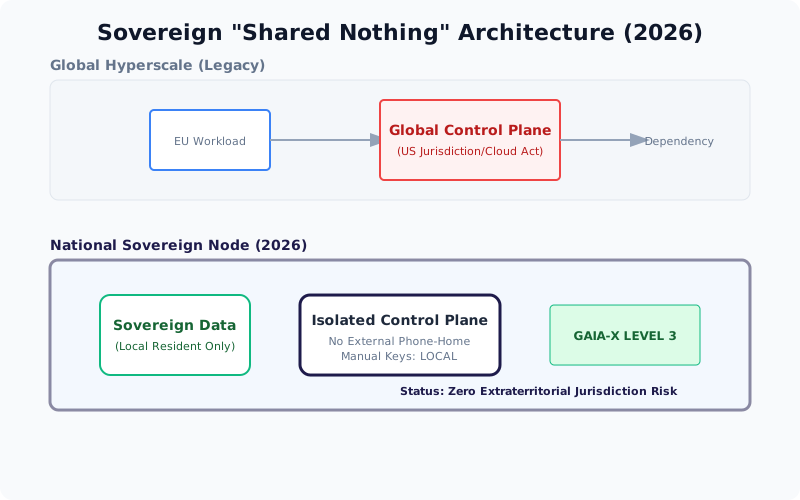
The Three Pillars of Hard Sovereignty:
- Isolated Control Plane: The sovereign region has its own independent billing, identity, and management systems. There is no “Phone Home” to the global US-based console.
- Resident-Only Operations: Every engineer with access to the physical hardware or the root logic must be a citizen and resident of the local jurisdiction.
- Hardware Repatriation: In 2026, “Sovereign” means the hardware is owned by a local entity and merely licensed from the hyperscaler, creating a legal firewall against foreign subpoenas.
The 2026 Geopatriation Market: By the Numbers
According to Gartner’s April 2026 report, 20% of critical enterprise workloads have moved from global public regions to sovereign nodes this year.
- Market Size: The sovereign IaaS market has hit $80.4 billion.
- The Premium: Companies are paying a 73% “Sovereignty Tax” to move.
- The Velocity Gap: Sovereign clouds typically offer only 90 core services compared to the 200+ available in the global AWS “US-East-1” region.
Information Gain: The ‘Sneha Loophole’ Closure
The most significant strategic move of 2026 was the closing of the “Encryption Loophole.” For years, US hyperscalers argued that if a customer held their own keys (BYOK), the data was sovereign.
The 2026 European Cloud Sovereignty Act rejected this, ruling that metadata (who accessed what, when, and from where) is itself a sovereign asset. This ruling has forced a massive migration of financial and healthcare metadata away from US-based providers to EU-native firms like OVHcloud and STACKIT.
The Verdict
In 2026, the “Global Cloud” is a legacy concept. We are moving toward a Splinternet of Compute. If your organization operates in high-risk sectors like Finance, Defense, or AI, you can no longer afford to be “Cloud Agnostic.” You must be Jurisdictionally Aware.
The “Great AWS Exit” isn’t an exit from technology; it’s an exit from Extraterritorial Dependency.
Found this geopolitical cloud analysis useful? Subscribe to my newsletter for weekly deep-dives into data sovereignty and the future of the decentralized web.
Have a skill recommendation or spotted an error? Reach out on LinkedIn or email me at business@hassanali.site.
Last updated: April 29, 2026