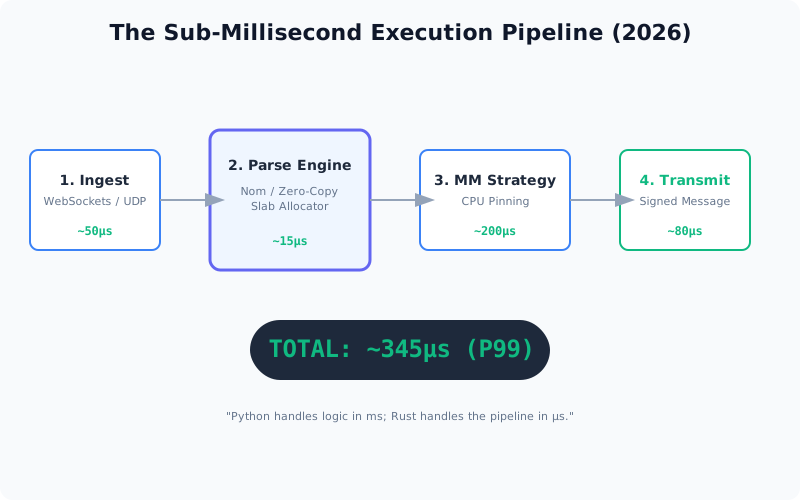
Sovereign HFT: Building Ultra-Low Latency Trading Stacks Without Cloud Telemetry
In the world of high-frequency trading, there is a famous saying: “Latency is the new tax.” But in 2026, we’ve identified a second, more dangerous tax: The Telemetry Tax.
Every time you send a market signal to a cloud-based LLM for sentiment analysis or order-book prediction, you are effectively “leaking” your alpha to a third-party provider. For the serious trader, this is unacceptable.
This is why the elite are moving toward Sovereign HFT—trading stacks built on local, owned silicon that execute at sub-millisecond speeds without a single byte of data leaving the building.
What You’ll Learn
In this technical blueprint, we’re bridging the gap between sovereign engineering and high-stakes financial markets.
- The Zero-Jitter Goal: Why local NPUs beat cloud APIs 100% of the time.
- The Rust Advantage: Using Rust 2024 for non-blocking, zero-copy trading loops.
- Inference on the Path: Integrating local models into your “Hot Path” via the Burn framework.
- Hardware Co-location: Building your own “AI Factory” inside the data center.
The Problem with the “Cloud Hook”
Traditional algorithmic trading bots often rely on webhooks or cloud APIs for their “intelligence.” This creates two massive bottlenecks:
- Network Jitter: Your order execution is at the mercy of the public internet. A 50ms spike in latency can turn a profitable trade into a liquidation event.
- Telemetry Leakage: Cloud providers aggregate user data to improve their models. If your bot is consistently winning on a specific “alpha signal,” the model provider eventually learns that signal.
In Sovereign HFT, we replace the cloud hook with a local NPU cluster.
Layer 1: The Reactive Loop (Rust + Kernel Bypass)
The foundation of a sovereign stack is a high-performance reactive loop. In 2026, we use Rust 1.85+ with the io_uring kernel bypass. This allows your trading bot to read market data directly from the network card, bypassing the Linux kernel’s overhead.
// Example: Zero-copy market data parsing in Rust 2024
#[repr(C)]
#[derive(zerocopy::FromBytes, zerocopy::AsBytes)]
struct MarketTick {
    price: u64,
    quantity: u32,
    timestamp: u64,
}
By using zero-copy deserialization, we ensure that the “tick-to-trade” path is free of memory allocations, eliminating the risk of Garbage Collection pauses.
Layer 2: Local NPU Inference (The “Brain”)
The “Brain” of your stack is a cluster of NPUs (Neural Processing Units) or Tensor Cores (RTX 50-series). Instead of a general-purpose LLM, we deploy Micro-Models (<1B parameters) optimized for specific HFT tasks:
- Order-Book Imbalance Detection: Predicting the next move based on buy/sell pressure.
- Micro-Burst Prediction: Identifying high-volatility events before they trigger.
Using the Burn or Candle frameworks in Rust, these models run with <50μs latency. This is “On-Path AI”—the model is so fast it can be part of the execution loop itself.
Layer 3: The Sovereign Management Plane
While the “Hot Path” is focused on speed, the “Management Plane” is focused on AI independence. Using the Sovereign Agentic Stack architecture, we deploy background agents to:
- Monitor Drift: Ensure the AI model isn’t hallucinating signals.
- Self-Heal: Automatically restart the trading loop if system jitter exceeds 100μs.
- Risk Gates: Execute hardware-backed “Guardian” checks to prevent catastrophic capital loss.
Conclusion: Own Your Alpha
The era of “Renting a Trading Bot” is over. If you want to survive the 2026 bull run, you must own your infrastructure. Sovereign HFT isn’t just a faster way to trade; it is the only way to ensure that your strategies remain your private property.
TL;DR
- Local beats Cloud: Sub-microsecond latency requires local NPUs.
- Stop the leaks: Zero telemetry ensures your alpha stays yours.
- Rust is the engine: Use Rust 2024 for memory-safe, non-blocking loops.
- The blueprint is ready: Build your sovereign stack today to lead the market tomorrow.
Ready to see a real-world implementation? Check out my Sovereign MT5 Trading Bot for a full Python/MetaTrader 5 blueprint, or dive into my Rust HFT Guide for the low-level details.