
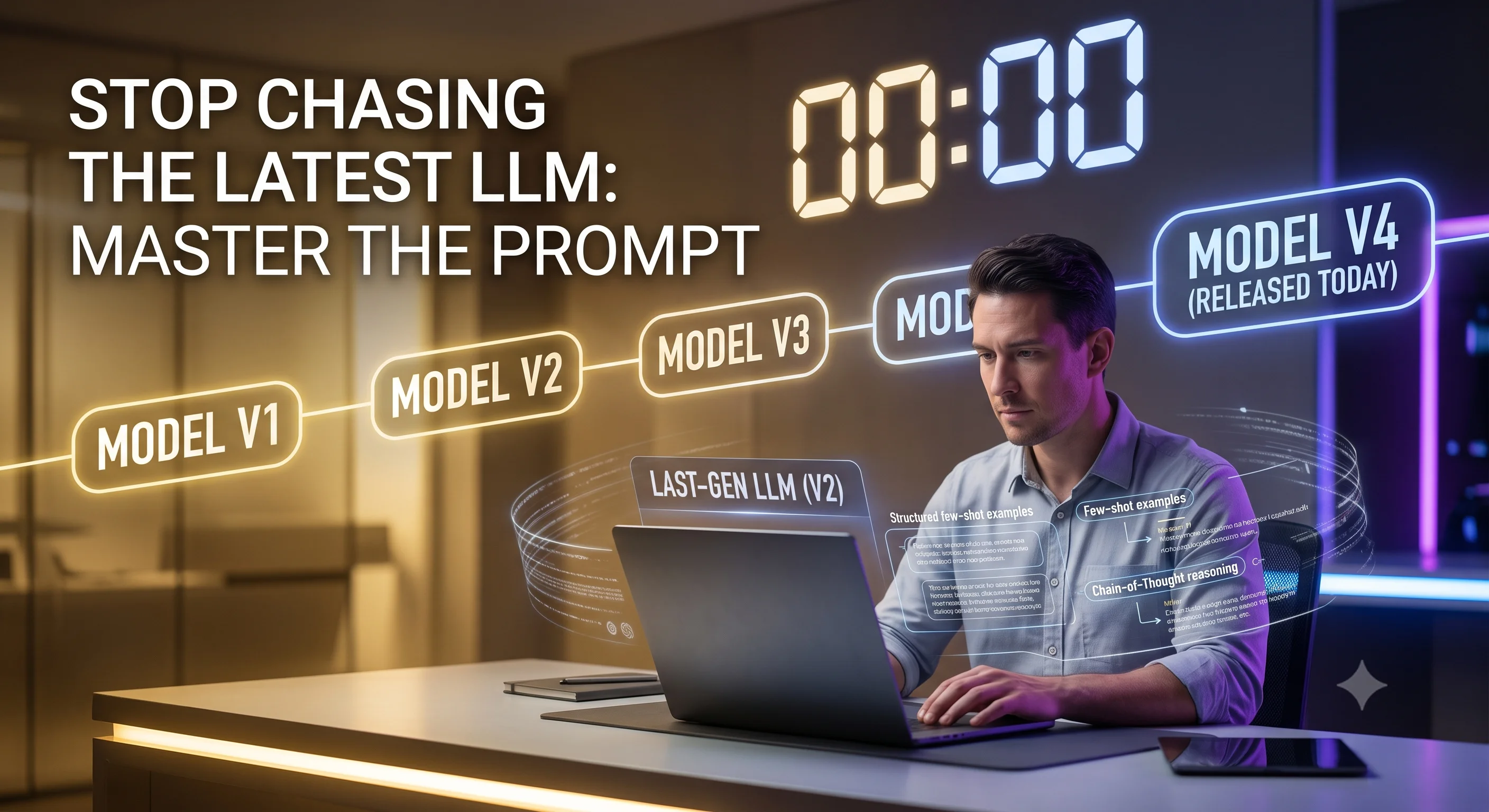
There is a quiet tax being paid across startups, dev teams, and solo creators every month. It doesn’t show up as a single massive invoice, but as dozens of individual API keys, premium tier subscriptions, and upgraded enterprise seats—all purchased in pursuit of the newest flagship Large Language Model (LLM).
The pitch is always compelling: This new model boasts a 3% increase on standard benchmarks, double the context window, and better reasoning capabilities.
So, users upgrade. They dump their existing setups, migrate their workflows, and willingly pay twice as much per token or monthly subscription. Yet, three weeks into using the latest model, a familiar frustration returns: outputs feel generic, hallucinations still happen, and complex multi-step instructions break down.
The problem isn’t the model you’re using. The problem is the assumption that throwing money at a newer model will fix poor technique.
The Era of Diminishing Returns
In the early days of generative AI, moving from basic models to frontier systems felt like night and day. Early upgrades fundamentally transformed capability.
Today, frontier AI development has hit a steep law of diminishing returns. The gap between the absolute newest release and a model released six to twelve months ago is no longer a canyon—it’s a minor incremental step.
Capability
   ▲                                    (Flagship Model - Top Price)
   │                                           ┌───────────►
   │                                     ┌─────┘
   │                              ┌──────┘ (Last-Gen Model - Bargain Price)
   │                       ┌──────┘
   │                ┌──────┘
   │         ┌──────┘
   └─────────┴───────────────────────────────────────────────► Time / Cost
               Early Era: Big Jumps | Today: Incremental Tweaks
When you pay a premium for the newest flagship model, you aren’t paying for a ten-fold leap in intelligence. You are paying a huge markup for tiny improvements at the extreme edges of complex reasoning. For 95% of real-world application writing, coding, data processing, and brainstorming, last generation’s flagship models—or even current-generation “mini” models—are far more than capable enough.
The Real Lever: Optimizing the Tool at Hand
If you give a skilled craftsman a mid-tier tool, they will build a masterwork. If you give an amateur the most expensive power tool on the market, they will still make a crooked cut.
Instead of constantly chasing model releases, investing time into mastering techniques yields significantly better results—often at a fraction of the cost.
1. Harness Engineering & Context Structuring
A slightly older model supplied with clean, structured context will outperform a cutting-edge flagship model fed a messy, ambiguous wall of text.
- System Instructions: Give the model a defined persona, strict negative constraints, and clear output rules.
- Few-Shot Prompting: Provide 2–3 concrete examples of exact input-to-output pairs. Demonstrations beat long explanation paragraphs every time.
- Delimiters: Use clear tags (like XML, Markdown, or JSON block structures) to separate your instructions, context, and variable inputs.
2. Multi-Turn Chain-of-Thought
Expecting any LLM—no matter how new—to solve a complex, 10-step problem in a single prompt is asking for failure. Breaking tasks down into modular, sequential steps eliminates most errors:
| Execution Method | How It Works | Typical Result |
|---|---|---|
| Monolithic Prompting | Single prompt asking for analysis, strategy, draft, and formatting all at once. | Generic, shallow, missed constraints. |
| Chained Execution | Step 1: Outline → Step 2: Critique → Step 3: Draft Section A → Step 4: Polish. | High precision, accurate, fully customized. |
3. Harnessing Cheap, Specialized Models
Instead of running every single request through a top-dollar reasoning model, build systems that delegate:
Use small, fast models for formatting, classification, extraction, and simple drafting. Reserve heavy reasoning for the precise steps that actually require high-level logic.
Stop Upgrading, Start Mastering
The temptation to buy into the hype of every new model release is strong. Marketing teams excel at making you feel as though your current tools became obsolete overnight.
They didn’t.
The models sitting right in front of you—the ones you already have access to—are capable of extraordinary output if you take the time to learn how to drive them effectively. Stop draining your budget chasing the newest version badge. Master prompt structure, build better workflows, and optimize your techniques.
The bottleneck isn’t the model. It’s how you use it.
If you found this useful, subscribe to my newsletter below for more AI research, practical prompt engineering techniques, and no-BS tech insights.