
I remember the first time I ran claude code on a production-scale repo. It was magical, but expensive. Within two hours, I had burned through $40 in API credits just to fix linting errors and re-index a few modules.
The problem wasn’t the AI—it was the orchestration. We were using a 200-billion parameter model to do the work of a regex script.
By early 2026, the elite developer community has solved this with Ruflo (developed by ruvnet on GitHub). It is the “nervous system” that transforms Claude Code from a lone-wolf tool into a High-Performance Hive Mind.
The Architecture of Sovereignty: Why Ruflo is Necessary
In the Sovereign Agentic Stack, we prioritize operational leverage. Ruflo provides this by inserting an intelligent routing layer between your terminal and the LLM.

Unlike standard “Agent Handoffs,” Ruflo uses a Swarm Topology. When you give a goal like “Refactor the auth layer and audit for SQLi,” Ruflo doesn’t just ask Claude. It spawns a parallel fleet:
- The Architect: Maps the dependencies.
- The Coder: Performs the refactor.
- The Security Auditor: Runs the SQLi vulnerability scan.
- The Tester: Validates the fix in a dedicated worktree.
Phase 1: The WASM “Agent Booster” (Zero-Latency Transforms)
The secret sauce of Ruflo v3.6 is the Agent Booster. By compiling common engineering tasks into WebAssembly (WASM) kernels, Ruflo handles 70% of the “labor” locally on your machine.
- Speed: Non-LLM tasks complete in <10ms.
- Cost: Reduces token usage by ~85% by eliminating “chitchat” for formatting and syntax checks.
- Privacy: Sensitive code transformations happen in a local Rust-based sandbox.
Phase 2: Building the Hive Mind (GOAP Planning)
Ruflo uses Goal-Oriented Action Planning (GOAP)—a technique borrowed from high-end game AI (like F.E.A.R.). Instead of following a rigid prompt, the agents look at the “World State” (your codebase) and the “Goal,” then calculate the shortest path of actions to reach it.
The Plugin Marketplace: 32+ Native Capabilities
Ruflo isn’t just for code. Its plugin system allows agents to interact with the real world.
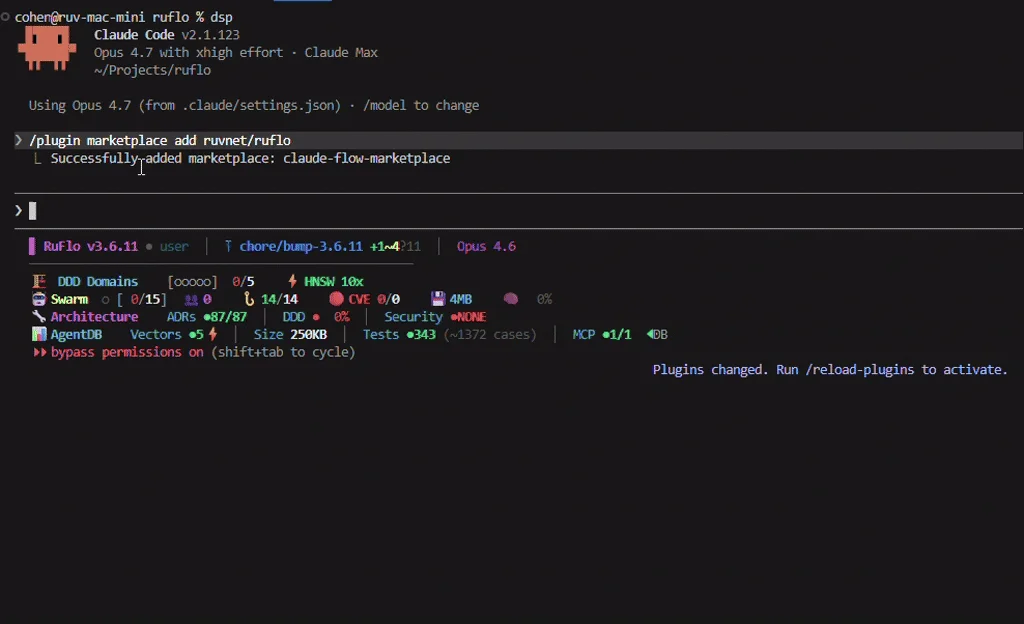
Whether it’s browser automation via Playwright or real-time AI Trading Bot execution, Ruflo agents can be extended with specialized “skills” that persist across sessions.
Phase 3: Persistent Memory (RuVector PostgreSQL Bridge)
The biggest weakness of vanilla AI agents is amnesia. Once the terminal session ends, the context is gone.
Ruflo solves this via RuVector—a high-speed PostgreSQL/pgvector bridge. It creates a “Long-Term Memory” (LTM) for your project. If you solved a specific dependency hell three months ago in a different repo, your Ruflo agents will “remember” the solution and apply it to the current task.
This is the core of Agentic Long-Term Memory, and it’s what separates “Assistants” from “Teammates.”
Phase 4: Setting Up Your Sovereign Swarm
Ready to deploy? Here is the 2026 “Quickstart” for Ruflo:
- Installation:
claude mcp add ruflo -- npx -y ruflo@latest - Configuration: Define your “Agent Fleet” in
ruflo.config.json. We recommend a Barbell Strategy: Use high-reasoning models (Claude 3.7 Sonnet) for the “Architect” and local models (Llama-3-8B) for the “Unit Tester.” - The First Run: Use the
flocommand to start the swarm.flo "Refactor the API and generate docs"
The Bottom Line
In the 2026 Agent-to-Agent Economy, the developers who win are those who own the Orchestration Layer.
Ruflo isn’t just an extension; it’s a paradigm shift. By moving away from linear chat and into parallel, self-learning swarms, you achieve a level of technical throughput that was previously reserved for entire engineering teams.
Don’t just code. Orchestrate.
Want to dive deeper into the math of swarm consensus? Join the discussion on the Ruflo GitHub. For more guides on elite agentic engineering, subscribe to the newsletter below.