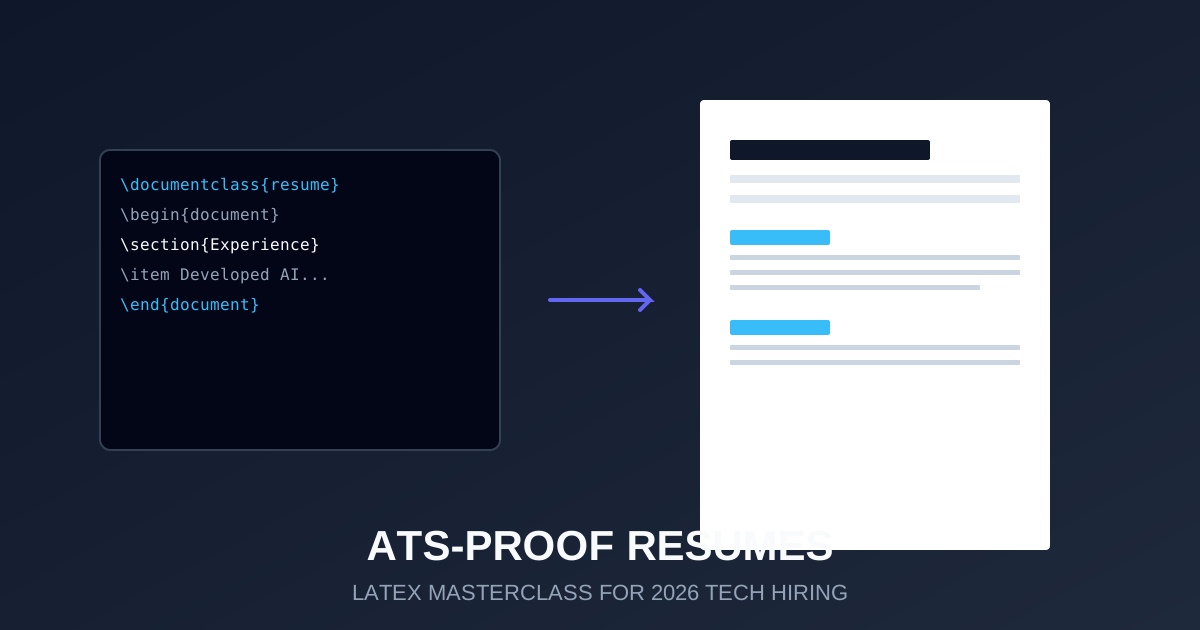
The Developer’s Resume Paradox: Building ATS-Proof LaTeX Resumes for 2026
I remember my first “beautiful” resume. It was 2023, and I had spent three days in Canva building a two-column masterpiece with progress bars for my skills and a custom-branded color palette. I was proud of it.
I sent it to 50 companies. I got exactly zero calls.
It took a coffee chat with a senior recruiter to realize I had committed the ultimate developer sin: I had over-engineered for the human, and under-engineered for the machine.
In 2026, where Agentic SEO rules the visibility of web content, the same logic applies to your career. If the AI recruiter (the ATS) can’t parse your data, you don’t exist.
Welcome to the world of LaTeX Resumes.
The 2026 ATS Reality: Recruitment is an NLP Problem
In the landscape of 2026, recruiters rarely “read” resumes in the first pass. Instead, systems like Workday AI and Greenhouse use Semantic Natural Language Processing (NLP) to extract “Entities” (Skills, Titles, Years) and rank you against a job description.
The problem with graphic editors (Canva, Figma, Photoshop) is that they export text as “floating boxes.” To a human, it looks like a sidebar. To a machine, the text in that sidebar might be injected right in the middle of your “Work Experience” block, turning your professional history into a jumbled mess of keywords.
Why LaTeX is the Gold Standard for Tech Resumes
LaTeX is not just a typesetting system; it’s a structured data format that happens to render a PDF.
- Linear Text Layers: LaTeX generates a predictable, top-to-bottom text layer.
- Metadata Integrity: It preserves the semantic relationship between a section header and its content.
- Signal of Technical Literacy: To a tech lead, a LaTeX resume says: “I understand version control, structured documentation, and precision.”
Phase 1: Choosing Your 2026 Template
In 2026, “Fancy” is a liability. You want High Information Density.
The “Jake’s Resume” Paradigm
If you look at r/resumes or talk to any FAANG engineer, one name comes up: JakeGut. His single-column template is the “Winning Formula” for 2026.
Why it works:
- No sidebars: Pure linear flow.
- Standard Packages: Uses
latex-resumeor simplearticleclass. - Itemize Blocks: Perfectly maps to how ATS parsers identify “Responsibilities.”
Phase 2: The Technical “Safety” Layer
Even in LaTeX, you can fail the parser if you aren’t careful. Here are the three technical “gotchas” for 2026:
1. The Ligature Issue
In standard LaTeX fonts (Computer Modern), certain character pairs like fi or fl are merged into a single “ligature” glyph for aesthetic reasons. While it looks pretty, older parsers might see fi as a question mark or a blank space.
The Fix: Use the mmap package or compile with XeLaTeX and use an ATS-safe font like Inter or Arial.
\usepackage{mmap} % Ensures the PDF text layer maps correctly
2. The Invisible Table Trap
Many developers use tables (tabular) to align dates to the right. While usually safe, deeply nested tables can confuse parsers.
The Fix: Use \hfill for alignment instead of tables where possible.
{\textbf{Senior AI Engineer}} \hfill {May 2024 -- Present}
3. Unicode and Special Characters
If you have an accent in your name or use icons for your phone/email, ensure you are using UTF-8 encoding.
Phase 3: The 2026 Keyword Strategy (Beyond Stuffing)
Recruiters in 2026 use “Contextual Verification.” They don’t just look for the word “Python”; they look for how you used it.
The X-Y-Z Formula
Instead of listing “AWS” as a skill, use the Google-pioneered X-Y-Z formula in your LaTeX itemize block:
“Accomplished [X] as measured by [Y], by doing [Z].”
Example:
- Reduced cloud infrastructure latency by 15% (Result) by implementing a Sovereign Agentic Stack (Action) using vLLM and Docker (Tool) over 4 months.
Phase 4: The Workflow (Overleaf + Git)
To maintain your resume like a professional, treat it like code.
- Host on Overleaf: Use the online LaTeX editor for easy collaboration.
- Sync with GitHub: Keep your
.texfile in a private repo. - Local Audit: Periodically use the Sovereign AI Stack to run a local LLM (like Llama-3) to “audit” your own PDF. Ask it: “Extract the entities from this resume and rank them against this job description.”
If the AI can’t extract your skills accurately, neither can the recruiter’s ATS.
Implementation: A “Modular LaTeX” Snippet
Here is a snippet of how a 2026-ready modular section should look. Note the lack of complex environments.
% Experience Section
\section{Experience}
  \resumeSubHeadingListStart
    \resumeSubheading
      {Sovereign Systems}{Karachi, PK}
      {Lead AI Developer}{Jan. 2025 -- Present}
      \resumeItemListStart
        \resumeItem{Engineered an autonomous \textbf{Agentic SEO} pipeline that increased organic reach by 40\% using \textbf{Claude 4.5} and custom \textbf{MCP} servers.}
        \resumeItem{Migrated legacy cloud dependencies to a \textbf{Local AI Stack}, reducing API costs by \$1.2k/month.}
      \resumeItemListEnd
  \resumeSubHeadingListEnd
The Bottom Line
Your resume is your first technical deliverable. In 2026, building an ATS-proof resume with LaTeX isn’t just about getting past a robot—it’s about demonstrating that you understand the Infrastructural Loop of the modern tech stack.
Don’t let a “pretty” design cost you a $200k career move. Go sovereign. Go LaTeX.
Want to see a live example of an ATS-optimized profile? Check out my CV page. Ready to build your own stack? Subscribe to the newsletter for deep dives into technical career engineering.