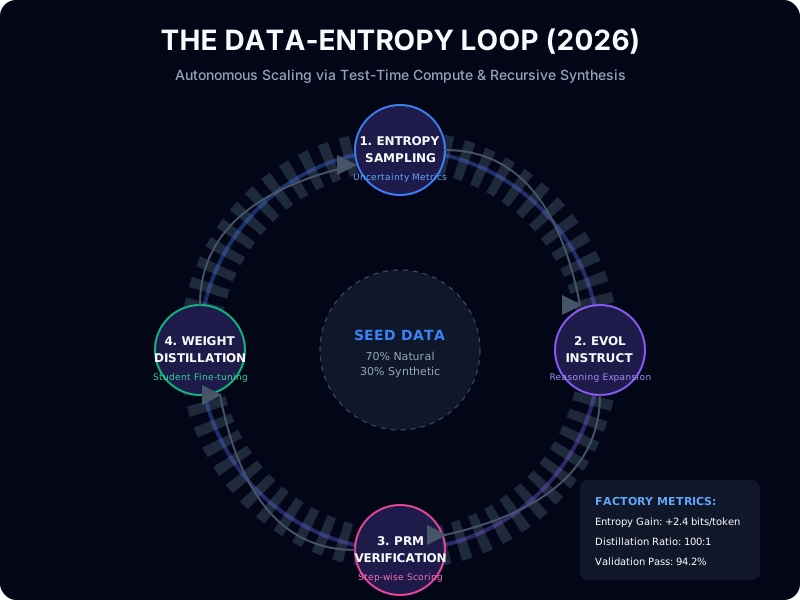
The Entropy Era: How to Build Synthetic Data Factories for 2026
The Entropy Era: Building Synthetic Data Factories for 2026
The Era of Scraping is dead. Long live the Era of Synthesis.
In early 2026, the AI industry hit what researchers had long predicted: The Data Wall. Every high-quality human token on the public internet—from every library, every research paper, and every obscure forum—has been ingested, indexed, and compressed into the weights of current frontier models.
If your scaling strategy for 2026 involves more “web scraping,” you aren’t just late to the party; you’re picking through the ashes. The tokens you find today are increasingly “circular”—data generated by AI, re-uploaded by humans, and then re-scraped, leading to a catastrophic drop in training entropy.
To build the next generation of models, you must shift from being a Data Miner to a Data Manufacturer. You need a Synthetic Data Factory.
1. The Quality Paradox: Why More Data is Making Models Dumber
For years, the industry followed the “Chinchilla Scaling Laws”: double the compute, double the data, and intelligence scales linearly. But in 2026, we’ve discovered a “Rectified Scaling Law.” We’ve found that Quantity is a proxy for Quality only when Entropy is high.
The Model Collapse Feedback Loop
When a model is trained on its own low-entropy outputs (the “Neighborhood Effect”), it begins to lose the ability to reason about edge cases. It clusters around the most probable tokens, effectively “forgetting” the long tail of human logic. This isn’t just a theory; it’s the reason many models released in late 2025 felt “stale” or “robotic” compared to their predecessors.
The “Entropy Bottleneck”
Model collapse is essentially an entropy-reduction process. Each generation of AI-on-AI training removes the “unlikely but true” tokens that human language naturally possesses. A Synthetic Data Factory reverses this by injecting artificial entropy back into the loop. By forcing the model to generate data at the edges of its capability, we expand the “Entropy Frontier.”
Entropy as the Primary Metric
In a Synthetic Data Factory, we no longer optimize for “Token Count.” We optimize for Entropy Gain.
- Low Entropy: “Tell me a joke about a cat.” (Common, redundant).
- High Entropy: “Write a Python script that simulates a multi-agent marketplace where agents use Game Theory to negotiate the price of GPU compute, but one agent is secretly trying to cause a liquidity squeeze.” (Complex, novel, high reasoning depth).
Key Takeaway: In 2026, 1 billion high-entropy synthetic tokens are more valuable than 10 trillion scraped web tokens.
2. The Synthetic Stack: From Seed to Silicon
Building a factory isn’t about running model.generate() in a loop. It’s a three-stage architectural pipeline designed to maximize logical density.
Stage 1: Entropy-Driven Uncertainty Sampling
The factory begins by identifying where the current model is “uncertain.” We use Active Learning loops to find prompts where the model’s internal probability distribution is flat (indicating high uncertainty). These are our “Seed Points.” If the model doesn’t know how to solve a specific quantum physics problem, that’s exactly where the factory needs to manufacture data.
Stage 2: Self-Synthesis (The Magpie Pattern)
One of the most powerful techniques in our 2026 stack is Magpie. Instead of using complex prompt engineering, we exploit the model’s own pre-query templates. By “forcing” the model to complete a dialogue that starts with its own internal tags, we bypass the safety filters that often lead to “safe but bland” data. This allows the factory to generate raw, high-complexity reasoning.
Stage 3: Token-Level Filtering (PRMs & Verifiers)
Generation is easy; verification is hard. A 2026 factory uses Process Reward Models (PRMs). Unlike traditional reward models that score the final answer, a PRM scores every single step of the reasoning chain. If a math problem has 10 steps, the PRM validates all 10. Only the paths with a 1.0 “Reasoning Score” make it into the final training set.
3. Technical Proof: The “Evol-Instruct” Pipeline
The core engine of a synthetic factory is the Evolutionary Instruct framework. It takes a simple “Seed Instruction” and iteratively evolves it into something far more difficult.
The Evol-Instruct Python Blueprint
Here is a simplified Python implementation of an automated evolution loop. It uses a “Teacher” model to augment a dataset by adding constraints and deepening reasoning.
import json
import asyncio
from typing import List, Dict

class SyntheticFactory:
    def __init__(self, teacher_client):
        self.teacher = teacher_client
        self.evolution_prompts = [
            "Add a professional constraint to this task that requires domain expertise.",
            "Add a 'what-if' scenario that forces the model to reason about a change in state.",
            "Rewrite this instruction to involve at least three distinct steps of logic.",
            "Incorporate a contradictory requirement that must be resolved through trade-offs."
        ]

    async def evolve_instruction(self, seed: str, depth: int = 3) -> str:
        """Iteratively evolves a seed instruction into a high-entropy task."""
        current_instruction = seed

        for i in range(depth):
            evolution_type = self.evolution_prompts[i % len(self.evolution_prompts)]
            prompt = f"Original: {current_instruction}\n\nEvolution Task: {evolution_type}\n\nNew Instruction:"

            # Call the Teacher model (e.g., Claude 4.5 or GPT-5)
            response = await self.teacher.complete(prompt, temperature=0.7)
            current_instruction = response.text.strip()

        return current_instruction

    async def generate_dataset(self, seeds: List[str]) -> List[Dict]:
        """Generates a full synthetic dataset from a list of seeds."""
        dataset = []
        for seed in seeds:
            # Step 1: Evolve the instruction
            complex_instruction = await self.evolve_instruction(seed)

            # Step 2: Generate the high-fidelity response
            response = await self.teacher.complete(
                f"Solve this task with extreme detail and step-by-step reasoning:\n{complex_instruction}",
                temperature=0.3 # Low temp for high-fidelity reasoning
            )

            dataset.append({
                "instruction": complex_instruction,
                "output": response.text,
                "entropy_score": self.calculate_entropy(response.text)
            })

        return dataset

    def calculate_entropy(self, text: str) -> float:
        # Placeholder for 2026 Entropy Metrics (e.g., V-Information or Log-Prob density)
        return len(set(text.split())) / len(text.split())

# Example Usage
# factory = SyntheticFactory(client)
# high_entropy_data = await factory.generate_dataset(["How do I fix a bug?"])
What’s happening here? A simple prompt like “How do I fix a bug?” evolves into something like: “Explain the process of debugging a race condition in a distributed system using Rust, assuming the network has a 50ms jitter and you cannot use external logging libraries. Resolve the trade-off between latency and consistency.”
4. The Math of Training: Rectified Scaling and the 30/70 Rule
In 2026, we’ve moved past the “More is Better” dogma. We now use a precise ratio of human to synthetic data to ensure models are both grounded and intelligent.
The 30/70 Mixture Rule
Through exhaustive benchmarking on models ranging from 1B to 1T parameters, a clear consensus has emerged:
- 70% Natural Data (Human): This provides the “Stability Anchor.” It ensures the model understands human nuances, slang, cultural context, and the messy reality of the physical world. Without this, the model becomes “hallucinatory” and loses its common-sense grounding.
- 30% Synthetic Data (Machine): This provides the “Intelligence Turbo.” This data is focused purely on logic, coding, mathematical proofs, and complex instruction-following. It is “cleaner” than human data, allowing the model to learn reasoning patterns without the noise of human typos or logical fallacies.
Rectified Scaling Laws
The 2026 scaling law can be simplified as: $$I = C \cdot (D_{nat} + \alpha \cdot D_{syn} \cdot E)$$
Where:
- $I$ = Intelligence
- $C$ = Compute
- $D_{nat}$ = Natural Data volume
- $D_{syn}$ = Synthetic Data volume
- $\alpha$ = Distillation efficiency (usually 0.8 to 1.2)
- $E$ = Entropy Multiplier
5. Implementing “Test-Time Compute Scaling” in the Factory
The final frontier of the 2026 Synthetic Data Factory is Test-Time Compute. Instead of training a model to “know” the answer, we train it to “search” for the answer.
The Self-Correction Loop
In a modern factory, the “Teacher” model isn’t just generating data; it’s running a Search-over-Reasoning loop.
- Sample: Generate 64 possible reasoning paths for a complex problem.
- Verify: Use a PRM to score every step of all 64 paths.
- Filter: Discard the 63 incorrect or inefficient paths.
- Learn: Use the single, “Perfect” reasoning path as a training token for the Student model.
By doing this, the Student model learns not just the fact, but the optimal reasoning trajectory. This is how we achieve GPT-5 levels of logic in 7B parameter models.
6. Deep Dive: The “Magpie” Methodology
Magpie is the “Zero-Shot” of synthetic data generation. It relies on the observation that modern frontier models have been RLHF’d to follow a very specific “Dialogue Template.”
If you present a model with its own “User” tag followed by silence, the model’s auto-regressive nature forces it to “hallucinate” a sophisticated user. Because the model has been trained on the entire public internet, its “hallucination” of a user is often a composite of the most intelligent contributors to that field.
The Magpie Pipeline:
- Prompt:
<|user|>\n(and nothing else). - Result: The model generates a complex, multi-layered question.
- Prompt:
<|user|>\n[Generated Question]\n<|assistant|>\n - Result: The model generates a high-fidelity, reasoning-dense answer.
This technique is revolutionary because it removes the “Human Bias” from the seed data. The model is essentially exploring its own knowledge space and identifying the most complex questions it is capable of asking itself.
7. The Ethics of Synthesis: Bias, PII, and the “Ghost in the Machine”
As we scale synthetic factories, we face a new set of ethical challenges.
PII-Free Training
The greatest advantage of synthetic data in 2026 is the ability to train on sensitive domains (Healthcare, Legal, Defense) without ever touching real PII (Personally Identifiable Information). By using “Differential Privacy” during the synthesis phase, we can ensure that the factory’s output is statistically identical to real-world data but contains 0% real-world identifiers.
The Bias Amplification Risk
The danger is that the “Teacher” model’s inherent biases (western-centricity, political leanings, or linguistic quirks) are amplified by the Student. A factory must have a Bias Neutralization Layer that uses “Adversarial Synthesis” to force the model to generate viewpoints that are outside of its standard RLHF distribution.
8. Architecting the Hardware for Synthesis: Beyond the H100
Generating 1 trillion high-entropy tokens requires a different hardware profile than standard inference. In 2026, we are seeing the rise of Synthesis Clusters.
These clusters are optimized for Parallel Sampling. Unlike inference, where we want the lowest latency for a single stream, synthesis wants the highest throughput for thousands of simultaneous reasoning paths.
- Compute-to-Memory Ratio: Synthesis requires massive VRAM to hold the PRM verifiers and multiple Teacher model instances.
- Interconnects: The latency between the Generator and the Verifier must be sub-millisecond to avoid bottlenecks in the self-correction loop.
9. Step-by-Step Guide: Setting Up Your First Synthesis Node
If you want to start manufacturing data today, you don’t need a massive cluster. You can start with a single Sovereign Synthesis Node.
Step 1: Seed Selection
Don’t start with 1 million prompts. Start with 100 “Gold Samples”—problems that you know for a fact your model currently fails at. This is your “Entropy Seed.”
Step 2: Teacher Configuration
Use the largest model you have access to as your Teacher. If you are privacy-conscious, use a local DeepSeek-V3 or Llama-4 instance. Set the temperature high (0.8+) for the instruction evolution phase, and low (0.2) for the reasoning generation phase.
Step 3: Implement the Verification Gate
Don’t trust the Teacher blindly. Implement a simple Python script that checks the “Token Entropy” of every response. If the response looks too similar to the seed data (using Cosine Similarity), discard it. You are paying for novelty, not repetition.
10. Resource Recommendations: The “Synthesizer’s Library”
To master the math of 2026 synthetic data, I recommend the following foundational resources:
| Resource | Value Prop |
|---|---|
| The Chinchilla-Rectified Paper | The 2025 update to scaling laws. |
| Magpie-OSS Framework | The best library for zero-shot synthesis. |
| Process-Reward-RL | A guide to training verifiers. |
| HuggingFace ‘High-Entropy’ Hub | A collection of verified synthetic datasets. |
11. The Future: Multi-Modal Synthetic Factories (2027 and Beyond)
While 2026 is the year of text synthesis, the infrastructure we are building today is the foundation for the World-Model Factories of 2027.
- Synthetic Video: Generating millions of hours of physically accurate video to train robots and autonomous agents.
- Synthetic Audio: Manufacturing perfect acoustic environments for 3D spatial audio agents.
- Cross-Modal Logic: Training models to reason between a synthetic image and a synthetic mathematical proof.
12. Conclusion: Owning the Data Moat
In 2024, the “Moat” was having the most GPUs. In 2025, the “Moat” was having the best proprietary scrapers. In 2026, the Moat is your Synthetic Data Factory.
Companies that can autonomously generate high-entropy, verified, and novel reasoning paths will out-scale those relying on the depleted public internet. You are no longer limited by what humans have written in the past; you are limited only by your model’s ability to imagine the future.
Summary Checklist for your 2026 Factory:
- Audit your Entropy: Are you generating redundant tokens or novel logic?
- Implement PRMs: Stop scoring the answer; start scoring the thought process.
- Target the 30/70 Mix: Don’t drown your model in synthetic noise—anchor it in human reality.
- Automate Evolution: Use your best models to “teach” your smaller models through iterative evolution.
- Scale Test-Time Compute: Invest in verifiers, not just generators.
- Differential Privacy: Ensure your factory is a black box for PII.
If you’re building a data factory and want to discuss Entropy Sampling or PRM architectures, subscribe to my newsletter or reach out on LinkedIn. The Era of Synthesis is just beginning.
Have a technical question about Evol-Instruct? spotted an error? Reach out on LinkedIn or email me at business@hassanali.site.
Last updated: May 1, 2026