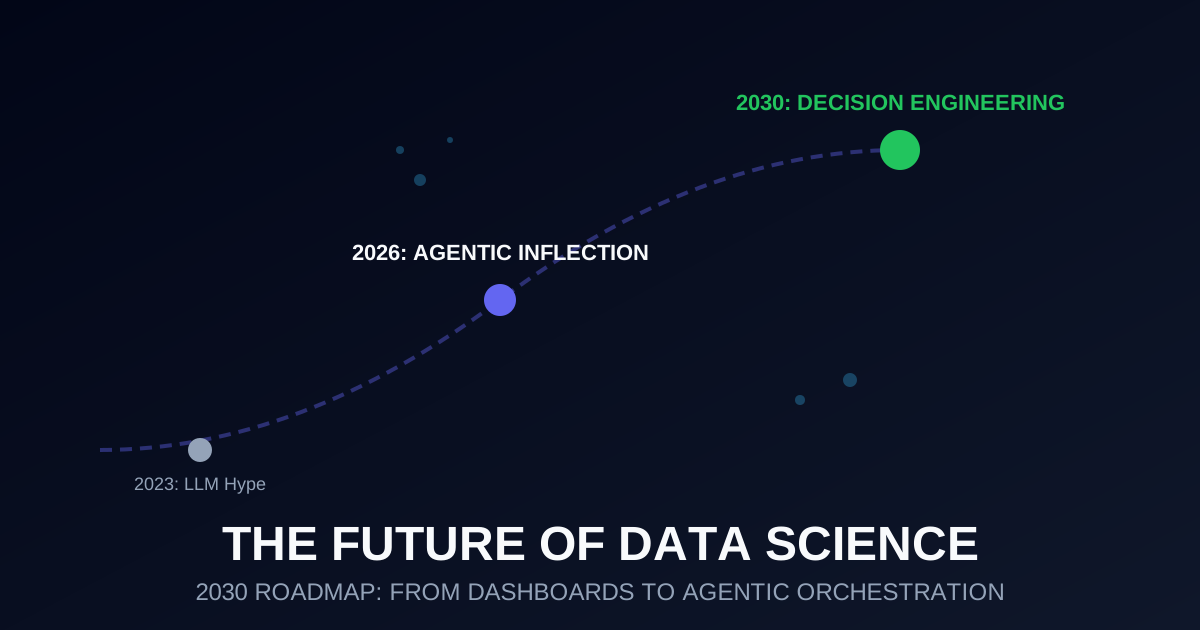
The Future of Data Science 2030: From Analysts to Decision Engineers
I remember a conversation in 2023 with a senior analyst who told me, “I spend 80% of my time cleaning data and 20% complaining about it.” Back then, we thought LLMs would just help us write better Python code. We were wrong.
By May 2026, the “Data Scientist” title has begun its final mutation. We are no longer just “using AI”; we are building the factories that produce it.
Welcome to the era of Decision Engineering.
What You’ll Learn
- The Agentic Inflection: Why dashboards are dead in 2026.
- The Synthetic Data Explosion: Designing the “Data Factory.”
- Edge Analytics: Moving inference to where the data lives.
- Career Roadmap: Pivot from Analyst to Orchestrator by 2030.
The Death of the Dashboard
For a decade, the “Dashboard” was the holy grail of data science. In 2026, dashboards are seen as a bottleneck. Executives don’t want a chart that tells them revenue is down; they want an Agentic Action Center that identifies why it’s down and executes a remediation plan autonomously.
This shift is powered by Agentic Engineering. Data scientists are moving from “Data Visualization” to “Agent Orchestration.” Instead of building a Tableau report, you are now building a Sovereign Agentic Stack that monitors real-time streams and triggers local agents to act.
Phase 1: The Synthetic Data Factory
By 2030, real human-generated data will be a luxury. The “Data Hunger” of frontier models has exhausted the public internet. The solution? Synthetic Data Pipelines.
Future data scientists won’t spend time “scraping” the web (a task now handled by AI-Powered Web Scraping). Instead, they will design Synthetic Data Factories that use Small Language Models (SLMs) to generate high-fidelity, privacy-compliant training sets.
Your value will lie in the Verification Loop—proving that the synthetic data matches the statistical distribution of reality without leaking PII (Personally Identifiable Information).
Phase 2: Edge Analytics & SLMs
The cloud is too slow for the future of 2030. When you are running a Sovereign Trading Bot or an autonomous drone fleet, 100ms of latency is a failure.
We are seeing the rise of Edge Analytics. This involves running optimized 7B and 8B models directly on local hardware. The “Data Scientist” of 2030 is also a hardware architect, understanding how to partition VRAM and optimize quantizations to ensure the fleet stays responsive.
Phase 3: From Accuracy to Operational Leverage
In the old world, we optimized for F1-scores and RMSE. In the new world, we optimize for Operational Leverage.
The question is no longer “How accurate is the model?” but “How many manual decisions were successfully automated today?” This is the core of Decision Intelligence. By using tools like the Model Context Protocol (MCP), data scientists can give their models surgical access to internal databases, allowing them to solve complex problems in the terminal rather than in a notebook.
The 2030 Career Roadmap: How to Pivot
If you want to survive the “Analyst Apocalypse,” here is your 2026–2030 roadmap:
- Stop learning syntax, start learning systems: Python is a tool; system architecture is the skill.
- Master the CLI: The terminal is where the agents live. Get comfortable with Terminal Guides and agentic workflows.
- Own the Stack: Don’t just rent cloud models. Build your own Local AI Stack and understand the plumbing of inference.
- Specialize in Verticals: Be the “Bio-Data Architect” or the “DeFi Quant Engineer.” Generalists are the first to be automated.
The Bottom Line
The future of data science is not about “data.” It is about Intelligence at Scale.
By 2030, the most successful people in this field won’t be those who can find the needle in the haystack—they will be those who can build the machine that builds the needles.
Ready to go sovereign? Subscribe to my newsletter below for deep dives into the agentic economy and the future of technical engineering.