The Math of Liquidations: Predicting Volatility Spikes in the 2026 Bull Run
I remember my first time watching a $2 billion “Long Squeeze” in real-time back in 2022. I thought the market was reacting to some catastrophic global news. I checked the wires—nothing. The crash was entirely internal. It was a mechanical failure of the market’s plumbing.
It was a fantastic learning experience.
In 2026, the market has become even more mechanical. With high-frequency bots and institutional ETFs dominating the order book, price action is increasingly driven by Liquidity Hunting. If you don’t understand the math of liquidations, you are trading with a blindfold on.
Here is the real, no-BS guide to predicting volatility spikes using liquidation math.
What You’ll Learn
In this deep-dive into market mechanics, we are exploring the “Guts” of the 2026 bull run. You’ll discover:
- The Fundamental Equations: Isolated vs. Cross Margin Math
- The “Magnet Effect”: Why price gravitates toward liquidation clusters
- Anatomy of a Cascade: Visualizing the slippage loop
- Institutional Absorption: How ETFs have changed the “V-Wick” recovery
- Prediction Models: Using Cumulative Liquidation Delta (CLD) for alpha
Prerequisites
- Basic Algebra: To understand the margin formulas.
- Access to a Liquidation Map: (e.g., CoinGlass, Hyblock, or custom API feeds).
- Understanding of Leverage: (10x, 50x, and the now-standard 125x “Degen” tiers).
Step 1: The Core Equations
Liquidations aren’t random. They are deterministic price points where a trader’s equity hits zero. In 2026, the math is divided into two main risk profiles.
Isolated Margin (Long)
The liquidation price ($P_{liq}$) is where your margin equals the Maintenance Margin. $$P_{liq} = P_{entry} \times \left(1 - \frac{IM - MM}{PositionSize}\right)$$
Cross Margin
In 2026, institutional desks use Cross Margin to buffer volatility. Here, your buffer includes your entire account balance ($B$) and unrealized PnL from other positions ($U$). $$P_{liq} = P_{entry} \pm \frac{B + U - MM}{Quantity}$$
Key takeaway: Cross margin is safer for single-asset spikes but creates Systemic Risk. If one asset in your portfolio crashes, it can pull your entire account into a “Portfolio Wipeout.”
Step 2: The Anatomy of a Cascade
A liquidation cascade is a chain reaction. It is the reason why “nothing happens for an hour, then everything happens in 60 seconds.”
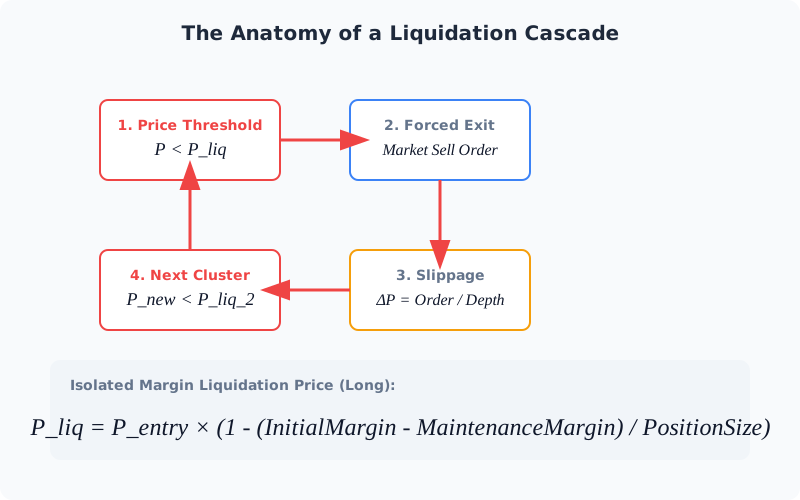
- Threshold Breach: Price hits the first dense cluster of liquidation orders.
- Forced Market Sell: The exchange instantly places market orders to close the positions.
- Slippage Loop: In a thin order book, these market orders push the price down further ($ΔP = Order / Depth$).
- The Next Dominos: This new, lower price hits the next cluster of liquidations, repeating the loop.
Step 3: Predicting the Spike — The Heatmap Strategy
In 2026, professional traders use Liquidation Heatmaps as their primary weather map.
Pro tip: Look for “Liquidity Gaps.” These are price zones between two massive liquidation clusters. Once price enters a gap, there is very little resistance, and the price will “teleport” to the next cluster. This is where the fastest 5% moves happen.
Step 4: 2026 Trend — Institutional Absorption
The 2026 Bull Run is unique because of Institutional Buyers. Unlike the 2021 retail-only market, today’s major desks (BlackRock, Fidelity) have algorithms specifically designed to buy liquidation cascades.
This results in the “V-Wick” pattern. Price crashes 10% in 5 minutes (mechanical liquidation) and recovers 8% in the next 5 minutes (institutional absorption).
Strategy: Don’t sell the crash; set “Stink Bids” just below the largest liquidation clusters to catch the institutional bounce.
Step 5: Information Gain — Cumulative Liquidation Delta (CLD)
If you want to know if the market is “top-heavy,” look at the CLD.
- High Positive Delta: There are far more long liquidations waiting below the price than shorts above it.
- The Prediction: The market is “Long Heavy.” A minor macro shock will trigger a disproportionate crash.
Tools and Resources
| Tool | Purpose | Link |
|---|---|---|
| CoinGlass | Real-time liquidation heatmaps | CoinGlass.com |
| VBT2 | Python library for backtesting liquidations | VectorBT.dev |
| TradingView | Custom PineScript for CLD alerts | TradingView.com |
Testing Your Implementation
- Overlay Heatmaps: Add a liquidation heatmap to your BTC/USD chart.
- Spot the Hunt: Observe how often price “wicks” into a high-leverage cluster before reversing.
- Verify the Math: Use the Isolated Margin formula to manually calculate your own “Death Zone” before opening a trade.
Common mistakes:
- Mistake 1: Assuming “News” causes the wick. 90% of sub-15-minute spikes are mechanical liquidations.
- Mistake 2: Ignoring Funding Rates. If funding is extremely high, the “Cost of Carry” for longs makes them more likely to be liquidated first.
Next Steps
- Automated Hedges: Build a Python script that opens a hedge position when price enters a high-density liquidation zone.
- Cluster Analysis: Learn to distinguish between “Retail Clusters” (100x leverage) and “Institutional Clusters” (low leverage).
- Macro Correlation: Track how SOFR rate shifts impact the liquidation thresholds of major trading desks.
TL;DR
- Volatility is Mechanical: Most spikes are caused by forced exits, not news.
- Price is a Magnet: Price hunts dense liquidation clusters for exit liquidity.
- Math over Mood: Use the $P_{liq}$ formulas to manage your own risk scientifically.
- Watch the CLD: A top-heavy market is a fragile market.
If you found this analysis useful, subscribe to my newsletter below for more market mechanics and data science insights.
Have a skill recommendation or spotted an error? Reach out on LinkedIn or email me at business@hassanali.site.
Last updated: April 29, 2026