The Rise of AI-Native Blockchains: Beyond Smart Contracts to 'Autonomous State Machines'
I remember the “AI-Crypto” hype of 2024. We saw dozens of projects claim they were “Decentralizing AI” when all they were doing was putting an API key behind a standard ERC-20 token. They weren’t building AI blockchains; they were building expensive middleware.
It was a fantastic learning experience.
Fast forward to April 2026: The “Middleware Era” is over. We have entered the age of the AI-Native Layer 1. We have moved beyond the static, deterministic scripts of Solidity and into the era of the Autonomous State Machine (ASM). For the first time, the ledger doesn’t just store your balance—it understands the intent behind your transactions.
Here is the real, no-BS guide to the rise of AI-native blockchains.
What You’ll Learn
In this technical deep-dive, we’re auditing the Agentic Ledger of 2026. You’ll discover:
- The 2026 Paradigm Shift: From Deterministic to Probabilistic State
- Autonomous State Machines (ASM): Why smart contracts are becoming passive
- Technical Core: Verifiable Inference and ZkML integration
- The Lithic Language: Building contracts that “Request Reasoning”
- Agentic Commerce: How machines now negotiate and settle on-chain
The Death of the ‘Passive’ Smart Contract
In the legacy world, a smart contract is a dead object. It sits on the blockchain waiting for a human to click a button and pay gas to “wake it up.” In 2026, this is considered a massive inefficiency.
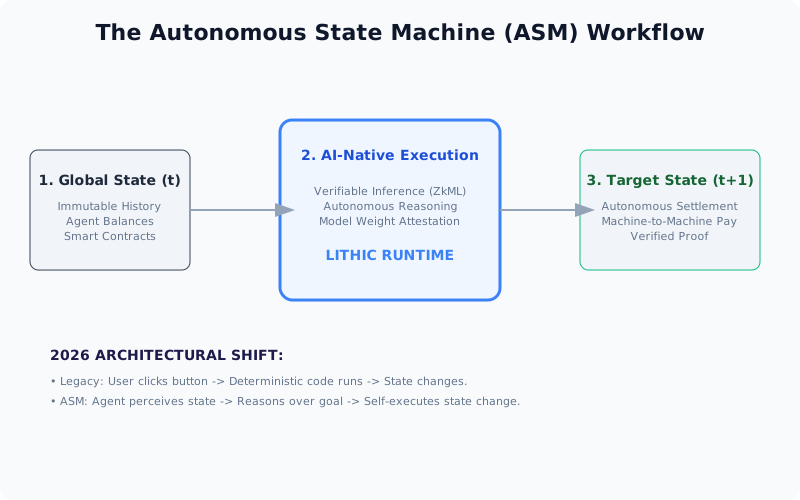
The ASM Breakthrough: An Autonomous State Machine is Active. It is an agentic loop that lives inside the consensus layer. It monitors the price of ETH, the latest news sentiment (via an MCP link), and the liquidity in a DEX. When its reasoning engine detects an “Alpha Signal,” it self-executes the transaction.
The machine is now the user.
Step 1: Verifiable Inference (The Trust Layer)
The biggest technical challenge of 2026 was Model Integrity. How do you know the “Cheap” model you’re using on a decentralized network hasn’t been swapped for a dumber one to save costs?
We use Verifiable Inference. Protocols like Ritual and Bittensor v5 now provide a cryptographic proof (Zk-Proof) that a specific model (e.g., Llama 4 70B) generated the output. In 2026, if there is no proof, there is no settlement.
Step 2: Programming in Lithic
We no longer write complex AI-logic in Solidity. We use Lithic. It’s a language that treats “Inference” as a first-class citizen, just like “Balance” or “Transfer.”
// 2026 'Agentic' Contract Example
contract MarketMaker {
  service ai_engine = @provider/fin-gpt-6;

  on_tick() {
    // Request a reasoning path from the native AI primitive
    let intent = ai.request(ai_engine, "Analyze L2 order book for volatility...");

    if (intent.confidence > 0.92) {
      // Self-execute state change
      state.rebalance(intent.target_ratio);
      emit AgentAction(intent.reasoning_hash);
    }
  }
}
Step 3: Information Gain — The ‘Agentic GDP’
In early 2026, the IMF introduced a new economic metric: Agentic GDP. This measures the total transaction volume generated by machines trading with other machines (M2M) without human intervention.
On AI-native blockchains like NEAR and Monad, Agentic GDP has already surpassed human-triggered volume. We are building a “Shadow Economy” where agents earn, spend, and invest on behalf of their human “Sovereigns.”
Step 4: The ‘Finality Gap’ Risk
The 2026 security landscape is defined by the Finality Gap Attack. Sophisticated adversarial AI agents now exploit the few seconds between an AI-reasoning step and the block being finalized on-chain.
Pro tip for Developers: In 2026, always implement an “Optimistic Rollback” for agentic actions. If your ASM detects a cross-chain state contamination during the finality window, it must be able to “Scream” to the consensus layer to halt execution.
Tools and Resources
| Tool | Purpose | Link |
|---|---|---|
| Bittensor v5 | Decentralized intelligence network | Bittensor.com |
| Ritual.net | The AI-Native execution layer | Ritual.net |
| NEAR Protocol | King of Agentic Commerce | Near.org |
Next Steps
- Deploy an ASM: Use the Alphea framework to deploy your first autonomous trader on a testnet.
- ZK-Inference Audit: Learn to read the cryptographic proofs generated by decentralized models to ensure your agent isn’t being “Gaslighted.”
- Cross-Agent Governance: Research Multi-Agent DAOs, where the “Board of Directors” is a collection of 5 specialized agents voting on protocol upgrades.
TL;DR
- AI is the Execution: Blockchains are moving from storage to reasoning.
- ASMs are Active: They perceive, reason, and self-execute.
- Verification is Mandatory: Use Zk-Inference to prove the AI isn’t lying.
- M2M Economy is Here: Machines are now the primary users of the 2026 web.
Found this technical thesis on AI-native crypto useful? Subscribe to my newsletter for weekly research on autonomous state machines and decentralized intelligence.
Have a skill recommendation or spotted an error? Reach out on LinkedIn or email me at business@hassanali.site.
Last updated: April 29, 2026