The Silver Pivot: Why BRICS is Anchoring the 'Unit' to Industrial Utility
Everyone is talking about the return to the gold standard. They’re missing the point. While the West watches the gold spot price in London, the East is orchestrating a Silver Pivot that anchors the future of global trade not just to “value,” but to industrial utility.
The BRICS “Unit”—the new multicurrency settlement system—is no longer a theoretical whitepaper. It is a functional reality designed to solve the ultimate vulnerability of the 21st century: the weaponization of the dollar. But the secret sauce isn’t just gold; it’s the 40% commodity anchor that heavily features silver.
Here’s what’s actually happening, why it matters, and where this is headed.
A Tale of Three Cities: The Price Dislocation
In May 2026, a strange phenomenon began to manifest across global exchanges. In London, silver was trading at $32/oz. In Dubai, it was $38. In Shanghai, it was $45.
This isn’t just a simple arbitrage opportunity; it’s the sound of the “Silver Curtain” falling. The East is vacuuming up physical silver at a rate that Western paper markets cannot track. Why? Because you can’t build an AI-driven economy or a green energy grid with a COMEX futures contract. You need the metal.
By triggering this Silver Pivot, BRICS+ nations are effectively decoupling their industrial base from Western price discovery mechanisms. They are pricing silver based on its replacement cost in a semiconductor fab, not its speculative value in a hedge fund’s portfolio.
Beyond Gold: The Case for Industrial Utility
The conventional narrative says that gold is the ultimate safe haven. It’s wrong—or at least, it’s incomplete. Gold is a store of value, but silver is industrial oxygen.
As we’ve analyzed in the Sovereign Agentic Stack, true sovereignty requires control over the physical layer of compute. Every H100 GPU, every advanced photovoltaic cell, and every high-speed rail connection requires silver.
By anchoring the BRICS Unit to silver, the bloc is ensuring that its currency has “industrial utility.” This isn’t just a de-dollarization play; it’s an industrial sovereignty play. If a nation holds “Units,” it essentially holds a claim on the metals required to build the future.
The Unit Architecture: Hard Assets for a Hardened World
The architecture of the Unit is a masterpiece of economic engineering. It bypasses the volatility seen during gold’s worst day in decades by diversifying the commodity anchor.
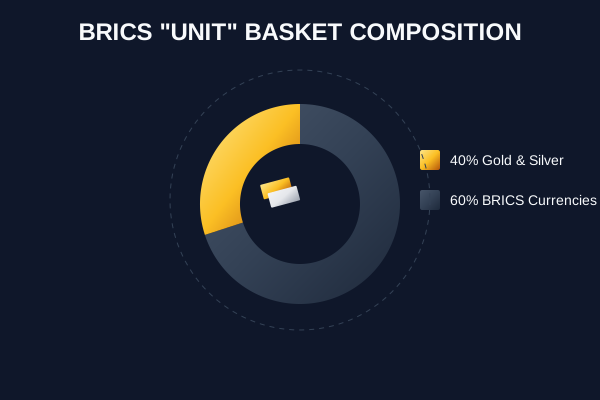
The basket follows a 40/60 split:
- 40% Commodity Anchor: A weighted mix of gold and silver. Silver provides the “industrial floor,” while gold provides the “monetary ceiling.”
- 60% Currency Basket: BRICS national currencies, weighted by GDP and trade volume.
This structure allows for trade settlement via the mBridge network—a cross-border payment system that settles in real-time without ever touching a US-based intermediary bank. For the first time since 1944, a global trade medium exists that is immune to the “OFF” switch of Western sanctions.
The reality: The Unit isn’t trying to replace the Dollar as a global reserve currency. It’s trying to replace the Dollar as a global settlement medium for the physical economy.
The Market’s Response (Or Lack Thereof)
Western markets are currently pricing in a “transitory” shift. That’s a massive underestimation. The dislocation between paper silver (digital promises) and physical silver (industrial reality) has reached a breaking point.
We are seeing the emergence of a two-tier market:
- Tier 1: The Western paper market, increasingly irrelevant to physical flow.
- Tier 2: The Eastern physical market, where the BRICS Unit serves as the primary accounting tool.
Where This Is Headed
Here is my call for the remainder of 2026:
- Short-term (1-3 months): Continued price dislocation between SHFE (Shanghai) and COMEX (New York). Expect silver premiums in the East to hit 30%+.
- Medium-term (6-12 months): The first official energy contracts (Oil/Gas) settled entirely in “Units” between Russia, China, and Saudi Arabia.
- Long-term (1-3 years): The “Unit” becomes the default accounting standard for all RWA (Real World Asset) tokenization in the Global South.
I could be wrong. But here’s what would prove me wrong: a sudden collapse in global AI hardware demand or a massive, new silver discovery in a pro-Western jurisdiction that offsets the current supply deficit. Neither looks likely.
The Bottom Line
The Silver Pivot isn’t about the price of a shiny metal going up. It’s about the fundamental restructuring of how the world accounts for power.
The BRICS Unit is the first currency of the “Physical Age.” It treats industrial utility as the ultimate collateral. The question isn’t whether the Dollar will collapse; it’s whether you’ll be holding a currency that can actually buy the silver needed to keep the lights on in 2027.
TL;DR
- Thesis: BRICS is pivoting to a silver-heavy “Unit” to anchor their currency in industrial utility, not just monetary storage.
- Key insight: Silver is the “industrial oxygen” for AI and green energy, making it the perfect hedge against tech decoupling.
- Watch: The price gap between Shanghai and London. If it stays above 15%, the “Silver Curtain” is permanent.
Disagree? Think gold is still the only king? Subscribe to my newsletter and let’s argue — I respond to every email.