The Tokenization of Real-World Assets (RWAs): A Developer’s Guide to Smart Contracts in 2026
I remember my first “Tokenization” project in 2021. We tried to put a piece of real estate on a standard ERC-20 contract. We thought we were revolutionaries. Three months later, our legal team informed us that our “Innovation” was essentially an unregistered security with zero compliance controls. We had to burn the tokens and start over.
It was a fantastic learning experience.
In April 2026, the “Wild West” of tokenization is over. Institutional giants like BlackRock and Franklin Templeton have moved $36 billion on-chain, and they didn’t do it with raw ERC-20s. They did it with Identity-Bound Smart Contracts. If you want to build in the RWA space today, you aren’t just writing code; you are writing Compliance-as-Code.
Here is the real, no-BS guide to building production-grade RWA protocols in 2026.
What You’ll Learn
In this technical blueprint, we’re building an Institutional Bond Token. You’ll discover:
- The 2026 RWA Stack: ERC-3643, ONCHAINID, and Zk-KYC
- Architecture: The 4-stage lifecycle of a tokenized asset
- Implementing the Identity Registry: Whitelisting without doxxing
- Automated Compliance: Handling MiFID II and SEC rules on-chain
- Off-Chain Sync: Using Chainlink PoR for real-time valuation
The 2026 RWA Lifecycle
In 2026, we don’t just “mint and pray.” We follow a rigid institutional lifecycle to ensure legal and technical validity.
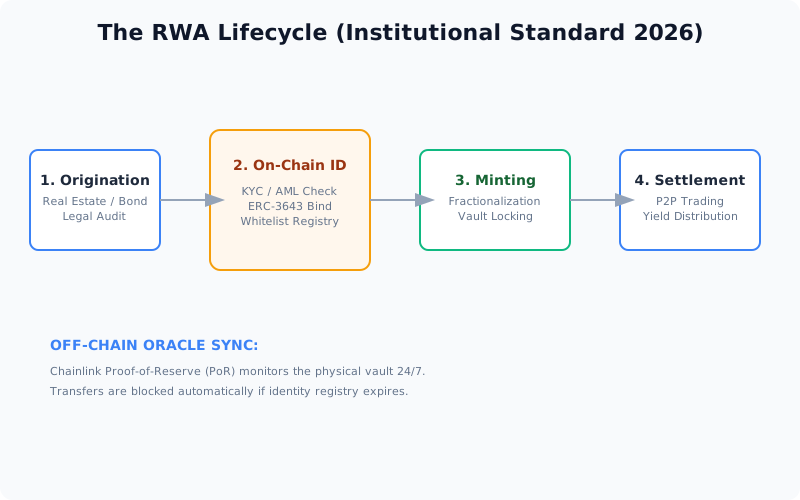
The Core Principle: Every transfer must be Conditional. In retail DeFi, if you have the gas, you can send the token. In RWA DeFi, the smart contract must “Ask for Permission” from the Identity Registry before the move is authorized.
Step 1: Beyond ERC-20 — Why ERC-3643 Wins
The standard ERC-20 is a “dumb” ledger. ERC-3643 is a “smart” security.
// 2026 RWA Compliance Check (Simplified)
function _beforeTokenTransfer(address from, address to, uint256 amount) internal override {
    // 1. Check Identity Registry
    require(identityRegistry.isVerified(to), "Receiver not KYC verified");

    // 2. Check Compliance Module
    require(compliance.canTransfer(from, to, amount), "Transfer violates jurisdictional rules");

    super._beforeTokenTransfer(from, to, amount);
}
Key takeaway: ERC-3643 decouples the Token from the Identity. This allows a user to keep their privacy while the contract verifies their “Eligibility Score” (e.g., “Accredited Investor = True”) via zero-knowledge proofs.
Step 2: The Identity Registry (ONCHAINID)
In 2026, we use ONCHAINID. This is a decentralized identity standard where a trusted claim issuer (like a bank or a government) signs a “Claim” on the user’s wallet.
Pro tip: Never store PII (Personally Identifiable Information) on-chain. Store the Hash of the claim and the Signature of the issuer. When the user tries to buy a tokenized real-estate share, the contract only checks if the signature is valid and the issuer is trusted.
Step 3: Off-Chain Verification (The Oracle Bridge)
How do you know the $1M apartment hasn’t burned down while the token is still trading? You use Chainlink Proof-of-Reserve.
// Chainlink PoR Integration
function checkCollateral() public view returns (bool) {
    uint256 physicalValue = oracle.getLatestValue(); // Real-world appraisal
    uint256 totalCirculation = totalSupply();

    return (physicalValue >= totalCirculation);
}
In 2026, institutional buyers will only touch RWA protocols that have an automated audit loop between the physical asset and the digital token.
Step 4: Information Gain — The ‘Liquidity Vault’ Pattern
The biggest breakthrough of 2026 is the Hybrid Liquidity Vault. Instead of an asset being either “Locked” or “Liquid,” we use vaults that allow RWA tokens to be used as collateral for stablecoin loans (e.g., using your tokenized building to mint USDC).
This is the “Holy Grail” of TradFi: Instant Liquidity for Illiquid Assets.
Step 5: Regulatory Checkpoints for 2026
If you are deploying in 2026, your code must account for:
- The EU AI & Data Act: All automated trading of RWAs must have an “Emergency Kill-Switch.”
- MiCA 2.0: All issuers must maintain a 1:1 liquid reserve for “Money-Like” RWAs (e.g., Tokenized Treasuries).
- Transfer Restrictions: The ability to “Force Transfer” tokens in the case of a court order (The “Legal Override” function).
Tools and Resources
| Tool | Purpose | Link |
|---|---|---|
| ERC-3643 Org | Official standard and documentation | erc3643.org |
| Tokeny T-REX | SDK for RWA issuance | Tokeny.com |
| ONCHAINID | Identity standard for security tokens | Onchainid.com |
Testing Your Implementation
- The ‘Sanctions’ Test: Attempt to transfer tokens to a blacklisted address. It should fail and log a “Compliance Rejection.”
- The ‘Limit’ Test: Set a maximum of 100 investors in the compliance module. Attempt to add the 101st. The minting should revert.
- Identity Expiry: Simulate a KYC expiry for a holder. Attempt a sell order. The contract should block the exit until the ID is renewed.
Common mistakes:
- Mistake 1: Forgetting the Trusted Issuer registry. If you don’t whitelist the KYC provider, anyone can sign their own “Investor” claim.
- Mistake 2: Hard-coding rules. In 2026, laws change monthly. Use Modular Compliance so you can swap out the “Rulebook” contract without re-deploying the token.
Next Steps
- ZK-Identity: Learn to implement Circom circuits to allow users to prove they are over 18 without revealing their date of birth.
- Fractional Ownership: Build a distribution engine that auto-sends rental income (stablecoins) to all RWA token holders every month.
- Cross-Chain RWA: Use CCIP to allow institutional tokens to move from Ethereum to a private banking chain (like Onyx) while maintaining the identity proof.
TL;DR
- TradFi is coming: $36B+ is already on-chain via RWA.
- ERC-3643 is the standard: Identity is built into the protocol.
- Privacy + Compliance: Use ZK-proofs to verify users without doxxing them.
- Real-World Sync: Use Oracles to prove the physical asset exists.
Found this technical guide useful? Subscribe to my newsletter for deep-dives into institutional DeFi and smart contract security.
Have a skill recommendation or spotted an error? Reach out on LinkedIn or email me at business@hassanali.site.
Last updated: April 29, 2026