The U.S. Economy Is Not Crashing — It's Quietly Thinning Everywhere at Once
I spent the last few days buried in numbers, filings, earnings calls, court deadlines, and tariff tables — and I keep coming back to the same uncomfortable feeling.
The U.S. economy is not breaking in one obvious place. It is thinning everywhere at once. Quietly. Systemically. And dangerously.
This is not a panic piece. It is a synthesis piece. Every claim below is anchored to primary reporting, embedded directly into the words so you can follow the trail without losing the flow.
Read this slowly. This is one of those articles you come back to six months later and say — “oh.”
Why This Matters
2026 is shaping up to be a bifurcation year. Either AI-driven spending and fiscal stimulus successfully paper over deep structural damage — or one stress fracture cascades into a full-system event. The risk is not recession alone. It is trust, liquidity, and institutional credibility breaking at the same time.
The Debt Wall Nobody Can Outrun
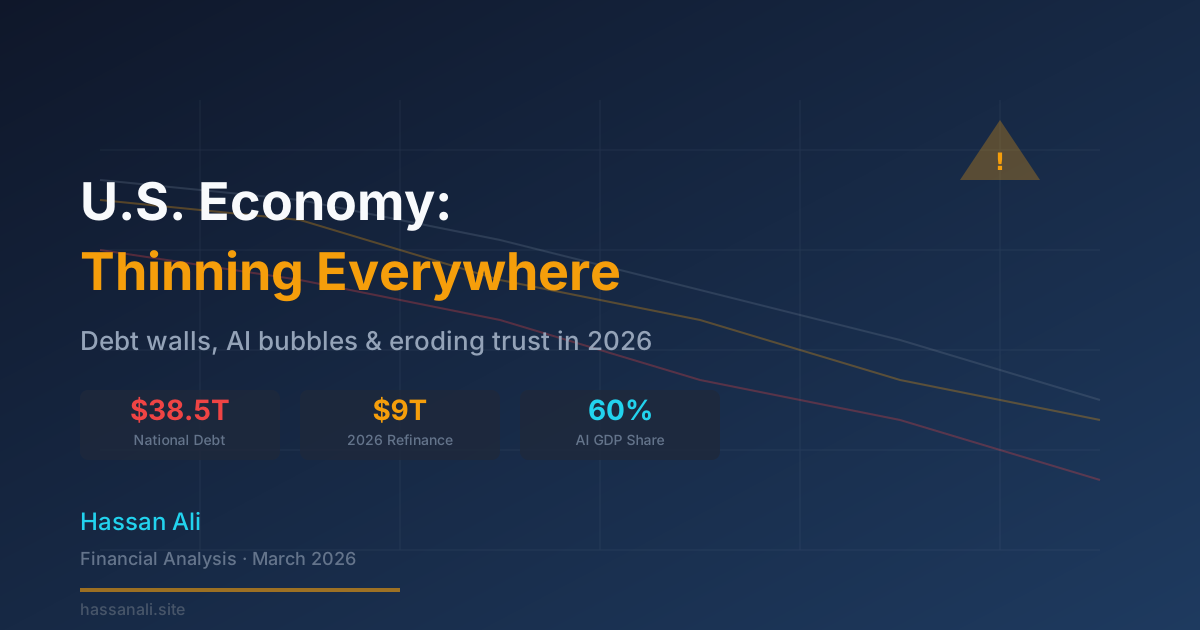
The U.S. crossed $38.5 trillion in national debt months ahead of schedule — a level the Congressional Budget Office once projected closer to 2030, according to reporting compiled by the Joint Economic Committee and analyzed by outlets like Economic Times and Fortune.
That number feels abstract until you zoom in.
Nearly $9 trillion of that debt matures in 2026 alone. It must be refinanced at rates far higher than the zero-rate world that created it. The Committee for a Responsible Federal Budget has openly warned that without course correction, “some form of crisis is almost inevitable” — a phrase that should not appear in polite fiscal conversations.
- Interest payments alone are projected to exceed $1 trillion this year
- That permanently locks in a higher baseline deficit
- Debt is now growing faster than GDP — not a political statement, but arithmetic
When governments lose control of refinancing costs, they lose policy flexibility. Everything else becomes reactive.
AI Did Not Just Boom — It Concentrated
Economist Ruchir Sharma uses a four-part framework to diagnose bubbles: overinvestment, overvaluation, over-ownership, over-leverage. As of late 2025, the AI trade hit all four.
AI-linked investment accounted for roughly 60% of U.S. GDP growth last year, according to analysis cited by Business Insider. Outside of AI, growth was disturbingly thin. To fund the arms race, companies like Meta, Amazon, and Microsoft became some of the largest corporate debt issuers in the market — a late-cycle behavior that mirrors the dot-com era almost uncomfortably well.
Retail investors followed. Equity ownership reached record concentration levels. Most incremental trading volume flowed into AI-adjacent names. Valuations stretched while rates stayed higher for longer.
Sharma’s warning was blunt: if rates stay elevated or rise again in 2026, borrowing costs spike and future earnings get discounted harder. Bubbles do not need bad news. They need gravity.
The Labor Market Is Talking — Softly
Headline unemployment is not screaming crisis. That is what makes this phase dangerous.
- Job openings fell to roughly 7.1 million — the lowest in over a year
- Hiring rates now resemble pandemic and Great Recession levels
- Monthly job creation collapsed from ~147,000 pre-tariff to as low as 38,000 in recent post-tariff periods, per Investopedia’s synthesis of Fed and BLS data
This is not mass layoffs. It is hesitation.
Employers are freezing decisions amid tariff uncertainty, higher financing costs, and accelerating automation. Immigration restrictions have tightened labor supply while AI reduces marginal hiring demand — creating a paradox where unemployment rises even as certain roles go unfilled.
The result is a K-shaped economy. Corporate and affluent spending remains strong. Average households feel increasingly boxed in. That tension rarely resolves gently.
Trade Wars Never End — They Just Pause
Under Donald Trump, U.S.–China tariffs peaked above 100% before settling into a “suspension” framework that still leaves effective rates near 47.5%, according to breakdowns from CNBC and China US Focus.
Suspension is not resolution.
- Chinese exports to the U.S. are down nearly 19% year over year
- U.S. manufacturing investment is projected to take a 13% annual hit through 2029, per Joint Economic Commission estimates
- Major U.S. retailers quietly lobbied for exemptions. Manufacturing did not meaningfully return.
Then came January’s announcement of new Iran-linked tariffs — a move that threatens to unravel fragile détente since China is Iran’s largest trading partner. Businesses plan on rules. Suspensions create none.
War as a Permanent Input Cost
The Russia–Ukraine conflict rolls into its third grinding year with no exit ramp. Russia’s economy is stagnating. Energy markets remain volatile. Supply chains stay distorted.
For the U.S., the cost is not just oil prices. It is risk premium. It is insurance. It is logistics. It is the quiet tax every geopolitical shock adds to inflation math. The World Bank may project lower Brent prices, but geopolitical risk does not disappear just because a spreadsheet says it should.
When Transparency Fails, Confidence Goes With It
The Epstein files should have closed a chapter. Instead, they reopened a wound.
Victims and advocates have accused the Trump administration of opacity and delay after the Justice Department missed congressional deadlines and released millions of documents with heavy redactions, according to CNN and Al Jazeera reporting. The administration denies wrongdoing. Victims are unconvinced.
At the same time, anti-corruption enforcement has been quietly rolled back:
- The Corporate Transparency Act’s teeth were dulled
- Foreign Corrupt Practices Act enforcement was paused
- Anti-money laundering rules for investment advisers were delayed until 2028, per Carnegie Endowment analysis
Scandals now fade faster. Research summarized by The Conversation and The Washington Post shows normalization has weakened accountability. Markets price trust whether politicians do or not.
Recession Odds Miss the Point
| Institution | Recession Probability |
|---|---|
| New York Fed | ~20% |
| Apollo Chief Economist | ~10% (revised down) |
| Goldman Sachs | ~30% scenario on the table |
| RSM | Above-trend growth possible |
All of them could be right — briefly.
The danger is not a single forecast missing. It is a two-speed economy pretending to be stable. AI spending props up GDP while consumers pull back. Debt refinancing tightens conditions just as labor softens. Policy tools weaken as trust erodes.
Recessions end. Confidence crises metastasize.
The Dollar Question Nobody Wants to Ask
Economist Peter Schiff has issued extreme warnings about a U.S.-centric financial crisis and potential dollar collapse, arguing that stealth quantitative easing and sovereign debt dynamics will overwhelm confidence. Forbes and Yahoo Finance note his track record is mixed — he was early in 2008, and he has also cried wolf before.
Treat his scenario as tail risk. But do not ignore the mechanisms. When debt, deficits, geopolitics, and institutional credibility align, currencies weaken faster than models predict.
The Systemic Picture
This is not seven separate problems. It is one networked system:
Tariffs freeze hiring → weak hiring strains consumers → slower consumption exposes overvalued assets → asset corrections tighten financial conditions → higher rates make debt refinancing harder → fiscal responses inflate deficits → trust erodes.
None of this requires panic. It requires attention.
What I Am Watching Next
- Federal Reserve rate decisions
- Treasury auction demand as refinancing accelerates
- Monthly job creation staying below 60,000
- AI earnings guidance slipping
- Tariff exemptions expanding
- Redactions in document releases increasing, not decreasing
Signals arrive quietly before they scream.
I am not saying collapse is inevitable. I am saying the margin for error is gone — and the next few data prints matter more than most people realize.
TL;DR
- The U.S. is hitting a $9 trillion debt refinancing wall in 2026
- AI accounts for most recent growth but shows classic bubble traits
- Hiring has slowed to recession-adjacent levels without layoffs yet
- Trade wars remain unresolved, only suspended
- Institutional trust is eroding alongside fiscal capacity
Disagree? Have a different take? Subscribe to my newsletter and let’s argue — I respond to every email.