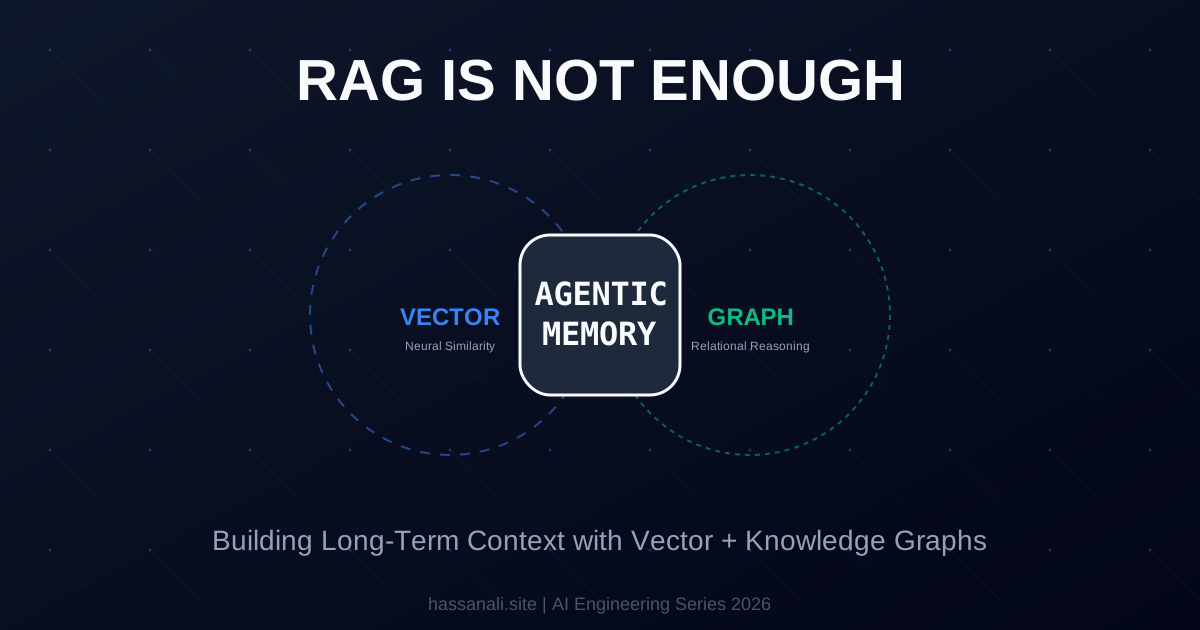
Vector Orchestration: Mem0 vs. Letta vs. LangChain Memory
I remember when “Long-Term Memory” for an AI meant just shoving the last 10 messages into a system prompt. It was messy, expensive, and the agent eventually “forgot” the most important details once the context window overflowed.
In 2026, we’ve moved from “Buffers” to “Orchestration.”
The Memory Layer is now a specialized database that extracts, ranks, and version-controls every fact your agent learns. In this showdown, we’re comparing the three titans of agentic memory: Mem0, Letta, and LangChain (LangMem).
What You’ll Learn
In this 2026 guide, we’re auditing the “Hippocampus” of the agentic economy.
- The UI Snapshots: Exploring the Memory Palaces and Fact Dashboards.
- Active vs. Passive Memory: Who manages the state—you or the agent?
- The LOCOMO Benchmarks: Performance in the wild.
- The Selection Matrix: Choosing your memory layer based on autonomy.
1. Mem0: The Pragmatic Layer
Mem0 is the leader in Memory-as-a-Service. It is a standalone layer that sits between your LLM and your users, automatically distilling facts into a persistent profile.
Functional Snapshot: The Fact Dashboard
Mem0 features a clean cloud console where you can monitor “Fact Evolution.” You see exactly when an agent learned a new fact (e.g., “User prefers Rust for HFT”) and how it resolved conflicts with old data.
Why it wins: Low Latency. In 2026, Mem0 holds the record for the fastest cross-session retrieval. It is the best choice for production apps requiring personalized experiences across millions of users.
LOCOMO Score: 67.13% (Optimized for speed/accuracy balance).
2. Letta (formerly MemGPT): The Agent OS
Letta treats the agent as a computer. It provides a tiered memory system (RAM, Disk, Archival) and gives the agent the Tools to manage it.
Functional Snapshot: The Memory Palace Visualizer
The Letta ADE (Agent Development Environment) provides a live “Map” of the agent’s internal state. You can see the agent “paging” through its archival memory in real-time.
Why it wins: Autonomy. In 2026, Letta’s Context Repositories allow agents to branch their own memories. An agent can say, “I’m going to try this complex refactor in a ‘Memory Branch’ and merge it back only if it passes the tests.”
Unique Feature: Git-for-Memory. Full version control over the agent’s internal reasoning traces.
3. LangChain (LangMem): The Framework Native
LangMem is the high-performance state store for the LangGraph ecosystem. It is designed for those who want deep integration over standalone modularity.
Functional Snapshot: The LangGraph Studio Integration
LangMem doesn’t have its own console; it lives inside LangGraph Studio. It allows you to step through graph transitions and see exactly how the “Behavioral Memory” is influencing the next prompt.
Why it wins: Behavioral Persistence. LangMem focuses on remembering “Rules and Personas.” It is the best at ensuring your agent doesn’t “drift” away from its core instructions over long-running, multi-week projects.
Performance: High recall accuracy, but higher p95 latency compared to Mem0.
The 2026 Selection Matrix
| If your goal is… | Use this framework |
|---|---|
| Production SaaS / Personalization | Mem0 |
| Autonomous Research / Coding | Letta |
| LangGraph Ecosystem Apps | LangMem |
| Lowest Latency (<200ms) | Mem0 |
| State Versioning / Git-Flow | Letta |
Conclusion: Matching Memory to Autonomy
Your choice of memory framework defines the “Wisdom” of your Personal OS.
If you need a reliable, fast way for your agents to remember user preferences across sessions, Mem0 is the industrial standard. If you are building the next $1B Solo Founder empire and need agents that can manage their own complex context without human intervention, Letta is the only choice.
TL;DR
- Mem0 for Apps: Fast, multi-scope, and production-ready.
- Letta for Agents: Autonomous, tiered memory with full version control.
- LangMem for Graphs: Deeply integrated into the LangChain ecosystem.
- Bottom line: In 2026, memory isn’t a buffer; it’s a Managed Asset.
Ready to secure these memory layers from exfiltration? Check out my next comparison on gVisor vs. Firecracker vs. Docker to choose your sandboxing layer.