Zero-Tech Debt: Building Self-Refactoring Codebases with Agentic Hooks
I remember the “AI Productivity Tax” of 2024. We all started using Cursor and Claude to write code 10x faster. We felt like gods. But three months later, we realized we had generated 50,000 lines of “Spaghetti-AI”—code that worked but followed zero architectural standards and had 40% duplication. We had traded speed today for a massive maintenance debt tomorrow.
It was a fantastic learning experience.
In April 2026, we don’t let the debt accumulate anymore. We have moved to the Self-Healing Codebase. By using Agentic Hooks and strict architectural “North Stars,” we have built repositories that effectively clean themselves while we sleep.
Here is the real, no-BS guide to achieving Zero-Tech Debt in the agentic era.
What You’ll Learn
In this technical blueprint, we’re building an Autonomous Maintenance Loop. You’ll discover:
- The 2026 “AIpocalypse”: Why AI-generated code is your biggest debt risk
- Agentic Hooks: Implementing
PreToolUseandPostCodeGenerationtriggers - The North Star: Using CLAUDE.md to enforce architectural integrity
- Autonomous Night Runs: Scheduling background agents for continuous pruning
- Self-Healing Security: Integrating real-time graph audits into the dev loop
The Self-Healing Repo Architecture
In 2026, a repository is not a static file system; it is a Living Organism.
Why the Manual Model Failed:
- The Volume Gap: Humans cannot review 100+ AI-generated PRs a day. Agents must review each other.
- The Linter Lag: Traditional linters check syntax, not Intent. Agentic hooks check if the code logic aligns with the project’s long-term goals.
- Dead Code Inflation: AI loves writing “just-in-case” utility functions. If they aren’t used in 48 hours, an agentic gardener must prune them.
Step 1: The ‘Architectural North Star’ (CLAUDE.md)
The single most effective tool for Zero-Tech Debt in 2026 is the CLAUDE.md file. It is the “Constitutional Document” for your repo.
The 2026 Standard: Every project must have a
.gemini/or.claude/folder containing an instructions file that defines your “Immutable Rules.”
Example Rule: “NEVER use inline styles. Always use the local design system tokens defined in @styles/tokens.json. If you detect an inline style, refactor it immediately before finishing the task.”
Step 2: Implementing Agentic Hooks
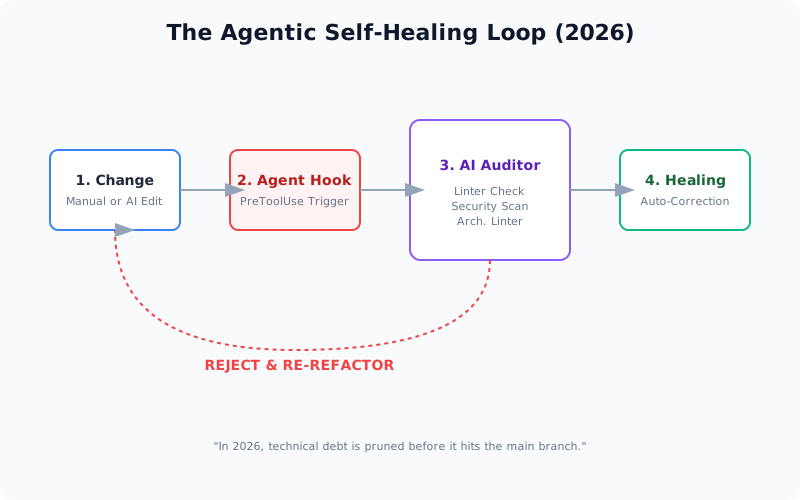
We use hooks to “Intercept” the AI agent before it makes a mistake.
// 2026 'PreToolUse' Hook (Pseudo-code)
export const onPreToolUse = async (context) => {
  const codeChange = context.incoming_delta;

  // 1. Semantic Check
  const is_compliant = await agentic_linter.check(codeChange, "CLAUDE.md");

  if (!is_compliant) {
    return {
      action: "REJECT",
      reason: "Proposed change violates rule #4: Multi-file state must use Redux-Toolkit."
    };
  }

  return { action: "PROCEED" };
};
Step 3: Information Gain — The ‘Autonomous Night Run’
The “Secret Sauce” of 2026 engineering teams is the Night Run.
Every night at 2:00 AM, a fleet of “Gardener Agents” clones the repo. They run a Semantic Duplicate Detector to find identical logic across different files and merge them into shared components. They then run a Dependency Audit, upgrading every package and fixing breaking changes in a sandboxed TDD loop.
When the human developers log in at 9:00 AM, they have a cleaner, more secure codebase than they left the night before.
Step 4: Measuring the ‘Debt Ratio’
In 2026, we don’t just “feel” that the code is clean. We use the ADR (Agentic Debt Ratio).
- Metric:
(Unverified AI Code) / (Total Codebase). - Target: Keep ADR below 0.5%.
If the ratio spikes, the “Agentic Sentry” blocks all new feature work and forces the fleet into an “Emergency Refactor” mode until the debt is cleared.
Tools and Resources
| Tool | Purpose | Link |
|---|---|---|
| Byteable 2.0 | Autonomous refactoring agent | Byteable.ai |
| Wiz Security | Graph-based vulnerability remediation | Wiz.io |
| LogicStar AI | Formal verification for agentic code | LogicStar.ai |
Next Steps
- Deploy a CLAUDE.md: Start by documenting your 5 most common “Human” refactoring comments into a machine-readable file.
- Build a Sentry Hook: Set up a GitHub Action that uses an LLM to specifically check for “AI-generated boilerplate” in every PR.
- Schedule a Night Run: Start small—have an agent check for outdated JSDoc and fix it automatically once a week.
TL;DR
- Debt is Inevitable: AI writes more code than humans; debt scales accordingly.
- Hooks are the Perimeter: Intercept bad patterns before they are committed.
- CLAUDE.md is the Law: Give your agents a clear architectural standard to follow.
- Gardening is 24/7: Use background agents to prune and refactor continuously.
This concludes my 30-article series on the 2026 Technical Inflection Point. I hope these blueprints help you build more resilient, autonomous, and profitable systems.
Have a skill recommendation or spotted an error? Reach out on LinkedIn or email me at business@hassanali.site.
Last updated: April 29, 2026