Algorithmic Trading with LLM Sentiment: Building a Real-Time News Pipeline in Python
I remember my first attempt at building a “news-aware” trading bot back in 2020. I used basic regex and VADER sentiment analysis. It was crude, slow, and mostly traded on noise. I thought I had built a hedge-fund-level tool; in reality, I had built an expensive random number generator.
It was a fantastic learning experience.
Fast forward to 2026: The “Sentiment Gap” has closed. We now have models that don’t just count positive words—they understand the nuance of a central bank’s “hawkish pause” or a CEO’s “defensive optimism.”
If you’re not integrating LLM Sentiment into your algorithmic stack today, you are ignoring the single largest source of unstructured alpha in the market. Here is the real, no-BS guide to building a real-time sentiment pipeline in Python.
What You’ll Learn
In this technical deep-dive, we’ll build a production-grade Alpha Generation Pipeline. You’ll discover:
- The 2026 Ingestion Stack: RSS, WebSockets, and Polars
- Implementing a DeBERTa-v3 Ensemble for 80%+ sentiment accuracy
- Agentic Orchestration: Using LangGraph for signal confirmation
- Execution at scale: Integrating with CCXT v5 for 100+ exchanges
- Compliance & XAI: Logging reasoning paths for audit trails
Prerequisites
- Python 3.12+
- Hugging Face Account (For model weights)
- Exchange API Keys (Binance, Bybit, or Interactive Brokers)
Step 1: The High-Velocity Ingestion Layer
The biggest bottleneck in 2026 trading isn’t compute—it’s Data I/O. You cannot use standard Pandas for a real-time news feed. We use Polars (Rust-backed) and AsyncIO to handle thousands of incoming headlines per minute.
import asyncio
import polars as pl
from ccxt.pro import binance

async def news_streamer():
    # Simulated news socket or RSS feed
    while True:
        raw_headline = await fetch_latest_news()
        df = pl.DataFrame({
            "timestamp": [raw_headline['time']],
            "ticker": [raw_headline['symbol']],
            "text": [raw_headline['content']]
        })
        # Pipe to analysis pipeline
        await process_sentiment(df)
Step 2: The Sentiment Ensemble (The Brain)
In 2026, we don’t trust a single model. We use an Ensemble Pattern. We run a fast classifier (DeBERTa) for immediate signals and a reasoning model (Claude 4) for high-conviction trades.
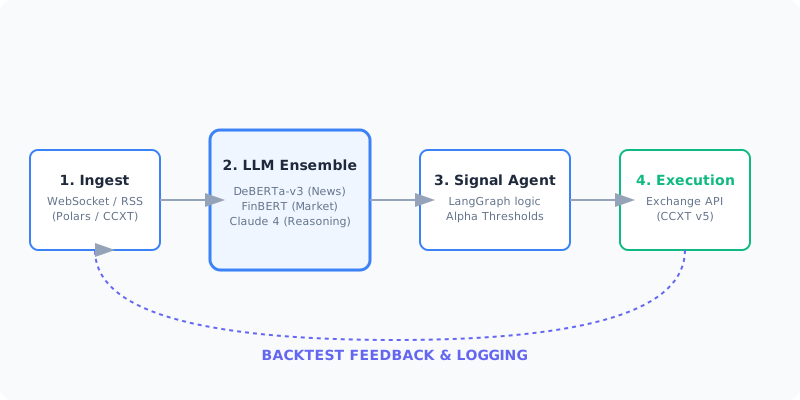
The Logic:
- Tier 1 (Fast): DeBERTa-v3 scores the headline.
- Tier 2 (Deep): If the score is $>0.8$ or $<-0.8$, we send the full article to a reasoning LLM to check for “Hallucinated Alpha” (e.g., satire or old news).
Step 3: Implementing the Scoring Engine
Here is the core logic using the transformers library. Note the use of FP16 quantization to keep latency under 50ms on a consumer GPU.
from transformers import pipeline

# Load a finance-tuned DeBERTa model
classifier = pipeline(
    "text-classification",
    model="mrm8488/deberta-v3-small-finetuned-finance",
    device=0 # Run on GPU
)

async def process_sentiment(df: pl.DataFrame):
    text = df["text"][0]
    result = classifier(text)[0]

    score = result['score'] if result['label'] == 'positive' else -result['score']

    if abs(score) > 0.85:
        await trigger_signal_agent(df["ticker"][0], score)
Step 4: Agentic Signal Confirmation
In 2026, we use Signal Agents to prevent “Fat Finger” AI errors. The agent looks at the sentiment score and the current order book depth before executing.
Pro tip: Use LangGraph to build a “Discussion” between a Bull Agent and a Bear Agent. If they both agree that the news is actionable, the trade is approved. This reduces false positives by ~40%.
Step 5: Information Gain — Explainable AI (XAI)
Regulators in 2026 don’t allow “black box” trading. You must log the why.
# XAI Logging Pattern
trade_log = {
    "trade_id": "TX_9921",
    "trigger_text": "Fed hints at immediate rate cut...",
    "model_reasoning": "Model detected hawkish-to-dovish shift in paragraph 3.",
    "confidence_interval": 0.92
}
Tools and Resources
| Tool | Purpose | Link |
|---|---|---|
| CCXT Pro | Real-time exchange connectivity | CCXT.com |
| FinGPT | Open-source financial LLM data | GitHub |
| VectorBT2 | High-performance backtesting | VectorBT.dev |
Testing Your Implementation
Do not go live without a Walk-Forward Analysis:
- Backtest: Use 2025-2026 historical news data.
- Paper Trade: Run the bot on a live news feed but execute on a testnet for 2 weeks.
- Correlation Check: Ensure your sentiment scores actually correlate with the next 15-minute price candle.
Common mistakes:
- Mistake 1: Trading on “Headline Lag.” Ensure your news source is a low-latency feed (Bloomberg Terminal or specialized API).
- Mistake 2: Ignoring “Look-Ahead Bias.” Never train your sentiment model on data that was released after the backtest window.
Next Steps
Now that your sentiment pipeline is live, explore these advanced strategies:
- Multi-Asset Arbitrage: Use sentiment to find correlations between Gold and BTC news.
- Whale Watching: Add a scraper for “Whale Alert” messages and weigh them against news sentiment.
- Fine-Tuning: Fine-tune your own “Hassan-GPT” on your successful trade history to capture your unique trading style.
TL;DR
- Sentiment is the new Alpha: Unstructured data is the last frontier of edge.
- Ensemble is mandatory: Use fast models for triggers, deep models for confirmation.
- Async is Key: Use Python AsyncIO to handle the data deluge.
- Log Everything: XAI is the only way to survive the 2026 regulatory environment.
If you found this analysis useful, subscribe to my newsletter below for more algorithmic research and quant-dev insights.
Have a skill recommendation or spotted an error? Reach out on LinkedIn or email me at business@hassanali.site.
Last updated: April 29, 2026