The HBM Blockade: Why High-Bandwidth Memory is the New Geopolitical Choke Point
In the early 2020s, the geopolitical focus was entirely on “The Chip.” We watched FAB construction in Arizona and export bans on EUV machines, believing that logic silicon was the sole crown jewel of the digital age.
It was a fantastic learning experience.
In April 2026, the focus has shifted. We have realized that a 100-teraflop processor is just an expensive paperweight if it can’t feed its data fast enough. The new battleground is not the “Brain” of AI, but its Nervous System.
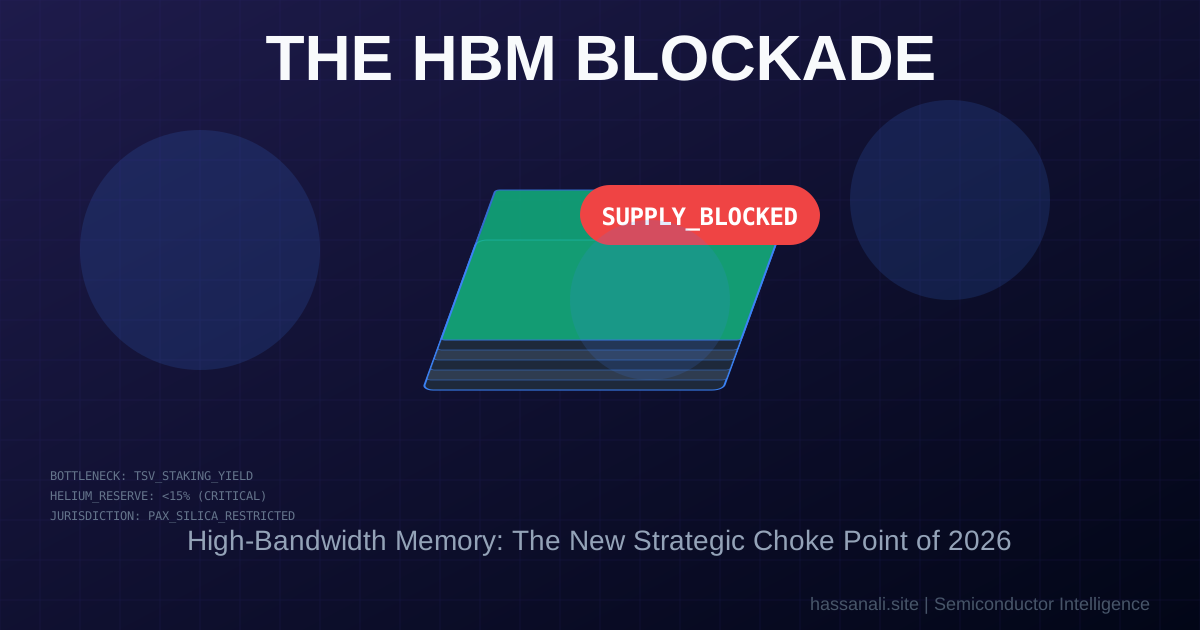
Welcome to the era of the HBM Blockade. High Bandwidth Memory has become the rarest and most strategically sensitive resource on Earth—more valuable than oil, more restricted than nuclear fuel.
The 2026 ‘Memory Gap’
As LLMs reached the 10-trillion parameter milestone in early 2026, the industry hit the “VRAM Wall.” Training and inference efficiency are no longer limited by the speed of the GPU, but by the bandwidth of the memory stacks attached to it.
Nations realized that while they could eventually design their own logic chips, mastering the physics of Through-Silicon Vias (TSVs)—drilling millions of microscopic holes through stacked layers of memory—is a decade-long hurdle.
The Helium Chokepoint: A Physical Blockade
The “Blockade” isn’t just legislative; it is physical.
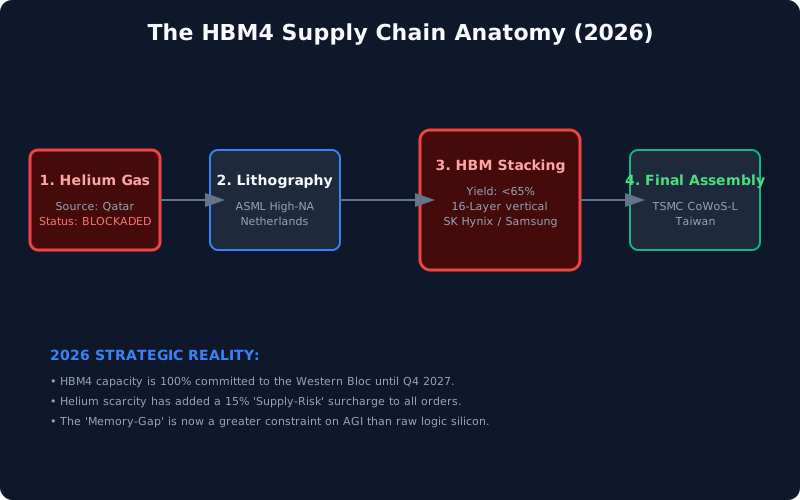
The Strait of Hormuz crisis of 2026 did more than just spike oil prices. It trapped the world’s primary source of semiconductor-grade helium in Qatar. Without this helium, the yield rates for 16-layer HBM4 stacks plummeted from 65% to under 40%.
This “Helium Shock” created a zero-sum game. If NVIDIA gets their HBM allocation, Apple doesn’t. If the US military secures a shipment, the commercial cloud must wait.
The SK Hynix-TSMC Alliance: The First ‘Logic-Memory’ Stack
The most significant technical shift of 2026 is the Bifurcation of Standards.
Previously, HBM was a commodity bought from a catalog. With HBM4, the “Base Die” (the bottom layer of the memory stack) is now a custom logic chip manufactured by TSMC and stacked by SK Hynix.
This alliance has effectively locked out any nation that is not part of the Pax Silica agreement. You cannot simply “buy” HBM4 on the open market anymore; you must be part of the integrated design ecosystem that spans from California to Hsinchu to Icheon.
Information Gain: The ‘Memory-to-Compute’ Ratio
In 2026, the most accurate predictor of an AI company’s stock price is their MCR (Memory-to-Compute Ratio).
Companies like Micron and SK Hynix have reported their 2026 and 2027 capacities are already 100% committed to top-tier Western hyperscalers. This has created a “Secondary Market” for memory that is more opaque and highly priced than the legendary H100 market of 2023.
The Geopolitical Verdict
The HBM Blockade has proven that Globalization is dead in high-tech.
In the 20th century, we had “Vertical Integration” within companies. In 2026, we have Vertical Integration within Geopolitical Blocs. If you are on the wrong side of the Silicon Curtain, you are facing a “Memory Famine” that will prevent your domestic AI industry from ever reaching parity with the frontier.
Found this semiconductor intelligence report useful? Subscribe to my newsletter for weekly deep-dives into AI supply chains and hardware geopolitics.
Have a skill recommendation or spotted an error? Reach out on LinkedIn or email me at business@hassanali.site.
Last updated: April 29, 2026
Found this valuable? Share the insight.