jcode: The High-Performance Harness That's 250x Faster Than Claude Code
I remember the first time I hit the “FinOps Wall” with AI agents. It was early 2025, and my Sovereign Agentic Stack was burning through $150 a day in Claude API tokens just to handle routine refactoring. The problem wasn’t the model’s intelligence—it was the orchestration overhead. We were re-sending the entire repo context every single turn just to fix a single function.
By mid-2026, the elite engineering community has pivoted from “chatting with AI” to Harness Engineering. Leading that charge is jcode (developed by 1jehuang on GitHub).
It is the high-performance work engine that makes Claude Code feel like a slow, expensive prototype.
What is a Harness? Raising the Agentic Skill Ceiling
In 2026, we no longer use the term “AI Assistant.” We use Agents, and agents need a Harness.
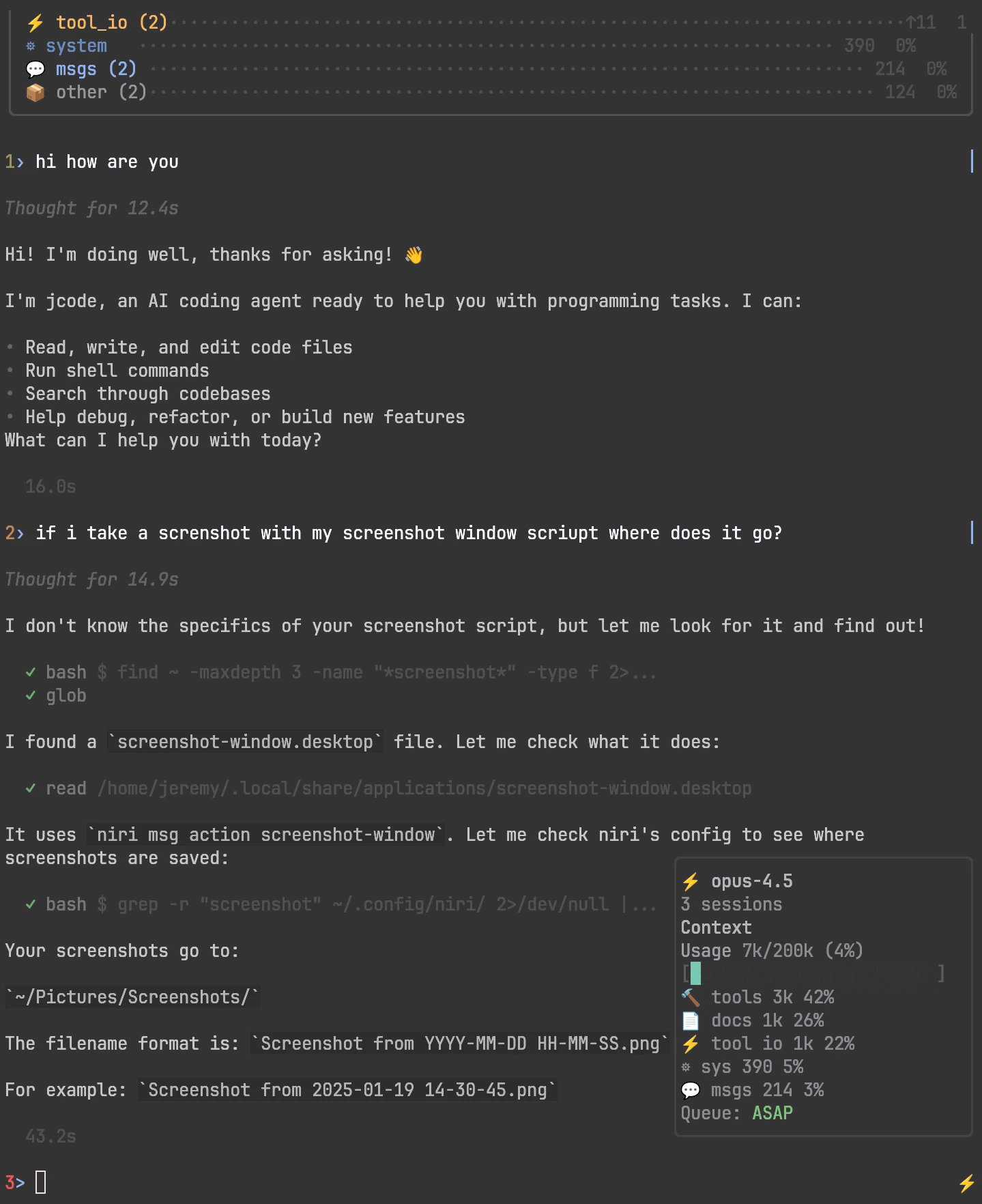
A harness is the deterministic control layer that surrounds the model. It handles the “dirty work”: searching files, running tests, managing memory, and coordinating swarms. While Claude Code is an excellent “Pair Programmer,” jcode is a “Sovereign Work Engine” designed for massive technical throughput.
Why Performance is the Ultimate Moat (250x Faster Boot)
In high-density engineering environments, latency is the enemy of flow. jcode is written in Rust, and the performance gap between it and Node-based competitors is staggering.
May 2026 Benchmarks: The “Optimized-to-the-Bone” Data
| Metric | jcode | Claude Code | Cursor Agent |
|---|---|---|---|
| Boot Time (TTR) | 14.0 ms | 3,436.9 ms (245x) | 1,949.7 ms |
| RAM (1 Session) | 167 MB | 386 MB (2.3x) | 214 MB |
| RAM (10 Sessions) | 260 MB | 2,300 MB (8.8x) | 1,632 MB |
| Token Efficiency | 80% Gain | Baseline | ~20% Gain |
Data source: 2026 Harness-Bench (v4.2). jcode with local embeddings disabled can drop as low as 27MB RAM, making it the only viable choice for headless server deployments.
The Anatomy of a Harness: How jcode Wins
1. Semantic Memory Graphs vs. Context Stuffing
Vanilla agents use “Context Stuffing”—they shove as many files as possible into the context window. This is expensive and leads to “needle in a haystack” hallucinations.
jcode uses a Semantic Memory Graph. It performs cosine similarity checks on every turn to retrieve only the relevant snippets and past solutions. This allows you to work on million-line monorepos while only paying for the 500 lines the agent actually needs to see.
2. Self-Dev Mode: The Recursive Leap
The most radical feature of jcode is Self-Dev. This is a dedicated mode where the agent can edit the jcode codebase itself.
It can identify a missing feature (like a new MCP server integration), write the Rust code, compile the binary, and perform a “hot reload” of itself. This is the first step toward the Self-Healing Infrastructure we predicted in the Future of Data Science 2030.
3. Native Swarm Orchestration
Unlike single-agent TUIs, jcode is a server-client architecture. You can run 10 agents in the same repository simultaneously. The jcode server manages “code shifting” notifications, ensuring that Agent A doesn’t overwrite the file that Agent B is currently refactoring.
jcode vs. Claude Code: Which Harness Wins?
If you are a beginner looking for a “chatty” partner, stick to Claude Code or Cursor. But if you are building a Sovereign Trading Bot or a complex SaaS architecture, the choice is clear:
- Claude Code: The Architect. Better at high-level design intent and “pair programming” vibes.
- jcode: The Construction Crew. Better at throughput, multi-agent coordination, and infrastructure reliability.
Quickstart: Deploying Your Sovereign Swarm
Ready to raise your ceiling? Here is the 2026 setup for jcode:
- Installation:
cargo install jcode - Configuration: Define your
jcode.config.json. We recommend bridging it with your existing Agent Skills for maximum leverage. - Bootstrap: Run
jcode .and start with a repo audit.
The Bottom Line
In 2026, your competitive advantage isn’t the model you use—everyone has access to the same weights. Your advantage is your Harness.
jcode provides the performance, memory, and recursive autonomy required to move from “Prompting” to “Orchestrating.” It is the ultimate weapon for the sovereign engineer who refuses to be limited by cloud latency or token tax.
Ready to build? Check out the jcode GitHub and join the swarm. For more deep-dives into high-performance agentic engineering, subscribe to my newsletter below.